The City Where I Was Never Supposed to Arrive
My brother took $77,042.16 from me for his wedding, sent me to the wrong Italian city on purpose, and texted LOL while the ceremony I paid for began nearly three hundred miles away.
I landed in Naples wearing the pale silk dress his bride had helped me choose for Florence. By the time I understood the itinerary was fake, the white roses I funded were already being carried into a candlelit villa, the quartet I hired was tuning beneath lemon trees, and my mother was telling guests I had stayed home because I was emotionally unstable.
Naples reached me through smell first: hot oil, salt, diesel, and sweet dough frying somewhere beyond the taxi line. The air was warm and impatient, nothing like the cool floral elegance I had imagined around Villa Aurelia in the hills outside Florence.
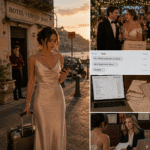
The taxi driver unloaded my suitcase beneath a faded green awning and drove away before I noticed the hotel looked wrong. There were no marble lions, no gold crest, and no attendants in cream uniforms—only a chipped planter holding a dead fern, a teenage bellhop smoking beside the entrance, and a sun-bleached sign reading Hotel Vesuvio Mare.
I stood on the curb with my suitcase handle digging into my palm while the silk skirt of my dress moved against my knees in the coastal wind. I had changed at the airport because Derek’s itinerary said the wedding shuttle would collect me immediately after check-in.
There was no shuttle.
Inside, the lobby television played a soccer recap at a volume sharp enough to make thinking difficult. A woman dragged a yellow mop bucket across cracked tile while the receptionist searched my name on her computer.
“I’m here for the Bellamy-Warren wedding,” I said. “There should be a room under Sloane Bellamy.”
She typed again, frowned, then looked at me with polite concern. “No wedding here, signorina.”
My stomach went cold. I pulled up the confirmation email Derek had forwarded four days earlier: Hotel Vesuvio Mare. Naples. Friday arrival. Bellamy wedding party.
Then I opened the wedding website I had spent six months helping his fiancée build. The welcome dinner was in Florence. The ceremony was at Villa Aurelia in the Florence hills. The farewell brunch was also in Florence.
For a few seconds, I heard everything too clearly—the television commentator shouting, the mop wheels rattling, a scooter screaming past outside, and my own breathing turning shallow.
I checked the train schedule. The fastest route took two hours and fifty-eight minutes if I caught the next high-speed train, which left in forty-two minutes. It would take longer with luggage, longer in heels, and longer still after humiliation had already arrived ahead of me.
I called Derek once, then again. The second call went straight to voicemail.
A moment later, my phone lit up.
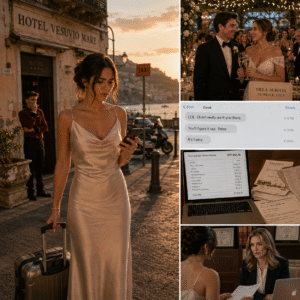
DEREK: LOL. Didn’t really want you there.
I stared at the message until the letters stopped looking like language and became shapes. Then another text appeared.
You’ll figure it out. Relax. It’s funny.
Funny.
The word sat on my screen like a stain.
I had paid the final venue deposit when Madeline’s father suddenly “restructured liquidity.” I had covered the florist when imported peonies were delayed, paid the quartet, the transportation coordinator, the lighting upgrade, the welcome dinner balance, and part of the bridal alterations after Madeline cried over the phone and said she could not walk down the aisle feeling cheap.
I had saved their wedding.
They had removed me from it.
I called my mother. She answered on the second ring, too quickly for innocence.
“Sloane, I’m busy.”
“I’m in Naples.”
There was a pause—not confusion, but calculation.
“So?”
“The wedding is in Florence.”
Another pause followed, smaller this time. “Then why are you in Naples?”
My fingers tightened around the phone. “Because that’s the hotel confirmation Derek sent me.”
“Hm.” I could picture her expression: mouth flattened, eyes already bored by a pain she had helped create. “Maybe you should have checked more carefully.”
“He texted me that he did it on purpose.”
Her voice changed immediately. It became flat and hard, the voice she used whenever protecting Derek required turning me into the problem.
“Stop pretending to be confused, Sloane. This is exactly why nobody wanted drama at the wedding.”
“I paid for half the wedding.”
“And there it is,” she snapped. “Always reminding people what you’ve done. Always making everything about money and recognition.”
Around me, the lobby continued functioning. A man asked for an extra key card, the mop bucket rolled past again, and someone laughed near the breakfast room. My life had split open, and the hotel did not care.
“My fault,” I said quietly.
“Yes,” my mother replied. “You’ve always had a way of making family events uncomfortable.”
Then she hung up.
I wish I could say I cried right there. Instead, I did something my family feared more.
I checked in.
The receptionist handed me a key card and explained breakfast hours in careful English. I thanked her, let the bellhop tag my suitcase, and rode the elevator with an elderly couple who smelled like sunscreen and peppermint candies.
On the fourth floor, I walked down a narrow hallway lined with framed photographs of lemons, fishing boats, and blue water. My room was not terrible, which somehow made it worse.
There was a narrow bed, white tile, a flickering vanity light, a tiny balcony with one rusting chair, and a bowl of wrapped candies on the desk. My garment bag lay across the bed like a body.
I sat beside it and stared at the wall until my phone buzzed again.
DEREK: You’ll get over it.
Another message followed.
Don’t post anything. I don’t need you ruining the vibe.
I laughed, but it came out small and cracked.
The first time Derek humiliated me publicly, I was seven years old and wearing a paper crown from a fast-food restaurant. He told our cousins I had wet my pants at school. I had not, but everyone laughed anyway.
My mother laughed too—not loudly, just enough to show me which child belonged at the center of the room and which one existed to make him shine brighter.
At thirty-three, I should have known Italy would not change the arrangement.
I unzipped the garment bag. The dress inside was the color of diluted champagne, elegant without being attention-seeking. That was how Madeline Warren had described it when she sent me the link.
Perfect for you, she had written. Beautiful, but understated.
Now I understood that understated had been a requirement.
They wanted my money visible.
Not me.
I walked onto the balcony. By dusk, Naples had turned gold. Church bells rang somewhere beyond the rooftops, plates clinked in the restaurant below, and a woman shouted from a balcony across the street until someone answered from the pavement.
The city smelled like sea salt, exhaust, and hot sugar. I gripped the metal railing and replayed every decision that had brought me there.
Six months earlier, Derek had appeared at my apartment with wet hair, red eyes, and a coffee-stained legal pad filled with numbers he did not understand. The venue needed another deposit, Madeline’s family had reduced its contribution, the florist required immediate payment, and Villa Aurelia would not hold the weekend without a wire transfer by Friday.
“I’m only asking because you’re the one person I trust,” Derek had said.
Trust.
In my family, the word usually meant I was about to be billed.
I worked in event strategy and had spent four years building an emergency fund because numbers stayed where I put them, unlike affection. I skipped vacations, renewed the lease on the same small apartment, and freelanced on weekends because safety had always felt more reliable than family.
Derek knew that. My mother knew it too.
“Family means loyalty,” she had said when I hesitated.
She never meant loyalty to me.
By the time the wedding weekend arrived, I had transferred $48,000 directly and covered another $29,042.16 in vendor costs. Seventy-seven thousand forty-two dollars and sixteen cents.
I had negotiated the welcome dinner, repriced the guest transport, found the string quartet, replaced a planner who quit, solved customs issues with the stationery, and changed the favors when Madeline’s mother decided locally bottled olive oil looked “too rustic.”
My kitchen table became their planning office. My savings became their prestige, and my competence became invisible the moment it stopped being useful.
A photograph arrived at 8:12 p.m.
Derek stood under fairy lights in a black tuxedo, smiling beside Madeline in ivory lace. White roses climbed behind them, candlelight glowed against crystal glasses, and guests raised champagne beneath the exact lighting design I had approved.
In the corner of the image, Madeline was looking directly toward the camera. She was not smiling.
Her expression looked closer to fear. One hand gripped the stem of her glass too tightly while my mother stood behind her, speaking to someone outside the frame.
The image bothered me—not enough to soften the betrayal, but enough to suggest I did not yet understand its full architecture.
I opened my laptop and created a folder called FLORENCE. Inside it, I made six more: Venue, Floral, Lighting, Travel, Wardrobe, Emergency Transfers.
Then I downloaded every invoice, wire confirmation, contract amendment, screenshot, hotel message, and vendor receipt connected to the wedding. I did not know exactly what I planned to do yet, but pain without structure becomes a story other people rewrite for you.
I was finished letting my family hold the pen.
At 9:03 p.m., my phone buzzed again. This time the message came from Madeline.
Please tell me where you are.
Another message followed before I could reply.
Derek said you changed your mind and didn’t want to come.
Then a third.
Sloane, what city are you in?
I looked out over Naples, at laundry moving from iron balconies and scooters flashing through narrow streets, then typed:
The city your husband sent me to.
The typing dots appeared instantly, disappeared, and returned. Finally, she wrote:
Oh my God.
I waited one minute, then two, then five. Her next message arrived just as the church bells began again.
Do not call your mother yet. Do not post anything. Save every message Derek sent you. I think this was planned before this week.
My hand went still over the keyboard.
Before this week.
I reopened the wedding files and searched for the latest seating chart. The version I had received three weeks earlier loaded slowly: twenty round tables, two hundred fourteen guests, family placements highlighted in gold.
I searched my name.
No result.
I searched again, changing the spelling even though I knew I had typed it correctly.
Nothing.
My name had been removed from the seating plan before Derek sent me the Naples itinerary. The wrong city was not a prank invented at the last minute.
It was the final step of a plan.
I clicked the file properties. The document creator was not Derek and not Madeline.
The name in the metadata belonged to my mother.
Marjorie Bellamy.
I sat in the hotel room while Naples rang and shouted beyond the balcony doors. For the first time that day, the humiliation stopped feeling chaotic and became evidence.
My family had not forgotten me.
They had arranged my disappearance.
And somewhere in Florence, beneath the flowers I paid for, someone was already afraid I might discover why.
The Bride Who Did Not Know the Whole Story
Madeline called me at 9:41 p.m., not because she had suddenly found courage, but because fear had finally become heavier than loyalty.
I answered on the second ring. For several seconds, neither of us spoke. I could hear distant music behind her—violins, laughter, someone tapping a champagne glass to make a toast. Somewhere in Florence, the wedding reception I had financed was unfolding exactly as planned, except one person had realized the plan contained a lie.
“Sloane?” she whispered.
“I’m here.”
“I need you to tell me exactly what happened.”
I stepped back onto the balcony overlooking the narrow Naples street. Below me, an elderly couple shared a pizza beneath strings of yellow lights while scooters drifted lazily through evening traffic.
“I arrived in Naples,” I said. “Your husband sent me here.”
Silence.
“I know where the wedding is.”
Another silence.
“He texted me that it was intentional.”
When she finally spoke, her voice sounded smaller. “Oh, God.”
“No,” I said. “Not God. Derek.”
She inhaled sharply. “I didn’t know.”
“I believe you.”
That surprised both of us, but I did believe her. Madeline was ambitious, status-conscious, and sometimes exhausting, but she was not cruel. Cruelty usually announces itself much earlier than a wedding weekend.
“I asked him where you were,” she said. “He told everyone you decided not to come because you couldn’t handle seeing him happy.”
“My mother probably confirmed that.”
“She did.”
Of course she had. For thirty-three years, my mother had rewritten reality faster than anyone else could describe it.
Derek broke my bicycle when we were ten, and I became careless. He borrowed money at sixteen, and I pressured him. He failed two semesters of college, and I distracted him. He forgot my birthday three years in a row, and I expected too much.
Some families have a golden child.
Mine had a permanent author.
My mother edited every story until Derek looked like the victim and I looked like the inconvenience.
Madeline lowered her voice. “There’s something else.”
I waited.
“I found the seating chart this afternoon.”
“So did I.”
“You weren’t on it.”
“I know.”
“I thought maybe your place card had been forgotten.”
“It wasn’t.”
She sounded like someone slowly walking toward the edge of a cliff. “I asked Derek about it.”
“What did he say?”
“He laughed.”
The orchestra behind her shifted into a slower piece. Then she repeated his exact words.
“Why would I waste twelve hundred dollars on another seat?”
The sentence landed harder than the Naples itinerary, not because of the money, but because I knew exactly where the number came from. Villa Aurelia charged twelve hundred dollars per guest after one hundred eighty attendees.
I had negotiated that clause myself.
He remembered the invoice.
Not his sister.
“I paid for that chair,” I said.
Madeline began to cry, not dramatically or loudly, but with the exhausted sound of a woman discovering that the person she married had been rehearsing deception longer than she had been planning vows.
“Sloane…”
“Yes?”
“He told me your emergency fund was almost gone.”
My apartment suddenly felt very far away. Only three people knew the exact balance of my savings: me, my financial adviser, and my mother.
“I never told Derek.”
“I know.”
“How would he know?”
Madeline did not answer because she did not need to. The answer had lived in my childhood bedroom.
My mother still knew the passwords to the first bank account she helped me open when I was fifteen. Years ago, after Dad died, I had added her as an emergency contact on almost everything because grief makes trust feel practical.
I suddenly wondered how many practical decisions had quietly become expensive.
“I have to go,” Madeline whispered.
“Why?”
“I think your mother is looking for me.”
Before she hung up, she said something that stayed with me long after the line disconnected.
“I don’t think this wedding was the only thing they planned.”
The Folder Named Family
Naples woke before I did the next morning. Church bells rolled across the rooftops, someone downstairs stacked metal chairs outside a café, and a delivery truck backed into the alley with three sharp beeps that echoed between the old buildings.
I opened my laptop before making coffee. The folder from the night before stared back at me: FLORENCE, nearly two hundred files deep.
I created another folder called FAMILY, then one called FINANCIALS.
For years, I had worked as a crisis strategist for hospitality groups. Hotels, luxury venues, and event companies hired me after disasters because I understood one simple truth: every crisis leaves paperwork.
People lie.
Records rarely do.
I reviewed every wire transfer I had made during the previous eight months: forty-eight thousand dollars sent directly to vendors and another twenty-nine thousand forty-two dollars and sixteen cents paid from my own accounts. Each payment carried a note—wedding emergency, venue extension, transportation shortfall, floral replacement.
Every so-called emergency had arrived after a phone call from my mother. Never Derek.
Always her.
She had called crying, telling me my brother was overwhelmed, that he would never recover from the embarrassment, and that I was the only stable one. Stable, useful, reliable—those words had followed me since childhood, not because they described me, but because they excused what everyone else took.
I opened my banking portal, then another tab, then another. I was not searching for theft yet.
I was searching for patterns.
By nine o’clock, I found one.
Every large payment I had made followed a call from my mother lasting between twelve and thirty minutes.
Every single time.
She had become the emotional invoice before the financial one arrived.
At 10:17 a.m., my oldest friend Olivia Hart called. She had known me since freshman year of college, when we split grocery bills down to the last dollar and celebrated promotions with supermarket cupcakes because restaurants felt extravagant.
“You’re trending,” she said.
I frowned. “What?”
“Don’t panic.”
“That’s never a good sentence.”
She sighed. “Someone uploaded reception photos. Read the comments.”
She sent me the link. Hundreds of congratulatory messages filled the page, but one comment stopped me.
Where’s Derek’s sister? I thought she helped organize everything.
My mother had replied publicly.
Unfortunately Sloane chose not to come. She’s always struggled with attention-seeking behavior and felt uncomfortable seeing her little brother happy. We love her anyway and hope she finds peace.
I read it twice, then a third time.
Attention-seeking.
There it was again—the diagnosis she had assigned me since childhood. When Derek crashed Dad’s truck at seventeen, I was attention-seeking for asking why I had to help pay the insurance deductible. When I skipped Christmas after working seventy hours a week, I was attention-seeking. When I bought my apartment without asking family for help, I was attention-seeking.
Whenever reality embarrassed Derek, I became unstable.
“Sloane?” Olivia said softly.
“I’m here.”
“You don’t sound surprised.”
“I’m not.”
“What are you going to do?”
I looked across the hotel room at the champagne-colored dress hanging beside the closet, perfect and unused, like the chair I had paid for.
“For the first time in my life,” I said, “I’m going to stop defending myself before anyone actually accuses me.”
At noon, another message arrived—not from Derek, Madeline, or my mother, but from an unfamiliar email address.
The subject line read: Your father wanted you to have this eventually.
Attached was a scan of an envelope with my father’s handwriting on it.
My name.
Sloane.
For several seconds, I forgot how to breathe.
The sender introduced himself as Richard Nolan, my father’s estate attorney before retirement. He explained that Dad had written several personal letters shortly before his death. Most had been delivered years earlier, but one remained sealed.
At my father’s request, it was to be released only if Richard believed I had become “the family caretaker at the expense of my own life.” Richard apologized for waiting, then added one final sentence.
After yesterday’s events, I believe your father would tell me I have already waited too long.
My hands trembled as I opened the attachment.
The first page contained only one line.
If you’re reading this, they finally convinced you that being useful was the same thing as being loved.
Everything inside me went quiet. The traffic, the bells, and the sea disappeared.
Only my father’s handwriting remained.
I kept reading.
The Letter My Father Never Got to Read Aloud
The first page contained only one sentence.
If you’re reading this, they finally convinced you that being useful was the same thing as being loved.
I read it twice before I realized I had stopped breathing. My father’s handwriting had not changed simply because ten years had passed; the loops in his capital letters were still too large, his signature still leaned slightly to the left, and every paragraph still ended just short of the right margin because he had always hated cramped pages. The letter had been written during the final months of his illness, when even holding a pen must have cost him something, yet the lines remained steady enough to make me feel as though he were sitting across from me.
He had never mentioned it, not once, even though I visited him almost every evening after work. We talked about medication schedules, baseball scores, whether the tomatoes in his garden would survive another week, and how hospital coffee tasted like punishment. Apparently, while I believed we were saying goodbye, he had been documenting the family he knew I would eventually inherit.
Dad wrote that he had noticed the pattern long before I did. Not Derek’s selfishness or my mother’s favoritism, because those had always existed in plain sight, but the way I adapted to both without complaint. Whenever Derek forgot something important, I remembered it for him; whenever he overspent, I reorganized my own budget; whenever he disappointed Mom, she cried to me instead of confronting him, and I mistook carrying her disappointment for being a good daughter.
At first, Dad said, he told himself I was simply generous. Later, he understood that I had become necessary, and there was a dangerous difference between being loved and being relied upon. One filled you. The other emptied you while convincing everyone that exhaustion was your personality.
I leaned back in the chair and looked through the open balcony doors. Naples shimmered beneath the afternoon sun, laundry stretched between old apartment buildings, scooters slipped through narrow streets with impossible confidence, and somewhere below, a man argued cheerfully over the price of tomatoes. My entire understanding of my family had shifted overnight, and the city kept serving coffee.
The letter continued. Dad admitted that he had tried, more than once, to interrupt the pattern between my mother and Derek. Whenever he suggested Derek needed consequences instead of rescue, they fought, and whenever he encouraged me to stop solving everyone’s problems, I smiled and told him I did not mind.
He had underlined the next sentence.
You always minded. You just believed love required silence.
I covered my mouth with one hand. Some truths hurt because they are unexpected, but others hurt because someone noticed them years before you were ready to admit they were true.