The Morning I Put Down the Whisk
My husband came home at four in the morning while I was making breakfast for his entire family. He stood beneath the hallway chandelier smelling of whiskey, cold November air, and a floral perfume that did not belong to me, then looked at the woman in the flour-dusted apron and said one word.
“Divorce.”
The kitchen smelled like cinnamon rolls, bacon, and fresh coffee. At 3:47 a.m., I had been arranging strawberries and melon on a white ceramic platter for twelve people who had never liked me: Ethan’s mother, Victoria; his father, Charles; his sister, Vanessa; Vanessa’s husband, Preston; their three children; Ethan’s younger brother, Lucas; Lucas’s new girlfriend; and Grandmother Evelyn.
Every one of them was sleeping peacefully inside my house, between sheets I had washed, beneath blankets I had purchased, in rooms I had cleaned after working a full week at Sterling Ridge Capital. I was awake before dawn baking from scratch because I still believed love was something a good woman proved through exhaustion.
Then Ethan Blackwood opened the front door.
His jacket hung halfway off one shoulder. His eyes were red, his hair untidy, and there was a faint mark near his collar that looked like lipstick after someone had tried to wipe it away. He studied the trays of food, the coffee brewing behind me, and the apron tied around my waist as though all of it belonged to a life he had already decided to discard.
“Divorce,” he repeated.
Not I’m sorry. Not We need to talk. Not even Good morning.
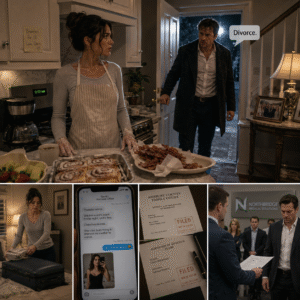
I remember the exact sound the whisk made when I set it on the granite counter—a small metallic click, almost too delicate for a marriage ending. The cinnamon rolls still had fourteen minutes on the timer, and the coffee machine continued to gurgle behind me as if the ordinary world had not noticed what had just happened.
I did not scream. I did not cry, throw the whisk, or ask which woman’s perfume he was wearing.
I untied the apron, folded it neatly, and placed it beside the fruit platter. Then I walked past him, close enough to smell the evidence he had carried home, and climbed the stairs to our bedroom.
The navy suitcase in the closet had been purchased for our honeymoon in Turks and Caicos four years earlier. I placed it on the bed and began folding my clothes into it while Ethan remained downstairs, waiting for the reaction he had rehearsed for.
Seven minutes later, I rolled the suitcase toward the stairs.
That was how long it appeared to take me to pack my life.
The truth was that the suitcase had already been packed for six days. I had hidden it in the trunk of my car, then carried it upstairs through the side entrance shortly before his family arrived. The performance was for Ethan, because I wanted him to believe his single word had shocked me into leaving.
The real departure had been prepared in bank statements, photographed text messages, legal consultations, a separate checking account, and a secure cloud folder he did not know existed.
He was still standing in the hallway when I came down. His expression had shifted from arrogance to confusion, as though he had expected tears, bargaining, perhaps even a scene loud enough to wake his mother.
I stopped in front of him and met his eyes.
“Tell Victoria the cinnamon rolls need eight more minutes.”
Then I walked out.
At 4:16 a.m., I drove away with the November air cutting across my face through the open windows. I did not turn on the radio, and I did not look back at the four-bedroom colonial where I had spent years becoming smaller.
That was the last time Ethan saw me as the woman he believed I was.
Quiet Claire. Accommodating Claire. Grateful Claire Bennett, the wife who would keep cooking long after everyone else had decided she was disposable.
He had no idea what was coming.
None of them did.
The Blackwood Standard
I met Ethan at a backyard barbecue hosted by my friend Natalie Brooks. I was twenty-six, newly promoted at Sterling Ridge Capital, and perfectly content with a one-bedroom apartment, a credit score of 742, and a retirement account my father had insisted I open with my first professional paycheck.
My father had worked construction for forty years and believed financial independence was a kind of shelter. “A locked door is useful,” he once told me, “but money in your own name is a second deadbolt.”
At the time, I thought he was being overly cautious.
Ethan was standing beside the grill when I first saw him, telling a story about getting lost in Santorini during a college trip. He was tall, dark-haired, and easy in the way certain men are when they have spent their entire lives being forgiven before they apologize.
“You’re not eating,” he said a few minutes later, appearing beside me with a plate.
He had assembled a burger with every topping, added potato salad and a pickle spear, and somehow remembered that I had been holding the same beer since I arrived.
“Maybe I’m pacing myself,” I said.
“Or maybe you’re planning an escape route. I’ve attended enough of Natalie’s parties to recognize the look.”
I laughed, and within a month we were nearly inseparable.
He brought me takeout and wildflowers because I once mentioned that roses felt generic. He remembered my coffee order, my favorite movie, and the name of the golden retriever I had loved as a child. When my car broke down on Interstate 77 at eleven one night, he drove forty minutes with a blanket and a thermos of hot chocolate because, as he put it, no one should wait beside a highway without something warm.
By the third month, I had met the Blackwoods.
Victoria Blackwood smiled with her mouth but never with her eyes. Her blonde hair was always perfectly shaped, her dresses pressed, her towels monogrammed, and even the ice cubes in her water glasses seemed to understand they represented the family.
She ran the Blackwood household like the chief executive of an old private company. Charles, Ethan’s father, had made substantial money in commercial real estate and now divided his retirement between golf, financial news, and agreeing with his wife.
The first time Ethan brought me to dinner, Victoria looked slowly from my sandals to my yellow sundress.
“Oh,” she said. “How casual.”
I glanced at Ethan.
“He didn’t mention this was a sit-down dinner?”