She Took My Parking Pass. I Took Back My Name.
The security guard called me because my name was still on the authorization list.
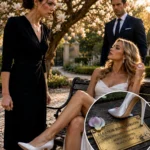
She arrived holding white roses like she had come to witness my defeat.
My husband stood behind her, already sweating through his custom navy suit, while half of the Franklin County Courthouse watched me park across the street like a stranger to my own ending.
And I simply smiled.
Chapter 1: The Woman in My Parking Space
The guard’s name was Mr. Alvarez, and I had known him for seven years.
He had watched me walk into that courthouse in Columbus, Ohio, on mornings when my law firm handled charity guardianship cases. He had seen me arrive with coffee stains on my blouse, with toddlers’ drawings tucked under my arm, with my wedding ring shining under the gray courthouse lights.
But that morning, when I stepped out of my black Mercedes on the curb because someone else had taken my reserved spot, he looked at me like he wanted to apologize for the entire world.
“Mrs. Whitmore,” he said quietly, holding his clipboard against his chest. “I am so sorry. She said she was with Mr. Whitmore.”
I looked past him.
There she was.
Sienna Vale.
Twenty-eight, glossy, champagne-blonde, wrapped in a cream cashmere coat that probably cost more than a month of my daughter’s private school tuition. She stood beside my reserved parking space like a magazine ad for cruelty. One manicured hand held a bouquet of white roses. The other rested lightly on my husband’s arm.
My husband.
Grant Whitmore.
The man I had married at twenty-six in a small chapel near Lake Erie, when his family company was drowning in debt and his mother still wore department-store pearls to pretend they had not lost almost everything.
The man I had helped rebuild.
The man whose name I carried through hospital hallways, bank boardrooms, charity galas, parent-teacher conferences, and every elegant room that had ever mistaken his ambition for character.
He did not come toward me.
That was the first real answer the morning gave me.
He just stood behind Sienna, his jaw tight, his forehead damp, his eyes flicking once toward the courthouse doors, once toward me, and then down at the concrete.
Sienna smiled first.
Not kindly. Not nervously.
Triumphantly.
“Oh,” she said, loud enough for the two attorneys passing by to hear. “I didn’t realize you’d actually come early, Evelyn.”
She used my first name like she had earned the right.
May you like
I glanced at the parking pass hanging from the rearview mirror of the silver Porsche Cayenne in my space.
EVELYN WHITMORE.
Authorized Court Access.
I had requested that pass months ago because I was the one who filed. I had filled out the paperwork. I had submitted the identification. I had emailed the clerk. It was my name, my authorization, my hearing, my divorce.
And somehow, even that morning, he had given her something of mine.
Mr. Alvarez cleared his throat. “Ma’am, this pass is not transferable.”
Sienna tilted her head. “Grant said it was fine.”
Grant said nothing.
He had been saying nothing for a year.
Nothing when our daughter, Lily, asked why Daddy slept in the guest suite.
Nothing when I found a diamond tennis bracelet receipt from Galleria Jewelers tucked inside his tuxedo jacket.
Nothing when Sienna posted a photo from a Miami hotel balcony wearing his shirt and captioned it, “Finally chosen.”
Nothing when his mother looked me in the eye at Thanksgiving and said, “Men under pressure make mistakes. Good wives don’t make them worse.”
But this morning, in front of security, clerks, attorneys, strangers, and the mistress who had brought flowers to my divorce hearing as if she were attending a funeral for my marriage, Grant’s silence became louder than any confession.
Sienna lifted the bouquet.
“They’re for the courtroom,” she said sweetly. “White roses symbolize new beginnings.”
I looked at the flowers.
Then at her.
Then at Grant.
“Do they?” I asked.
My voice was even. Soft. Almost polite.
That bothered her. I saw it immediately.
Women like Sienna expected shattered glass. They wanted tears, shaking hands, mascara streaks, a scene worth retelling over brunch. She wanted me to look old, desperate, abandoned. She had dressed for my collapse.
Instead, I stood there in a charcoal wool coat, my hair pinned low, my hands steady around a leather folder that contained more truth than Grant could survive.
Sienna’s smile sharpened.
“Well,” she said, stepping closer to Grant, “I just thought someone should support him today.”
I nodded once.
“That’s generous of you.”
Grant finally looked at me. “Evelyn.”
Just my name.
Not sorry.
Not please.
Not let’s talk.
Only my name, spoken like a warning.
I had loved that voice once.
I had heard it in the kitchen at midnight when we were broke and sharing leftover takeout from one container. I had heard it tremble in the maternity ward at Riverside Methodist Hospital when Lily was born six weeks early and blue around the lips. I had heard it whisper promises against my hair in hotel rooms, on ski trips, in the back seat of town cars after charity dinners.
That morning, the sound did not move me.
It only reminded me how expensive a lie can become when you keep paying for it with your dignity.
Mr. Alvarez straightened. “Miss, I need you to move the vehicle.”
Sienna blinked. “Excuse me?”
“The pass is assigned to Mrs. Whitmore. You’re not authorized to park here.”
Her cheeks flushed under her flawless foundation.
Grant shifted. “Can we not do this right now?”
Mr. Alvarez did not look at him. “Sir, this is courthouse parking. The car has to move.”
For the first time that morning, people stopped pretending not to stare.
A woman in a navy pantsuit paused by the glass doors. A court reporter slowed near the metal detectors. Two paralegals whispered beside the entrance. The humiliation Sienna had planned for me began turning, quietly and beautifully, in her direction.
She gave a brittle laugh. “Fine. It’s just a parking space.”
“No,” I said gently. “It’s authorization.”
Her eyes narrowed.
Grant’s face changed. Barely. But I saw it.
He knew that tone. He had heard me use it in boardrooms, at settlement tables, in meetings with bankers who underestimated me because I smiled before I ruined their leverage.
Sienna tossed her hair and marched toward the Cayenne. The white roses bounced against her arm.
As she passed me, she leaned close enough for her perfume to hit my throat.
“You can keep the parking pass,” she whispered. “I already have your husband.”
I looked at her for one quiet second.
Then I said, “Then you should know he comes with debt.”
Her smile faltered.
Just for a breath.
Then she slid into the Porsche, slammed the door, and reversed too quickly out of my reserved space while Mr. Alvarez watched with professional satisfaction.
Grant stayed behind.
For a moment, he and I were alone in the little circle of silence her arrogance had left.
“You didn’t have to embarrass her,” he said under his breath.
I almost laughed.
Not because it was funny.
Because after sixteen years of marriage, three miscarriages, one premature birth, two business rescues, one mortgage refinance, countless public smiles, and a year of sleeping beside betrayal, the first sentence he offered me that morning was a defense of her.
I looked at him carefully.
He was still handsome in the way expensive men are handsome: tailored, polished, preserved by money and good lighting. But beneath the suit, beneath the watch I had given him on our tenth anniversary, beneath the confidence that once filled rooms, he looked afraid.
Good.
“You’re right,” I said. “She did that by herself.”
Then I walked past him into the courthouse.
The marble floor shone beneath my heels. The metal detectors hummed. Somewhere above us, elevators opened and closed with soft silver chimes.
Behind me, I heard Grant hurry to catch up.
“Evelyn,” he said. “Before we go in, we need to talk.”
“No,” I said. “We needed to talk last April, when you signed the consulting contract in her name.”
His steps slowed.
I kept walking.
“We needed to talk in June, when you told Lily you missed her recital because of a flight delay, but you were actually at The Langham in Chicago with Sienna.”
The courthouse hallway stretched ahead, bright and cold.
“We needed to talk in September, when you moved two hundred thousand dollars from Whitmore Development’s emergency reserve into a shell account controlled by her LLC.”
Grant grabbed my elbow.
I stopped.
Slowly, I looked down at his hand.
He released me like I had burned him.
“Keep your voice down,” he said.
I smiled again.
That was the thing about powerful men who did small, dirty things. They were never afraid of the sin while committing it. Only the sound it made when named aloud.
“Today is not the day you tell me to be quiet,” I said.
Then I walked into Courtroom 7B.
And every head turned.
Chapter 2: The Marriage He Spent Like Money
Courtroom 7B smelled like polished wood, winter coats, and expensive anxiety.
Grant’s attorney, Mason Rourke, sat at the petitioner’s table even though I was the petitioner. He was one of those men who wore confidence like cologne. Too much of it. He had represented developers, executives, retired athletes, and at least three politicians whose scandals were quietly settled before primetime news found them.
He rose when Grant entered.
Then his eyes landed on me.
Then on the folder in my hand.
His smile thinned.
My attorney, Diana Prescott, was already seated at the opposite table, silver hair swept into a knot, reading glasses low on her nose. She did not stand. She did not wave. Diana believed greetings wasted power. She simply glanced at my face, then at Grant’s, and closed the document she was reading.
“You look calm,” she said when I sat beside her.
“I am.”
“Good,” she replied. “That will irritate them.”
Across the aisle, Sienna walked in carrying the white roses again.
She had moved the car, but she had not moved her ego.
Every eye followed her. That was what she wanted. She paused just inside the doorway as if giving people time to admire the coat, the hair, the flowers, the youth Grant had purchased at full public price.
Then she sat directly behind him.
Not in the back.
Not quietly.
Directly behind my husband, close enough that when he leaned back, her knee touched his chair.
Diana’s mouth curved almost imperceptibly.
“She brought props,” she murmured.
“She always does.”
The judge had not arrived yet, so the courtroom filled with the awkward breathing of people pretending not to witness a private life being dismantled in public. There were attorneys waiting for other cases, clerks moving files, a few family members from different hearings, and two reporters I recognized from business pages. Grant must have recognized them too, because he kept adjusting his cuff links.
Sienna noticed the reporters.
Of course she did.
She placed the flowers on the bench beside her, then slipped a hand onto Grant’s shoulder.
It was a small gesture, but it landed exactly where she intended.
A murmur passed through the room.
Grant did not remove her hand.
I looked at him.
Not with rage. Not with pleading.
Just long enough for him to know I had seen it.
He looked away.
Diana leaned toward me. “That hurt?”
“Yes,” I said.
“Will it change anything?”
“No.”
“Excellent.”
That was Diana. She had been my mother’s best friend before she became one of the most feared family law attorneys in Ohio. She had held my hand at my father’s funeral. She had sat with me at Riverside when Lily’s lungs were too weak and machines did what my prayers could not. She had warned me before I married Grant that charm without humility becomes entitlement.