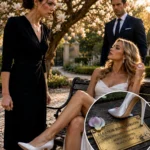
His mistress tried to take my seat at my own mother’s will reading.
Not metaphorically. Not socially. Literally.
She walked into the drawing room of the Whitmore House in Newport wearing winter white cashmere, diamonds too loud for daylight, and the kind of smile women practice in mirrors before they ruin someone’s life. Then she crossed the Persian rug my mother had imported from Isfahan, placed her crocodile purse on the chair beside my husband, and said, “I should be near family.”
For a moment, nobody breathed.
The fire clicked softly in the marble hearth. Rain tapped against the tall windows overlooking Bellevue Avenue. The silver coffee service gleamed untouched on the sideboard because grief had stolen everyone’s appetite.
My husband, Cole Harrington, looked at me with the polished impatience he usually reserved for waiters and women he thought were losing value.
“Vivienne,” he murmured, as if I were the one being difficult. “Don’t make a scene.”
His mistress, Madison Vale, tilted her head with fake sweetness. She was twenty-six, glowing with cruelty, and wearing my mother’s pearl earrings.
My pearl earrings.
The ones Cole had told me were locked in our apartment safe.
My uncle Graham rose from the velvet settee. He did not look at Madison. He did not look at Cole. He simply walked over, lifted her purse with two fingers through a folded linen napkin, and placed it on the floor near the doorway as if it were something that had been tracked in from the street.
Then he turned the chair toward me.
“Sit down, Vivienne,” he said.
So I did.
Madison’s mouth opened. Cole’s jaw tightened. The room watched, hungry and horrified, as the old Newport world swallowed a scandal whole without raising its voice.
Across the mahogany table, my mother’s attorney adjusted his glasses.
“Shall we begin?” he asked.
No one answered.
He opened the will.
And my dead mother, Eleanor Whitmore Hart, began destroying my marriage from beyond the grave.
Chapter 1: The Woman in White Who Came to Inherit
My mother died on a Tuesday morning in March, beneath a silk coverlet in the master bedroom of the house she had ruled like a queen and loved like a prisoner.
She had not been sick long. That was the mercy people kept offering me, as if brevity could soften extinction.
“She didn’t suffer,” they said.
But I had watched her suffer in ways most people could not name.
I watched her hands tremble when she signed foundation papers. I watched her pause before mirrors because the woman looking back was thinner than the one she remembered. I watched her smell the roses in the conservatory with the concentration of someone trying to memorize the world.
On her final afternoon, she asked me to open the curtains.
May you like
Beyond the glass, Newport was silver and cold. The Atlantic broke itself against the cliffs in white bursts, like lace being torn apart by invisible hands.
“Vivienne,” she whispered.
I sat beside her and took her hand. Her wedding ring was gone. She had removed it after my father’s funeral twelve years earlier and never wore it again.
“I’m here, Mom.”
Her eyes found mine. They were the same gray-blue as the winter ocean outside.
“Do not trade dignity for companionship.”
I thought she was talking about grief.
I thought she was warning me not to become the kind of widow who clings to the first warm voice in an empty room.
I did not yet understand that she was talking about my husband.
Cole did not come to say goodbye.
He said he had an emergency board meeting in Manhattan. He said it would look irresponsible if he canceled. He said my mother had never liked him anyway, so why pretend at the end?
That night, when I called him from the hallway outside her room, my voice so raw it barely sounded human, he sighed.
“Vivi, I’m in the middle of something.”
“My mother is dying.”
A pause. Then the clink of glass.
“I’m sorry,” he said. “Truly. But you knew this was coming.”
Behind him, a woman laughed.
Not loudly. Not dramatically. Just enough.
A thin silver blade slipped between my ribs.
“Who is with you?” I asked.
“No one.”
The woman laughed again.
Cole’s voice hardened. “Do not start this tonight.”
I looked back at my mother’s door. A nurse moved quietly inside. The lamp on the bedside table glowed amber against the wallpaper.
“Come home,” I said.
“I’ll be there for the funeral.”
He hung up.
My mother died forty-six minutes later.
I did not cry immediately. Grief, I discovered, is sometimes too large for the body to process at once. It stands in the room with you, immense and silent, while you make phone calls and sign papers and choose flowers.
White orchids. My mother had hated lilies.
By dawn, the house was full of people speaking in low voices and moving with exaggerated care, as if one wrong sound might shatter the antique mirrors.
Uncle Graham arrived first.
He was my mother’s younger brother, though nobody would have guessed it. Eleanor had been all pearl and steel, elegance sharpened into an art form. Graham was rougher, broader, a retired federal judge with silver hair and a face that made liars reconsider their hobbies.
He found me in the library, staring at a portrait of my mother painted when she was thirty-two. In it, she wore emerald satin and looked as if she had just won a war no one else knew had happened.
“Where is Cole?” Graham asked.
“Manhattan.”
His mouth moved almost imperceptibly.
That was Graham’s version of profanity.
“He’ll be here for the funeral,” I said.
“Generous of him.”
I laughed once. It sounded broken.
Graham crossed the room and put one arm around my shoulders. He smelled like rain, wool, and the expensive tobacco he never smoked around my mother.
“She prepared for this,” he said.
“For death?”
“For everything.”
I turned to him.
His eyes remained on the portrait.
“What does that mean?”
“It means your mother was Eleanor Whitmore Hart.”
As if that explained anything.
As if that explained everything.
The funeral was held at Trinity Church, with black cars lining the street and half of Rhode Island’s old money pretending not to look at my empty left side. Cole arrived six minutes before the service began, wearing a bespoke charcoal suit and the expression of a man inconvenienced by mortality.
He kissed my cheek in front of everyone.
His lips were cold.
“You look exhausted,” he whispered.
“My mother died.”
“You still need to hold yourself together.”
I stared straight ahead at the white orchids surrounding my mother’s casket.
In the second row, a blonde woman dabbed at dry eyes with a lace handkerchief.
I did not know her then.
Not officially.
But my body knew before my mind did.
The way Cole did not look at her was too careful. The way she watched him was too intimate. The way her hand rested on the small swell beneath her ivory coat was too theatrical.
After the burial, while people gathered at Whitmore House for the reception, Cole finally introduced her.
“Vivienne, this is Madison Vale. She handles private client relations for Harrington Development.”
Private client relations.
That was what we were calling adultery now.
Madison held out her hand.
Her nails were pale pink. Her diamond bracelet was familiar.
My bracelet.
A Cartier piece Cole had given me for our seventh anniversary, then told me I must have misplaced during one of his lectures about how grief had made me careless.
“I’m so sorry for your loss,” Madison said.
Her voice was soft, breathy, American sweetness poured over poison.
“Thank you,” I replied.
I did not take her hand.
A flicker crossed her face. Not embarrassment. Calculation.
Cole noticed. His fingers tightened around his glass.
“Madison came to pay respects,” he said.
“To my mother?” I asked.
“She knew of Eleanor.”
“Everyone knew of Eleanor.”
A nearby conversation faltered. My aunt Patricia suddenly became fascinated with a cucumber sandwich.
Madison smiled again.
“I know this is a hard day. I hope we can all move forward with grace.”
Grace.
From a woman wearing stolen diamonds to the funeral of the woman whose daughter she had helped humiliate.
For one beautiful second, I imagined throwing champagne in her face.
Instead, I heard my mother’s voice.
So I did nothing.
People mistake silence for weakness because they have never seen a woman loading a gun in the dark.
That evening, after the last black car disappeared down the drive and the caterers wrapped silver trays in plastic, Cole came into my childhood bedroom without knocking.
He had not slept beside me in months unless there was a camera, a gala, or a board member nearby. But he still moved through my spaces like ownership was muscle memory.
“We need to talk,” he said.
I was standing by the window, looking at the rain on the garden.
“Not tonight.”
“Yes. Tonight.”
I turned.
He looked handsome in the cruel way expensive men often do. Strong jaw, perfect haircut, eyes the color of old bourbon. When I married him, people said he looked like the kind of man who would build an empire.
They did not tell me empires are usually built by taking what belongs to someone else.
“The will reading is Friday,” he said.
“I know.”
“I want you calm.”
I almost smiled.
“Calm?”
“Your mother’s estate is complex. Emotions could make things messy.”
“My mother died yesterday.”
“And I am trying to protect you.”
There it was.
The phrase that had become his favorite cage.
I am trying to protect you meant sign this document.
I am trying to protect you meant stop asking about the accounts.
I am trying to protect you meant smile beside me while I bring my pregnant mistress to your mother’s funeral.
“What do you want, Cole?”
He walked closer.
“My attorneys believe some of Eleanor’s assets may flow through marital channels.”
I stared at him.
“You brought attorneys into my mother’s death before she was buried?”
He did not flinch.
“Vivienne, don’t be naive. Your mother used family trusts, holding companies, private foundations. There will be tax consequences. Public implications. Business opportunities.”
“Business opportunities.”
His face hardened.
“I have carried this marriage socially and financially for years.”
It was such an absurd sentence that my grief stepped aside and let rage stand up.
“You carried me?”
“Yes. I gave you stability.”
“My mother funded your first development project.”
“That was a loan.”
“That you never repaid.”
His eyes sharpened.
“You never understood business.”
“No,” I said softly. “I understood loyalty.”
That landed. I saw it in the small tightening beside his mouth.
Then he reached into his jacket and placed a folded document on my vanity.
“I need you to sign a joint representation consent. For estate coordination.”
“I have my own attorney.”
“You have a family lawyer who still uses a fountain pen.”
“Mr. Alden represented my mother for thirty years.”
“Exactly. He represented your mother. Not us.”
Us.
The most dangerous lie in marriage is when one person uses us to mean mine.
“I’m not signing anything tonight.”
Cole stepped closer until I could smell his cologne, amber and cedar and another woman’s perfume beneath it.
“You need to be smart.”
“I am.”
“You are grieving.”
“Yes.”
“You are emotional.”
“Of course.”
“Then let me handle this.”
I looked up at him. For the first time in months, perhaps years, I saw him clearly. Not as the charming boy who kissed me under the magnolia trees at Brown. Not as the husband who spun me around the ballroom at our wedding. Not as the man who once promised he would never make me feel alone.
I saw the hunger.
I saw that my mother’s death was not a loss to him.
It was an opening.
“No,” I said.
One syllable.
Small enough to fit inside the room.
Sharp enough to cut the future in half.
Cole stared at me as if I had spoken in a foreign language.
Then he smiled.
Not kindly.
“Friday, then,” he said. “We’ll see what your mother wanted.”
He left the document on the vanity.
After he walked out, I opened the drawer where my mother had hidden things when I was a child: birthday gifts, letters from my father, once even a tiny gray kitten she claimed she had no intention of keeping.
Inside, beneath a stack of silk scarves, I found an envelope with my name written in her hand.
Vivienne.
My fingers shook.
I opened it.
There was only one card inside.
Seven words.
Let them show you who they are.
I sat on the floor in my funeral dress and held my mother’s last instruction against my heart.
Then I waited for Friday.
Chapter 2: The Will Reading in the House of Mirrors
Whitmore House was not technically a mansion.
My mother hated that word. She said mansion sounded like something a football player bought after his second contract.
It was a house, she insisted. A house with twenty-two rooms, a ballroom, a winter garden, a private chapel, three kitchens, staff quarters, a carriage house, and a library so beautiful architectural magazines had begged to photograph it for decades.
But still a house.
The will reading took place in the blue drawing room because my mother had requested it. She had requested everything.
The flowers were white gardenias in low crystal bowls. The curtains were open despite the weather. A fire had been lit, though the room was warm. The chairs were arranged in a careful crescent facing the long mahogany table where Mr. Alden sat with a leather portfolio, two sealed envelopes, and a silver pen.
Nobody questioned the arrangement.
That was my mother’s genius. Even dead, she made people obey the furniture.
I arrived ten minutes early in a black wool dress, my hair twisted low at the nape of my neck, my wedding ring still on my finger. I had considered removing it, but decided against it.
A ring is not always a promise.
Sometimes it is evidence.
Uncle Graham stood by the mantel. Aunt Patricia sat rigidly near the window, smelling of Chanel and suspicion. Two cousins I barely knew whispered near the coffee service. Mr. Alden gave me a brief nod, his face unreadable.
Cole arrived exactly on time.
Madison came with him.
The room changed when she entered.