My husband secretly sold my paintings and told buyers his mistress was the artist.
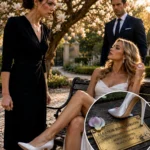
She stood beneath the white lights of a Manhattan gallery, one elegant hand resting beside a portrait of my dead mother, accepting praise for pain she had never lived.
“That piece came to me after a dream,” she told a circle of collectors.
I stood twelve feet away in a black silk dress, my fingernails digging crescents into my palms.
The woman in the painting had my mother’s silver-gray eyes, my mother’s crooked smile, and the tiny scar beneath her chin from the winter she slipped on our back porch when I was nine.
No photograph had ever captured all three.
Only I knew how that scar looked when she laughed.
Only I knew why there was a pale line beneath the blue paint on her left hand.
It was where I had painted her wedding ring before grief made me cover it.
My husband, Julian, stood beside the false artist with his hand resting possessively against the small of her back.
He wore the navy suit I had bought him for our fifth anniversary.
She wore the emerald earrings he had told me were a gift for his sister.
Above them, a brass wall label read:
THE LAST LIGHT — CELESTE WYNN, 2025.
My name was nowhere in the room.
Not beneath the portrait.
Not beside the storm paintings I had created after my miscarriage.
Not under the canvas of the empty nursery window that had taken me four months to finish because I could only paint it for ten minutes at a time before I started shaking.
Celeste smiled while strangers praised her “fearless emotional honesty.”
Julian smiled because he believed I was still at home in Connecticut, apologizing for being difficult.
They thought art belonged to whoever signed the wall label.
They forgot every canvas carried my fingerprint beneath the paint.
And they had no idea the gallery’s curator had just noticed the way I was looking at my mother’s face.
PART ONE — THE WOMAN STANDING BESIDE MY MOTHER’S FACE
My name is Nora Bennett Hale, and I was twenty-seven years old the night I discovered that my marriage had been built from stolen things.
Stolen money.
Stolen trust.
Stolen years.
And, hanging beneath warm gallery lights in Chelsea, sixteen stolen paintings.
At twenty-seven, I still had the soft, youthful face strangers often mistook for twenty-three.
My chestnut-brown hair fell in smooth waves below my shoulders, and the gallery lights caught copper strands whenever I turned my head.
I had gray-green eyes, high cheekbones, and the kind of delicate features my mother used to call “quietly dangerous” because people assumed softness meant weakness.
May you like
That night, I wore a simple black dress with a narrow waist and a high neckline.
It was elegant without trying to command attention, which was how I had learned to survive beside a man who needed every room to belong to him.
I had not planned to attend the exhibition.
Three days earlier, a cream envelope had arrived without a return address.
Inside was a printed invitation to the private opening of Unspoken: New Works by Celeste Wynn at the Reed Calder Gallery.
Someone had drawn a small blue star beside the gallery address.
My mother used to draw that exact star on every note she left in my school lunchbox.
Five uneven points, with the bottom line crossing too far to the right.
For several minutes, I sat alone at our kitchen island in Greenwich, staring at it.
I told myself it was a coincidence.
Then I turned the invitation over and found six words written in blue ink.
You deserve to see what he did.
I called Julian immediately.
He did not answer.
Ten minutes later, he sent a text saying he was boarding a flight to Chicago for a commercial real estate conference.
He added a heart emoji.
Julian had started using heart emojis when he stopped saying “I love you” aloud.
I almost threw the invitation away.
For the past year, Julian had repeatedly told me I was becoming paranoid.
Whenever I asked why he guarded his phone, he said I was projecting my grief onto our marriage.
Whenever I noticed unfamiliar charges, he reminded me that he handled our finances because numbers made me anxious.
Whenever I asked why he smelled like a perfume I did not own, he kissed my forehead and told me exhaustion could distort memory.
He had become very skilled at making my questions sound like symptoms.
By the time the invitation arrived, I no longer trusted my own instincts enough to follow them without permission.
So I called my younger sister, Maddie.
Maddie Bennett was twenty-four, sharp-tongued, fiercely loyal, and finishing her final year of nursing school in Boston.
She listened without interrupting.
Then she said, “Nora, you’re going.”
“What if it’s nothing?”
“Then you’ll see some overpriced paintings and drink free champagne.”
“What if it isn’t nothing?”
Her voice softened.
“Then you’ll finally know you’re not imagining it.”
I booked a train to Manhattan the next morning.
I told Julian I had a migraine and would probably sleep early.
He replied that he was sorry he could not be there to take care of me.
At seven forty-three that evening, I walked into the Reed Calder Gallery and saw the first painting.
It was called January Window.
I had painted it after waking from a dream about my childhood home in Maine.
In the dream, snow pressed against the glass, and my mother stood outside without a coat, smiling as if she had finally found somewhere warm.
I had never shown the painting to anyone except Julian.
Now a red dot beneath its label announced that it had been sold for forty-eight thousand dollars.
The second painting was called After the Cradle.
I had painted that one in our garage studio six weeks after losing our daughter at nineteen weeks.
Julian had never wanted to name her.
I had called her Lily in the privacy of my own mind.
The painting showed an empty white room with morning light falling across unfinished floorboards.
In the lower right corner, almost invisible beneath the glaze, I had painted five tiny lily petals.
Celeste had renamed it Morning Without You.
It had sold for seventy-two thousand dollars.
I moved through the gallery as though walking through the wreckage of my own body.
Collectors discussed my brushwork.
A magazine editor praised “Celeste’s unusual understanding of feminine grief.”
A woman in a silver jacket said the paintings felt as if they had been created by someone who had survived being erased.
I wanted to laugh.
I wanted to scream.
Then I reached my mother’s portrait.
The room seemed to narrow around it.
I had painted The Last Light during the final month of my mother’s life.
Her name was Evelyn Bennett.
She had been fifty-two when pancreatic cancer reduced her powerful body to bones and bright eyes.
She had raised Maddie and me after our father left, repaired our leaking roof herself, worked two jobs, and still found time to take me to secondhand art stores on Saturdays.
When I was twelve, she bought me a box of professional oil paints she could not afford.
She told me beautiful things did not have to apologize for taking up space.
During her final weeks, she sat beside the bay window in our old Portland house while I sketched her.
She knew I was lying whenever I said the portrait was for practice.
“You’re trying to keep me,” she whispered one afternoon.
“I’m trying to remember you.”
“You won’t remember me by making me perfect.”
So I painted everything.
The shadow beneath her eyes.
The yellow cast of her skin.
The scar under her chin.
The wedding ring she still wore even though my father had been gone for eleven years.
After she died, I painted over the ring.
I could not bear the idea that she had carried loyalty to a man who had not stayed.
Now Celeste stood beside that portrait, telling strangers that the woman had appeared to her in a dream.
Celeste Wynn was thirty-one, though the polished photographs in the gallery brochure made her look ageless.
She was tall and striking, with platinum-blonde hair arranged in a smooth knot and a sculpted face designed for cameras.
Her white satin suit looked expensive enough to have its own insurance policy.
She held herself with the ease of a woman accustomed to being believed.
Julian stood close beside her.
Too close.
His thumb brushed the fabric at her waist in a movement so familiar that my body understood the truth before my mind could name it.
They were not business partners.
They were not friends.
My husband was touching her the way he used to touch me before every gesture between us became calculated.
Celeste raised her champagne glass.
“This portrait is about accepting that some people are meant to leave us,” she told the group.
My breath caught.
A man standing near the edge of the circle turned toward me.
He was in his late thirties, with dark hair touched by a slight wave and an attentive, serious face.
His charcoal suit was understated, and unlike everyone else in the room, he was watching people instead of paintings.
I recognized him from the invitation.
Marcus Reed, founding curator of the gallery.
His gaze moved from my face to the portrait and back again.
I looked away.
He stepped closer.
“Do you know the subject?” he asked quietly.
The question was simple.
It split my life in half.
I could have said no.
I could have walked out, returned to Connecticut, and let Julian continue telling me who I was.
Instead, I looked directly at Marcus.
“She was my mother.”
His expression did not change, but something sharpened behind his eyes.
“Are you certain?”
“I painted the scar beneath her chin from memory.”
I nodded toward the lower half of the canvas.
“And beneath the blue glaze on her left hand, there’s a wedding ring.”
Marcus glanced at the portrait.
“The hand appears bare.”
“I painted over it after she died.”
He studied me for one silent moment.
Then he walked toward Celeste.
Julian saw me.
All the color left his face.
His hand dropped from Celeste’s waist as though her body had suddenly burned him.
Celeste followed his stare.
For the first time that evening, her smile broke.
Marcus waited until the collector beside her finished speaking.
Then, in a calm voice that carried across the room, he asked one question.
“Ms. Wynn, what is painted beneath the blue glaze on the subject’s left hand?”
Celeste blinked.
“I’m sorry?”
“You described the work as heavily layered.”
Marcus gestured toward the portrait.
“What image did you cover beneath the final glaze?”
Celeste looked at Julian.
The pause lasted perhaps three seconds.
It felt long enough for an entire marriage to die.
“There are several layers,” she said.
“Which image did you cover?”
“I’d have to consult my notes.”
Marcus turned toward me.
“Mrs. Hale?”
I forced air into my lungs.
“A gold wedding band with a tiny green reflection along the bottom edge.”
A nervous silence moved through the room.
Marcus signaled to a gallery assistant.
“Bring the portable infrared scanner.”
Julian stepped forward.
“That won’t be necessary.”
Marcus looked at him.
“Why not?”
“This is a misunderstanding.”
“A misunderstanding about who painted the work?”
“My wife is emotional.”
The words came quickly, smoothly, as though Julian had prepared them long before he knew I would appear.
“She’s been struggling since her mother passed away.”
“My mother died three years ago,” I said.
Julian gave me the sorrowful look he used whenever he wanted strangers to see him as my patient caretaker.
“You know grief doesn’t follow a calendar, Nora.”
That sentence nearly worked.
For years, he had trained me to hear concern in his cruelty.
Then I looked at my mother’s face.
I remembered what she had told me before she died.
Beautiful things did not have to apologize for taking up space.
“Scan it,” I said.
The gallery assistant returned with a compact imaging device.
Marcus asked the remaining guests to step back.
Within minutes, a ghostly shape appeared on the connected screen.
A ring.
A narrow gold band with a small green stroke along the lower edge.
Someone in the crowd whispered, “Oh my God.”
Celeste lowered her glass.
Julian moved toward me.
“Nora, let’s talk privately.”
“No.”
“You don’t understand what happened.”
“I understand that my mother is hanging on your mistress’s wall.”
His eyes flickered toward Celeste.
That tiny movement confirmed everything.
Several people raised their phones.
Marcus immediately asked security to close the gallery doors and instructed his staff to stop all photography.
Then he stood beneath the exhibition title and addressed the room.
“Due to a serious dispute concerning authorship and provenance, this exhibition is suspended effective immediately.”
A collector demanded to know whether his purchase was fraudulent.
Another asked who would be refunding the deposits.
The room erupted.
Julian reached for my arm.
I stepped away before he could touch me.
His face hardened for half a second, revealing the man beneath the concerned husband.
Then the mask returned.
“You’re making a mistake.”
I looked around at the sixteen canvases I had created in secret, during nights when Julian claimed my work was embarrassing and childish.