The Shoulder of a Stranger
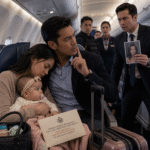
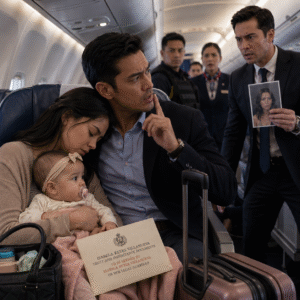
“Pretend you’re asleep on my shoulder,” the stranger beside me whispered as the plane began to taxi. “Someone is recording me.”
I should have refused. I had a ten-month-old baby in my arms, two suitcases in the overhead compartment, and a former husband who had emptied our bank account before changing the locks on the apartment I had helped pay for.
Instead, I looked across the aisle and saw a young man holding his phone too carefully, camera angled toward us.
So I rested my head against the stranger’s shoulder.
Three hours later, a flight attendant called him Mr. Villaseñor, three armed security officers boarded before anyone else could leave, and I learned that my ex-husband was already waiting inside the airport with my photograph in his hand.
My daughter, Emilia, slept against my chest through all of it.
She did not know that her father had not come because he missed her.
He had come because she was worth forty-eight million pesos.
The Flight Out of Monterra
That morning, I had boarded Flight 218 from San Aurelio to Ciudad Esperanza with everything I still legally possessed.
Two suitcases. A folded stroller. Emilia’s diaper bag. A white rabbit doll with one missing ear. Seventeen thousand pesos in savings. And a document envelope I had nearly left behind because my former husband had told me it was worthless.
I was thirty-two years old and still carried the last name Cárdenas, though the marriage attached to it had ended long before the judge stamped anything official. Tomás Cárdenas had spent five years teaching me how quietly a woman could disappear inside her own life.
First he corrected the way I spoke in front of his friends. Then he insisted that he handle the finances because numbers made me “anxious.” Later, he moved my salary into a shared account and began asking why groceries cost so much, why Emilia needed another pair of shoes, why I had bought coffee outside the house.
By the time I found the messages between him and Renata Solís, I no longer had access to the account that held my own money.
He did not deny the affair.
He smiled.
“You were useful when I was building,” he told me. “Renata fits where I’m going.”
Three days later, he changed the locks.
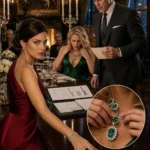
He left two suitcases outside the apartment door and sent my baby’s crib to my mother’s storage unit. Then he posted photographs from a rooftop restaurant with Renata wearing the emerald earrings I had received on our fourth anniversary.
The caption said, Finally choosing happiness.
I did not comment.
Pain eventually becomes information.
And information, if you are patient enough, becomes evidence.
My cousin Lucía had offered me a narrow spare room in the district of Santa Paloma until I found work. It was not a plan. It was shelter shaped like one.
I boarded the plane with Emilia asleep against me and kept my eyes lowered as passengers filed past. Most people saw a tired mother and looked away. A woman behind me saw Emilia and sighed loudly enough for three rows to hear.
The baby woke before takeoff.
Her face crumpled. Her hands reached for the rabbit doll, which had fallen beneath the seat.
“Oh, wonderful,” the woman behind me muttered. “A screaming baby for the whole flight.”
Heat climbed my neck.
I bent to reach the doll, but the man beside me picked it up first.
He wore a navy jacket over a white shirt with no tie, and his watch looked expensive without trying to. His beard was neatly trimmed, but there were shadows beneath his eyes that no amount of money could hide.
He handed Emilia the rabbit, then turned toward the woman behind us.
“The child did not choose the flight,” he said calmly. “The adults did. We can behave accordingly.”
He did not raise his voice.
He did not need to.
The woman pressed her lips together and turned toward the window.
I looked at him. “Thank you.”
He gave Emilia a small paper star he had folded from a napkin.
“No need.”
“I’m Isabela.”
“Gabriel.”
He did not offer a last name.
That should have seemed strange. Instead, it felt merciful. For the first time in months, a man had spoken to me without asking for something.
During takeoff, he helped secure the diaper bag beneath the seat and held Emilia’s rabbit while I fastened her carrier. He never touched me without asking. He never tried to make conversation out of my exhaustion.
But after twenty minutes, I noticed people watching him.
A college student across the aisle angled his phone toward us. Two women three rows ahead whispered, then turned around in unison. A man in a charcoal suit stared over the top of his newspaper.
Gabriel’s face changed.
Not fear.
Recognition.
He leaned closer, his voice low enough that only I could hear.
“Can I ask you for an unusual favor?”
I tightened my arm around Emilia. “What kind?”
“Would you pretend to fall asleep on my shoulder?”
I stared at him.
He glanced toward the phone across the aisle. “They are trying to confirm I’m traveling alone. If they think we are a family, they may stop filming.”
“A family?”
“An exhausted one.”
Despite everything, I almost smiled.
“You ask strangers this often?”
“Never.”
There was no flirtation in his voice. Only fatigue.
I knew what it was to want one hour without being watched, judged, or claimed. So I adjusted Emilia against my chest and rested my head against his shoulder.
The student lowered his phone within seconds.
The women stopped whispering.
Gabriel released a slow breath.
“Thank you,” he murmured.
I intended to sit upright after a minute.
Instead, exhaustion pulled me under.
When I woke, the cabin lights had dimmed and the plane was descending through a layer of silver cloud. My cheek was still against Gabriel’s jacket. His right arm rested stiffly on the armrest, and he had not moved enough to wake me.
I sat up quickly. “I’m so sorry.”
His mouth curved. “You needed sleep.”
“Your shoulder must be dead.”
“I’ve survived worse.”
The flight attendant approached before I could ask what that meant.
She bent slightly toward him.
“Mr. Villaseñor, your security team has confirmed the private arrival route.”
My body went still.
Gabriel closed his eyes for one brief second.
Then he looked at me.
“You really don’t know who I am.”
It was not a question.
I studied his face again, then the navy jacket, the watch, the people pretending not to look.
“No.”
He gave a tired smile.
“Gabriel Villaseñor.”
The name struck with the force of recognition.
Villaseñor Capital.
VelaPay digital banking.
Altura Medical.
Crescenta Properties.
The Villaseñor Foundation, which funded hospitals, schools, and university scholarships across the country.
Gabriel Villaseñor was not simply wealthy. He was one of the most guarded businessmen in Mexico, famous for avoiding interviews, weddings, gala photographs, and almost every kind of public life.
“You’re that Gabriel Villaseñor.”
“I’m afraid so.”