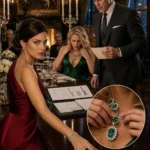
“After our wedding, Alexander will become Alexander Mercer.”
Sloane Mercer said it beneath a ceiling painted with angels, raising her champagne glass as though she were announcing a merger instead of the destruction of my marriage.
The winter benefit dinner at Manhattan’s Asterion Club had gone silent around us.
Two hundred members of New York’s oldest families sat beneath crystal chandeliers, surrounded by white orchids, polished silver, and enough inherited wealth to purchase several small countries.
My husband’s mistress sat directly across from me wearing my grandmother’s sapphire necklace.
The stone rested against her throat like a blue drop of frozen blood.
Alexander did not correct her.
He leaned back in his chair, loosened his black bow tie, and laughed.
“Maybe it’s time I escaped the Carrington family shadow.”
Every face at the table turned toward me.
Some people looked shocked.
Others looked fascinated.
A few looked almost relieved that the humiliation belonged to someone else.
I felt the exact moment my twelve-year marriage ended.
It did not sound like breaking glass.
It sounded like the quiet click of my thumb opening the trust document hidden beneath my linen napkin.
My attorney had sent the final version ten minutes earlier.
The signature pages were complete.
The board votes had been secured.
The residence license had been terminated.
Alexander’s company access would expire at midnight.
I looked at Sloane’s triumphant smile.
Then I looked at the man I had once loved enough to build an empire around.
“Good,” I said.
My voice carried farther than hers had.
“My family name comes with assets he no longer deserves.”
PART ONE — THE NIGHT HE GAVE AWAY A NAME THAT WASN’T HIS
Alexander’s smile disappeared before the echo of my words did.
He glanced around the table, suddenly aware that the audience he had enjoyed a moment earlier was still watching.
“Vivienne,” he said softly, using the patient tone he reserved for waiters, junior employees, and women he believed were becoming emotional.
“Don’t make a scene.”
“I haven’t.”
I folded the document once and returned it beneath my napkin.
“You did.”
May you like
Sloane gave a brittle laugh.
The sound was elegant enough to pass in polite company, but her fingers tightened around the stem of her champagne glass.
She was thirty-one, beautiful in the expensive, disciplined way certain Manhattan women were beautiful.
Nothing about her appearance happened by accident.
Her blond hair had been swept into a low knot.
Her dress was silver silk.
Her makeup made her look as though candlelight followed her everywhere.
The sapphire at her throat belonged to the Carrington Legacy Trust.
It had been worn by my grandmother at a state dinner in 1963, by my mother at my wedding, and by me the night Alexander became chief executive officer of Carrington Meridian Hospitality.
It had never belonged to Alexander.
It certainly did not belong to Sloane.
She touched it now, perhaps noticing where my eyes had landed.
“Alexander gave it to me,” she said.
“I know.”
“He said it was a Whitmore family piece.”
Alexander’s jaw shifted.
That single movement told me Sloane had not known the truth.
For one brief second, something uncertain flickered behind her confidence.
Then she smiled again.
“He said it should belong to the woman who would carry his future.”
The cruelty was deliberate.
Alexander had taught her where to cut.
I had once taught him.
Twelve years earlier, Alexander Whitmore had been handsome, brilliant, ambitious, and nearly bankrupt.
His father’s investment firm had collapsed under the weight of bad debt and worse judgment.
The Whitmore name still appeared on library wings and museum plaques, but the family money behind it was mostly gone.
Alexander never told people that part.
He told them he had walked away from inherited privilege to build something of his own.
What he had actually walked into was me.
I met him at a charity auction in Boston when I was twenty-eight.
He had been standing alone near a display of antique maps, wearing a rented tuxedo and pretending not to notice that everyone else knew one another.
He made me laugh within four minutes.
He challenged me within ten.
By midnight, he knew I was Vivienne Carrington, only daughter of Charles and Celeste Carrington, and beneficiary of one of the largest privately held hospitality trusts in the country.
By one in the morning, I had convinced myself that the knowledge did not matter to him.
For years, I defended that belief.
When my father refused to offer Alexander an executive position, I spent six months persuading the board to give him a chance.
When lenders rejected his first boutique hotel concept, I guaranteed the debt through a subsidiary I controlled.
When his mother needed specialized care after a stroke, the Carrington family office paid the bills without placing our name on a single statement.
When industry magazines called him a visionary, I stood beside him at the photographs and allowed them to crop me out.
I thought love meant giving someone room to become themselves.
I did not understand that Alexander had begun to resent every room because I owned the building.
At the dinner, he reached for my wrist.
I moved my hand before he could touch me.
“Let’s go home,” he said.
Sloane’s expression sharpened.
Perhaps she had expected him to leave with her.
Perhaps that had been part of the performance.
“We don’t have a home together anymore,” I said.
His face remained composed, but a pulse began beating hard in his temple.
“You’re angry.”
“No.”
“You’re embarrassed.”
“Then what is this?”
“A correction.”
Around us, conversation began again in careful fragments.
Silverware touched porcelain.
Someone ordered another bottle of wine.
No one at our table looked away.
The people seated closest to us included two senators, the chairwoman of a private bank, the owner of a national newspaper chain, and three Carrington Meridian board members.
Alexander had chosen the audience because he wanted witnesses to my humiliation.
He had not considered that I might need witnesses too.
My phone vibrated inside my evening bag.
A message appeared from Naomi Price, general counsel for the Carrington Legacy Trust.
BOARD RESOLUTION PASSED.
SEVEN TO ONE.
REMOVAL EFFECTIVE 11:59 P.M.
Alexander’s phone vibrated a second later.
He checked the screen.
The color left his face so quickly that Sloane noticed.
“What is it?” she asked.
He ignored her.
His eyes met mine.
“What did you do?”
“I stopped protecting you.”
“Vivienne.”
“At eleven fifty-nine tonight, your authority as chief executive of Carrington Meridian Hospitality will be suspended pending an independent investigation.”
A board member two seats away lowered his gaze to his wine.
Alexander stared at him.
“Thomas?”
Thomas Aldridge had been Alexander’s closest ally on the board.
He had also been my father’s friend for thirty years.
Thomas did not answer.
I continued before Alexander could recover.
“Your corporate cards have been frozen.”
His mouth opened.
“The Gulfstream reservation for tomorrow morning has been canceled.”
Sloane’s eyes flicked toward him.
Their planned flight to Saint Barts had appeared in the audit.
“The penthouse at the Beaumont is a company residence, not personal property.”
The Beaumont was one of our flagship hotels.
Alexander had placed Sloane in its presidential suite for six months and instructed accounting to classify the expense as executive hospitality.
“The suite must be vacated by noon tomorrow.”
Sloane’s champagne glass struck the table harder than she intended.
Alexander’s voice dropped.
“You have no idea what you’re doing.”
I almost smiled.
That sentence had once frightened me.
Alexander had used it whenever I questioned a decision, reviewed a contract, or suggested that a strategy carried too much risk.
He had spent years convincing me that his confidence was evidence and my caution was weakness.
Unfortunately for him, I had learned the difference.
“I know exactly what I’m doing,” I said.
“You’re destroying the company because your feelings are hurt.”
I looked toward the sapphire around Sloane’s throat.
“I’m protecting the company because you stole from it.”
The table fell silent again.
Sloane’s hand moved instinctively over the necklace.
Alexander’s expression hardened.
“That is an outrageous accusation.”
“The necklace she’s wearing was removed from the Carrington vault using your executive authorization.”
“I had access.”
“You had temporary access for the Metropolitan Museum exhibition.”
“I’m your husband.”
“You were my husband when you signed the trust acknowledgment stating that access did not constitute ownership.”
His eyes narrowed.
Alexander remembered every document he signed.
His gift was not forgetting language.
His flaw was believing no one else remembered it as well as he did.
Sloane looked between us.
“You told me it was yours.”
“It is complicated,” he said.
“No,” I replied.
“It is cataloged.”
The sapphire’s registry number was engraved beneath the clasp.
The trust’s insurer had already been notified.
So had the head of security at the Carrington vault.
I did not intend to have Sloane arrested at dinner.
I wanted her to understand that the jewel against her skin was not a trophy.
It was evidence.
Alexander pushed his chair back.
“We’re leaving.”
He spoke to me, but Sloane stood first.
He looked at her with irritation.
It was a tiny thing, almost invisible.
A week earlier, she might not have noticed.
Now she did.
Sloane had believed she was watching a wife lose her husband.
She was beginning to realize she might be watching a man lose everything else.
“I’m not going anywhere with you,” I told him.
“You came in my car.”
“The car belongs to the trust.”
I stood and smoothed the skirt of my black velvet gown.
“Your driver will take you wherever you are legally permitted to go.”
His humiliation finally cracked through his composure.
“You think you can erase me with paperwork?”
“No, Alexander.”
I lifted my evening bag.
“You erased yourself.”
My mother was waiting near the ballroom doors.
Celeste Carrington had watched the entire exchange without moving from her table.
At sixty-eight, she remained the kind of woman who could silence a room by entering it.
Her silver hair was cut at her jaw.
Her emerald gown carried no visible label.
She did not embrace me when I reached her.
The Carringtons had never been theatrical with pain.
She placed one hand against my back.
“That was unpleasant,” she said.
“It was.”
“Are you going to cry?”
“Not here.”
“Good.”
Her gaze moved past me toward Alexander.
“Neither am I.”
We walked through the marble corridor together.
Behind us, I heard Sloane demanding an explanation.
Alexander answered in a low, furious voice.
I did not turn around.
The black Maybach was waiting beneath the club’s awning.
Snow had begun to fall over Manhattan, softening the city without making it kinder.
As the driver opened my door, Alexander came outside.
I paused.
He descended the steps alone.
Sloane remained under the awning, wrapped in white fur and disbelief.
Alexander stopped several feet from me.
For the first time that evening, there was no audience close enough to hear him.
“You planned this.”
“Yes.”
“How long have you known?”
“Long enough.”
His eyes searched my face.
“About Sloane?”
“About more than Sloane.”
He lowered his voice.
“We can fix this.”
The word we almost made me pity him.
Alexander believed marriage was a partnership only when consequences arrived.
“You announced your next wedding before ending this one.”
“That was Sloane being impulsive.”
“You laughed.”
“I was trapped.”
“You looked comfortable.”
His expression changed.
The anger receded, replaced by the charm that had once made me choose him in crowded rooms.