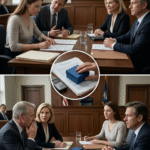
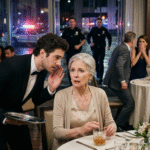
The diamonds caught the chandelier light.
My mother’s portrait watched over us.
Bennett looked like a man watching the tide pull his house out to sea.
I picked up the brooch, slid it into the velvet pouch, and handed it to Margaret Ellis.
Margaret’s eyes were wet. “Your grandmother would be proud.”
For the first time that day, my composure nearly broke.
But Vivienne, bless her arrogance, saved me.
“This is pathetic,” she said, voice rising. “All of this over some dusty old house and a pin? Bennett was right. You are obsessed.”
Bennett whispered, “Stop.”
“No,” Vivienne said, turning on him. “You said she’d cave. You said once people saw me here, she’d be too embarrassed to fight. You said the trustees were old and sentimental and would eventually agree if the money was good enough.”
The room froze.
Bennett looked as if she had slapped him.
Daniel’s pen moved calmly across his notepad.
Vivienne realized what she had said.
I tilted my head. “He said that?”
Her lips parted.
I waited.
The silence forced her to live inside her own words.
Bennett tried again. “Caroline, I was under pressure. The Savannah project—”
“Needed collateral you didn’t have,” I said.
His eyes widened.
There it was. The second wave.
I turned to Elaine Porter, who had slipped in quietly near the butler’s pantry after receiving Daniel’s invitation. She was elegant in a gray suit, silver hair cut to her chin.
“Mrs. Porter,” I said, “would you please confirm whether First Carolina Bank received projections from Mr. Ashford using projected revenue from Whitmore House?”
Elaine stepped forward.
“I can confirm such projections were submitted during preliminary loan discussions,” she said carefully. “No loan was approved. The bank requested ownership verification, which was not provided by Mr. Ashford.”
Bennett gripped the chair beside him.
“Elaine,” he said, humiliated.
She looked at him with profound disappointment.
“Your father respected paper, Bennett. You should have learned from him.”
That wounded him. I saw it.
His father had founded Ashford Construction with nothing but credit, discipline, and a refusal to borrow against what wasn’t his. Bennett had built his entire identity on surpassing him. Now, in front of the city’s donors and preservation board, Elaine had placed him beneath the standard of a dead man.
Vivienne looked panicked now.
“This has nothing to do with me,” she said.
Daniel removed another document.
“I’m afraid it does. The pledge portal for the unauthorized Whitmore House Legacy Fund directs donor inquiries to an account controlled by Cross Creative Consulting LLC.”
Vivienne’s mouth fell open.
The journalist whispered, “Oh my God.”
Daniel continued, “We have preserved screenshots and payment routing information. Any donors who contributed will be contacted and refunded. The trust reserves all rights.”
Charles Keaton stood abruptly.
“My office wired twenty-five thousand dollars yesterday.”
Vivienne turned white.
Bennett looked at her. “You told me no money had moved.”
She turned on him with naked fury. “You told me this would be ours.”
Ours.
The word that had started it all.
The word she had said from my staircase like a spell.
Now it sounded small. Greedy. Cheap.
Bennett’s regret arrived visibly then, not as moral awakening, but as personal ruin. His eyes moved from the deed to the guests to the phone recording in the journalist’s hand to me.
“Caroline,” he said, voice cracking, “I never meant for it to go this far.”
I almost laughed.
Instead, I spoke softly.
“That is what people say when they lose control of something they fully intended to begin.”
His eyes filled.
Twelve years of marriage, two children, a thousand breakfasts, a hundred small kindnesses I could not erase—and still, his tears did not move me toward him. They moved me backward, toward the woman I had been before I learned to make his comfort my responsibility.
Vivienne began to cry then, but not with sorrow.
With rage.
“You think you’re better than me,” she said.
“Yes, you do. With your old family and your old house and your quiet little victim act.”
I stepped closer.
“I don’t think I’m better than you because of my family,” I said. “I think I made better choices today because I did not steal from another woman and call it destiny.”
The words settled over her like ash.
Bennett covered his face with one hand.
Daniel turned to the room.
“Ladies and gentlemen, the trust apologizes for any confusion created by today’s unauthorized event. The home is now closed to tours. If you made or pledged a donation, please provide your contact information to my assistant in the foyer. You will receive formal notice and refund instructions. No authorized Whitmore House fund exists at this time.”
No one moved at first.
Then Mrs. Pritchard approached me.
Her eyes were red with embarrassment.
“Caroline,” she said, “I am deeply sorry. I should have called you personally when I received the invitation.”
I took her hand.
“Thank you.”
Charles Keaton came next, his face hard.
“Bennett,” he said without looking at me, “our investment agreement is suspended pending review.”
Bennett flinched.
The zoning board member stepped away from him.
The journalist lowered her phone, but not before I knew she had enough to destroy the version of the story Bennett had planned to tell.
Vivienne stood alone at the head of my dining table.
Without the brooch, she looked suddenly overdressed.
Bennett reached for my arm.
I moved before he touched me.
Not dramatically.
Just enough.
“Caroline,” he whispered. “Please. I know I don’t deserve it, but let me explain.”
I looked at the hand he had almost put on me.
Then at his face.
“You already did,” I said. “You explained in every room where you stayed silent.”
His tears spilled then.
I had imagined that moment for months.
I had wondered whether his regret would feel like justice.
It didn’t.
It felt like standing in the ruins of a house he had burned while he mourned the smoke.
“I love you,” he said.
The room was quiet enough for everyone to hear.
Maybe he meant it.
Maybe he loved me as a home base. As history. As the mother of his children. As the woman who once believed his ambition was noble. Maybe in that moment, watching reputation, money, mistress, and future collapse at once, he mistook loss for love.
But I had learned the difference.
“No,” I said gently. “You loved being forgiven.”
His face broke.
I turned to Daniel.
“Please escort Mr. Ashford and Miss Cross out.”
Vivienne laughed once, sharp and broken. “You can’t kick Bennett out.”
“From my house?”
Her mouth closed.
Daniel gestured toward the foyer.
Bennett did not move.
For a moment, I thought he might refuse. I thought the polished mask might finally fall away into something uglier.
Then Margaret Ellis stepped forward.
She was seventy-six, five feet three, and wearing pearls large enough to intimidate Congress.
“Bennett,” she said, “do not make Caroline ask twice.”
He looked at her, then at me.
The shame did what love had not.
He walked out.
Vivienne followed, but not before turning at the doorway.
“You’ll be alone in this mausoleum,” she said.
I smiled faintly.
“No,” I said. “I’ll be home.”
The front door closed behind them.
The sound moved through Whitmore House like a final breath.
For several seconds, no one spoke.
Then the room exhaled.
Not loudly. Not with applause. This was not a movie where women clap after another woman’s pain becomes entertaining. It was quieter than that. More human.
Mrs. Pritchard began gathering brochures from guests as if cleaning up after a spill.
Elaine Porter squeezed my shoulder.
Daniel handed me the certified deed.
Margaret returned the sapphire brooch to my palm.
I held it tightly.
Not because it proved I had won.
Because it reminded me that some things survive being mishandled.
Chapter 5: The House That Remembered Me
The story broke before sunset.
Not because I leaked it.
I did not need to.
The journalist from Charleston Home Review posted a carefully worded article by seven that evening:
Unauthorized Tour at Historic Whitmore House Raises Questions Over Ownership Claims and Donor Funds
.
By nine, it had spread across local Facebook groups.
By midnight, someone had uploaded a short clip of Vivienne saying, “the old caretaker must step aside,” followed by Daniel placing the deed on the dining table.
The internet did what the internet does.
It judged faster than courts and with less mercy.
The comments were brutal.
Not all of them were kind to me, of course. There is always someone willing to blame a woman for having the audacity to be betrayed publicly. Some called me cold. Some said I had staged it. Some said Bennett must have had reasons.
But most people saw what happened.
A wife stood in her own home while her husband’s mistress called herself caretaker.
A husband said nothing.
A deed said everything.
Within forty-eight hours, Bennett’s Savannah investors requested an audit. Ashford Heritage Development’s board froze discretionary spending. Cross Creative Consulting deleted its website, then restored it, then deleted half its portfolio. Vivienne issued a statement about “miscommunication during a painful private transition,” which the internet received about as warmly as a mosquito at a christening.
Daniel filed for an injunction preventing Bennett or Vivienne from using Whitmore House, the Whitmore name, or any related imagery in fundraising, marketing, loan applications, or media.
It was granted.
The family court judge, already aware of Bennett’s attempts to frame me as unstable, was not impressed by public evidence of him using the children’s ancestral home as bait in his affair. Temporary custody remained mostly with me. Bennett received scheduled parenting time, supervised at first by a family coordinator because he had violated the romantic partner order by allowing Vivienne to FaceTime Grace during dinner.
Grace had cried afterward.
“She told me she loved my room,” my daughter whispered in bed, clutching her rabbit.
I smoothed her hair.
“What did you say?”
“I said it isn’t her room.”
I kissed her forehead.
“That was true.”
Oliver handled things differently. At eleven, he had already begun practicing the masculine art of pretending devastation was irritation.
One Sunday, after Bennett dropped them off, Oliver walked straight into the kitchen, opened the refrigerator, and stared into it without taking anything.
“Dad says people are lying about him online,” he said.
I set down the mug I was holding.
“What do you think?”
He shrugged.
“I think he keeps saying people are lying, but he doesn’t say what the truth is.”
Children are terrifyingly clear when adults stop fogging the windows.
I sat at the breakfast table.
“Your father made choices that hurt people,” I said. “He is still your father. You are allowed to love him. You are also allowed to feel angry.”
Oliver closed the refrigerator.
“Are you angry?”
“Yes.”
“You don’t act angry.”
“I act careful.”
He considered that.
“Is careful better?”
“Sometimes careful keeps anger from burning down things you still need.”
He nodded like he understood more than I wanted him to.
Then he came over and leaned against me, awkward and bony and still somehow my baby.
I held him until he pulled away.
That winter was not glamorous.
People love the public reveal. They love the moment the mistress is exposed, the husband cries, the wife walks away in pearls with the deed in her hand.
They do not see the insurance calls.
They do not see the custody calendar taped inside a pantry cabinet.
They do not see a woman lying awake at 2:13 a.m., remembering how her husband looked the day their son was born and trying to reconcile that man with the one who handed her grandmother’s brooch to another woman.
They do not see little girls asking whether Daddy forgot which house was home.
They do not see boys pretending not to listen when lawyers call.
They do not see the first quiet morning when the betrayed wife realizes nobody is coming downstairs to ask how she slept, and the loneliness feels less like freedom than weather.
But slowly, weather changes.
Bennett tried to come back three times.
The first time, he sent flowers.
White roses.
The same kind he had placed on the dining table for Vivienne’s tour.
I donated them to the hospital chapel.
The second time, he wrote a six-page letter.
It was beautiful in the way Bennett could be beautiful when language was cheaper than accountability. He wrote about our early years. The rain in New York. The first time he saw me in the garden. The children. His fear of failure. His shame. His confusion. His claim that Vivienne had manipulated his insecurity.
I read it once.
Then I gave it to Daniel.
Not because I wanted to weaponize every word, but because I had finally accepted that tenderness without boundaries is just an unlocked door.