The third time, Bennett came to Whitmore House in person.
It was late January. Cold rain. The kind of damp Charleston night that made the old windows sweat.
I saw his car through the library window before he rang.
For a moment, my body remembered being a wife.
It remembered opening doors.
It remembered forgiving.
Then I remembered the staircase.
I met him on the porch instead of letting him inside.
He looked thinner. His hair was damp. There were shadows beneath his eyes.
“Caroline,” he said.
“Bennett.”
“Can we talk?”
“We are talking.”
He glanced past me into the lit foyer.
The house glowed behind my shoulders.
For the first time, I understood that he had always wanted in. Not into the house exactly, but into what it gave me without asking him: identity, continuity, a place not built around his approval.
“I ended it with Vivienne,” he said.
I felt nothing sharp.
Only a distant sadness.
“That was inevitable.”
He looked hurt. “She lied to me.”
“You lied with her.”
His jaw tightened, then loosened. He nodded. “I know.”
Rain tapped the porch roof.
“I’ve lost almost everything,” he said.
“No,” I said. “You lost things. You still have yourself. You still have your children, if you choose to become someone safe for them. Don’t exaggerate loss into tragedy because it feels more noble than accountability.”
He stared at me.
Then he laughed once, not happily.
“You sound like your grandmother.”
“I miss you.”
The sentence I had once wanted badly enough to imagine hearing it in the dark.
I looked at the man before me. My husband. My betrayer. The father of my children. A man capable of love and cowardice, tenderness and theft, regret and self-pity.
“I miss who I was before I had to survive you,” I said.
He flinched.
I did not apologize.
“Is there any chance?” he asked.
The word was quiet.
It did not need to be cruel.
He looked down.
“I don’t know how to live with what I did.”
“You learn,” I said. “Away from me.”
For a long moment, he did not move.
Then he nodded.
“I’m sorry, Caroline.”
“I believe you.”
Hope flickered across his face.
I extinguished it gently.
“Believing your apology does not require me to rebuild a marriage from the pieces you broke.”
His tears came silently.
This time, no audience watched him.
No mistress stood nearby.
No deed lay on the table.
Just a man on a porch in the rain, finally understanding that regret is not a key.
I stepped back.
“Goodnight, Bennett.”
Then I closed the door.
I cried afterward.
Of course I did.
Calm is not numbness. Dignity is not stone. Strength is not the absence of collapse; sometimes it is choosing the room where collapse is allowed.
I cried in the library with Maple’s old collar in my hand and my mother’s portrait above the mantel. I cried for the man Bennett had been, or the man I had believed he was. I cried for the years that were real to me even if they had become convenient to him. I cried for my children. I cried for the version of myself who thought being easy to love would keep me safe.
Then I washed my face.
Because morning still came.
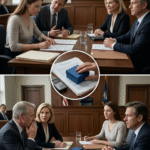
The divorce finalized in May at the Charleston County Courthouse.
I wore navy.
Bennett wore gray.
Vivienne did not appear. By then, she had left Charleston for Palm Beach, according to people who enjoyed updating me despite my complete lack of curiosity. Cross Creative Consulting had rebranded twice. Her social media turned off comments. The unauthorized donor funds had been repaid after Daniel threatened civil action. Charles Keaton withdrew from Bennett’s Savannah project, which collapsed under debt and embarrassment.
Bennett sold his stake in Ashford Heritage Development to cover obligations.
The prenup held.
The trust remained untouched.
Custody was shared in a structured schedule after Bennett completed counseling and agreed, in writing, not to expose the children to romantic partners without mutual consent and therapeutic guidance. He also agreed to stop discussing the divorce, the house, or me with donors, school staff, media, or the children.
The judge looked over her glasses when reading that clause.
“Mr. Ashford,” she said, “you are fortunate Mrs. Ashford is more interested in stability than punishment.”
Bennett lowered his head.
“Yes, Your Honor.”
Outside the courthouse, he approached me.
Daniel stood nearby, close enough to intervene, far enough to respect the ending.
Bennett looked at the courthouse steps, then at me.
“You look peaceful,” he said.
“I’m getting there.”
He nodded.
“I know this doesn’t matter now, but you were the best thing in my life.”
I looked at him.
“That did matter,” I said. “You should have treated it like it did.”
He swallowed.
“I’ll spend the rest of my life regretting that.”
“I hope you spend the rest of your life becoming better than your regret.”
He looked as if he wanted to say more.
But finally, finally, Bennett understood that wanting did not create permission.
He stepped back.
I walked down the courthouse steps into warm May sunlight.
Daniel opened the car door for me.
As we pulled away, I did not look back.
That summer, Whitmore House opened for one authorized tour.
Not a glossy social event.
Not champagne.
Not influencers posing beneath portraits they could not name.
A children’s preservation day.
Oliver helped set up folding chairs in the garden. Grace made lemonade with more sugar than any medical professional would recommend. Mrs. Pritchard, still apologetic and now fiercely loyal, arranged docents from the Preservation Society. Elaine Porter sponsored transportation for students from two public schools. Margaret Ellis wore pearls and terrified a group of fourth-grade boys into listening respectfully to a lecture on original pine floors.
I stood on the staircase before the first group arrived.
The same staircase.
For a moment, I could still see Vivienne there in champagne satin, one hand on the railing, my brooch at her chest, using the word “our” like a stolen key.
Then Grace ran into the foyer.
“Mom, where do you want the name tags?”
Her hair was crooked because she had insisted on doing it herself. One sock had strawberries. The other had stars.
I looked at my daughter and felt the memory loosen.
“On the entry table,” I said.
She glanced up at me.
“Are you okay?”
Children ask the most enormous questions in the smallest voices.
I smiled.
“Really?”
I stepped down and knelt in front of her.
She studied me with my own eyes.
“Is this house happy now?”
I thought about that.
Houses are not happy. They are wood, plaster, brick, glass. They hold heat badly in winter and secrets too well in summer. They creak when no one is walking. They demand money and patience and repairs nobody compliments because beauty is expected and maintenance is invisible.
But they also hold laughter.
They hold soup smells and piano mistakes and muddy shoes. They hold grandmothers’ warnings and fathers’ songs. They hold mothers crying quietly, then standing again. They hold children growing taller against doorframes marked in pencil.
“This house is healing,” I said.
Grace nodded solemnly.
“Like us.”
My throat tightened.
“Yes,” I whispered. “Like us.”
The first students arrived at ten.
They poured through the front door with wide eyes and untied shoelaces, their voices bouncing off marble and wood. A little boy asked if ghosts lived upstairs. A girl wanted to know why old people liked tiny spoons. Oliver explained, with great authority, that the cannonball in the garden wall was “completely real and extremely cool.”
For the first time in months, Whitmore House felt less like evidence and more like shelter.
At noon, I gave a short talk in the dining room.
Not at the head of the table.
Beside it.
“I used to think inheritance meant receiving something,” I told the children. “A house, a name, a piece of jewelry, a story. But I’ve learned inheritance is also responsibility. It means protecting what came before you without letting it trap you. It means telling the truth, even when a lie would be easier. And it means knowing that being a caretaker is not about owning something loudly. It is about loving something well.”
Margaret dabbed her eyes.
Mrs. Pritchard pretended to inspect the drapes.
Oliver looked embarrassed but proud.
Grace clapped first.
Then the children clapped too, because children are generous when they sense adults need help.
After the tour ended, I walked alone into the library.
Sunlight crossed the floor in long gold bars. Dust floated through it like tiny, harmless ghosts. On the desk sat the certified copy of the deed, framed now beneath museum glass—not for display, not for pride, but as a reminder.
I read the line again.
Caretaker: Caroline Whitmore Ashford.
Soon, after the legal name change was complete, it would read Caroline Whitmore again.
Not because marriage had erased me.
Because I had decided to stop carrying a name that had tried to overwrite mine.
I opened the top drawer and removed the sapphire brooch.
For months, I had not worn it. It had felt contaminated by Vivienne’s touch, by Bennett’s betrayal, by that horrible afternoon when heritage had been turned into theater.
But objects can be reclaimed too.
I pinned it to my dress.
My hands were steady.
In the mirror above the mantel, I saw myself clearly.
Not young in the way Vivienne had been young. Not untouched. Not unscarred. Not the woman from my wedding photographs, smiling under white lights at a man who had promised forever because forever had not yet cost him anything.
I looked older.
I looked tired.
I looked free.
And beneath the chandelier, beneath my mother’s portrait, inside the house that remembered every version of me, I smiled.
Conclusion: The Door I Opened for Myself
Two years later, people still sometimes asked about the tour.
They never called it “Vivienne’s tour” anymore.
They called it “the deed day.”
I hated that at first. Then I made peace with it. Women are often remembered for the moment they refused to be erased, even when that moment was born from pain.
Bennett became a better father slowly, imperfectly, without applause. He moved into a modest house ten minutes from the children’s school. He attended therapy. He stopped arriving with excuses. He learned how to sit through Grace’s recitals without checking his phone. He learned how to let Oliver be angry without calling it disrespect.
We became civil.
Not close.
Not cruel.
Civil was enough.
Vivienne married a hotel investor in Miami, according to an article someone sent me that I did not read beyond the headline. In the photograph, she wore white lace and a diamond bracelet. She looked beautiful. She always had.
For a moment, I hoped she had found whatever she thought houses could give her.
Then I closed the link.
Some chapters do not need epilogues.
Whitmore House changed too.
Not into a brand.
Into a living place.
We hosted student workshops, preservation lectures, small charity teas, and one annual candlelight tour authorized properly through the trust. The nursery became a reading room for Grace. The old carriage house became a studio for Oliver, who discovered photography and took moody black-and-white pictures of windows, fences, and his own sneakers.
I kept one brochure from that first unauthorized tour.
Not framed.
Not displayed.
Folded inside a file in Daniel Reeves’s office, beside the injunction, the bank records, the custody order, the screenshots, and the certified deed.
Proof that a lie once stood on my staircase wearing satin and a stolen brooch.
Proof that silence is not surrender when a woman is listening.
Proof that dignity can be sharper than rage.
On the anniversary of the deed day, I stood again in the foyer of Whitmore House. The front door was open. Warm air moved through the hall. Grace was in the garden with friends. Oliver was upstairs editing photographs. Somewhere in the kitchen, someone had left music playing.
The house was loud.
Beautifully loud.
I touched the banister and thought of my grandmother.
Never correct a lie too early.
I had let the lie grow legs.
I had watched it walk through my rooms, smile at my guests, wear my family’s jewels, and call itself the future.
Then I had placed the truth on the dining table.
The room had gone silent.
The mistress had lost her borrowed crown.
The husband had learned regret could not purchase absolution.
And I had walked away with my children, my name, my house, and my peace.
Because the deed named one caretaker.
And it was not her.