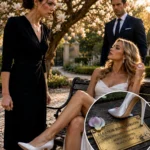
I nodded.
Because at four o’clock, Whitmore Development’s board would meet at the Leighton Club.
Grant did not know Diana and I had requested time on the agenda.
He did not know my father’s trust still held voting rights attached to the emergency collateral shares issued during the 2020 refinancing.
He did not know the bank’s default clause allowed the guarantor—me—to demand governance review if reserve funds were misused.
He did not know I had waited until the morning of the divorce hearing for a reason.
Public humiliation had been his language.
Documentation was mine.
Sienna finally moved the Porsche again, this time under the watchful eye of a courthouse guard who had become my favorite witness.
As she got in, the roses fell from the passenger seat onto the dirty curb.
She looked at them.
Then at me.
I did not bend to help.
Grant did.
That image stayed with me: my husband, in a five-thousand-dollar suit, crouched on cold concrete, picking up the mistress’s white roses after she had mocked my daughter’s pain in open court.
That was when I knew no apology would ever find the woman I used to be.
She was gone.
And I was grateful.
The Leighton Club stood on Broad Street behind iron gates and old oak trees wrapped in white winter lights. Its limestone facade looked carved out of inheritance and denial. Inside, the lobby smelled of cedar, leather, and expensive secrets.
Grant arrived with Sienna at 3:51.
I arrived with Diana at 3:56.
He saw me in the lobby and stopped cold.
“What are you doing here?” he asked.
Before I could answer, Celeste Whitmore appeared at the top of the staircase.
Grant’s mother had dressed for battle in a black Chanel suit and pearls the size of small lies. At seventy, she remained stunning, severe, and loyal to the Whitmore name above every human being attached to it.
“Evelyn,” she said, descending slowly. “This is a board meeting.”
“I know.”
Her eyes flicked to Diana. “Family counsel is not invited.”
Diana smiled. “Bank counsel is.”
Celeste paused.
Grant looked between us. “What does that mean?”
“It means,” I said, “that when I pledged my separate inheritance to save Whitmore Development, the bank required protective governance provisions. You signed them.”
He shook his head. “No.”
“You signed a lot of things when you needed my money.”
Sienna stepped closer to him. “Grant, what is she talking about?”
He did not answer.
Celeste’s face hardened. “Evelyn, whatever happened in your marriage should remain separate from company affairs.”
I looked at my mother-in-law, the woman who had taught me over a decade how society excuses men and invoices women.
“You were right about one thing, Celeste,” I said. “Good wives don’t make things worse.”
Her lips pressed together.
“I was a good wife,” I continued. “That is why the company still exists. Today I am not here as Grant’s wife.”
I held up my folder.
“I am here as a guarantor, secured creditor, and voting rights holder.”
For the first time in sixteen years, Celeste Whitmore had no immediate reply.
The boardroom was worse for Grant than the courtroom.
Court had strangers.
The boardroom had his world.
Seven directors sat around a dark walnut table beneath a chandelier that made everything below it look expensive and guilty. There was Harold Baines from First Commonwealth Bank. Marjorie Ellison, who had invested in the Riverside Heights project because I convinced her the zoning risk was manageable. Peter Wexler, Grant’s golfing partner. Two independent directors. Celeste. And Grant’s uncle Robert, who had never liked me until the year I saved his dividend.
Sienna entered as if expecting admiration.
She received silence.
White roses do not look elegant in a boardroom. They look desperate.
Grant whispered, “You should wait outside.”
Her head snapped toward him. “What?”
“This is company business.”
“You said I was part of your future.”
Diana set her briefcase on the side table.
Every board member heard Sienna.
I watched Grant realize, too late, that mistresses who enjoy public victory rarely accept private exits.
“Sienna,” he said, quieter. “Please.”
She laughed. “Please? You let her drag me in court, and now I’m supposed to sit outside like some dirty secret?”
That was the thing about public rooms.
They punish people who forget how sound travels.
Harold Baines folded his hands. “Grant, perhaps we should begin.”
Sienna remained standing.
So did I.
Diana passed documents down the table.
The first packet showed unauthorized transfers.
The second showed contract irregularities.
The third showed board approval thresholds Grant had bypassed.
The fourth showed Sienna’s LLC payments.
The fifth showed the morality and conduct clause in the Riverside Heights investor agreement, which allowed removal of executive control if misconduct materially threatened financing.
Grant’s face turned gray.
Celeste read quickly, pearls trembling at her throat.
Peter Wexler muttered, “Jesus, Grant.”
Sienna looked around the room. “This is insane. I had a legitimate contract.”
Marjorie Ellison glanced at her. “For what work?”
Sienna blinked. “Brand strategy.”
Marjorie’s voice was cool. “Can you produce deliverables?”
Sienna lifted her chin. “I don’t have to answer to you.”
Marjorie smiled without warmth. “You do if my capital paid you.”
Grant put a hand over his eyes.
The room went quiet again.
Diana spoke then, measured and lethal.
“Mrs. Whitmore is prepared to seek injunctive relief, notify the lender of reserve misuse, and pursue reimbursement to the marital estate. However, she is also prepared to support a cleaner resolution.”
Grant looked up.
Hope is ugly when it arrives too late on a selfish face.
“What resolution?” he asked.
I opened the last folder.
“My separate collateral is released. The reserve account is restored within ten business days. Sienna Vale’s contract is terminated for cause. You step down as acting CEO pending audit. I retain my voting rights until the audit concludes. And the board appoints an interim executive.”
Celeste’s voice was thin. “Who?”
I looked at her.
“Me.”
The boardroom fell silent.
Sienna laughed.
Actually laughed.
A short, sharp, foolish sound that echoed off the glass and walnut.
“You?” she said. “You’re a divorce lawyer.”
“I’m a corporate attorney who practiced family law after Lily was born,” I said. “I negotiated the refinancing that kept this company alive. I secured the Riverside Heights entitlement. I know every lender, every covenant, every pending liability, and every director at this table.”
Marjorie Ellison nodded once.
Harold Baines did too.
Sienna’s laugh vanished.
Grant stared at me like he was seeing not his abandoned wife, not the mother of his child, not the woman he had called cold, but the structure he had mistaken for furniture.
“Evelyn,” he whispered. “You can’t do this to me.”
There it was again.
To me.
Not because of me.
Not after what I did.
I looked at him, and for the first time all day, I let him see a little of the wound.
Not the whole thing.
He no longer deserved the whole of anything from me.
“I didn’t do this to you,” I said. “I stopped hiding what you did to us.”
His eyes filled.
Sienna stepped back as if the room had tilted.
Celeste gripped the edge of the table.
Harold Baines cleared his throat. “I move to appoint Evelyn Hart Whitmore as interim executive chair pending audit.”
Marjorie seconded.
One by one, hands rose.
Celeste hesitated longest.
Then, because survival had always mattered more to her than loyalty, she raised hers too.
Grant did not vote.
He could not.
His authority had just left him in the same quiet way I had.
Sienna turned on him before the vote even finished.
“You told me she had no power.”
“You told me the house was yours. The company was yours. That she was just dragging things out.”
He said nothing.
Sienna’s voice rose. “Grant.”
The boardroom watched her unravel.
The mistress who had carried flowers into court like a victory flag now stood under a chandelier in front of bankers and investors, discovering she had not stolen a king.
She had stolen a liability.
“You said you were protecting me,” she snapped.
Diana collected her papers.
I closed my folder.
Grant whispered, “Sienna, not here.”
She threw the white roses onto the boardroom table.
Petals scattered across the unauthorized transfers.
“Not here?” she said. “You humiliated me in court, you let your wife take the company, and now my contract is gone?”
Marjorie Ellison looked mildly fascinated.
Sienna pointed at me. “You think you won because you have papers?”
“No,” I said. “I won because I kept records.”
Her mouth twisted. “He never loved you.”
That one should have hurt.
Maybe it would have a year earlier.
Maybe even six months earlier.
But by then, love was not the argument.
Trust was.
Respect was.
Safety was.
And all three had already been buried.
I picked up one white rose from the table. Its stem had snapped.
“You may be right,” I said softly. “But he needed me. And he used you. Neither of those is love.”
The sentence landed harder than any insult.
Sienna’s face crumpled for half a second before rage covered it.
Grant looked at her, then at me.
For the first time, he seemed to understand that nobody in the room belonged to him anymore.
Not his wife.
Not his mistress.
Not his company.
Not even the story.
Chapter 5: The Name on the Door
News travels differently in wealthy circles.
Poor people are gossiped about loudly.
Rich people are whispered about efficiently.
By dinner, half of Columbus knew there had been a scene at Franklin County Courthouse.
By breakfast, the business page had a carefully worded item about Whitmore Development appointing an interim executive chair amid an internal governance review.
By noon, Sienna Vale had deleted her Instagram.
Not before someone screenshot her post from the morning.
White roses on cream leather seats.
Caption: New beginnings require courage.
The internet did what the internet does.
It sharpened.
Women found the courthouse parking story first. A clerk’s cousin posted about it anonymously. Then one of the reporters wrote a column about “a reserved parking pass, a mistress with flowers, and the quiet power of paperwork.” No names at first. But names do not stay hidden when people in luxury coats make public scenes.
By Friday, Sienna was no longer a mysterious blonde.
She was a meme.
Not because I encouraged it.
I did not post. I did not comment. I did not like a single article. Diana told me silence looked better in court, and besides, I had never wanted strangers to carry my pain like entertainment.
But I would be lying if I said there was no justice in watching arrogance meet consequence.
The board audit moved quickly.
It found what I already knew and more than I wished I knew.
Grant had used company resources to fund travel with Sienna. He had overstated projected commitments to secure bridge financing. He had delayed vendor payments while paying Vale Strategic Image LLC ahead of legitimate contractors. He had promised Sienna a bonus tied to Riverside Heights, then tried to classify it as business development.
He resigned before the board could remove him permanently.
The word was voluntary.
The truth was not.
Sienna’s contract was terminated for cause. Her LLC was sued for return of improper payments. Two luxury brands quietly dropped her as a consultant. The Leighton Club suspended her membership application, which Celeste had sponsored in a final act of denial two months earlier.
Celeste called me once.
I let it go to voicemail.
She left a message that lasted forty-three seconds.
“Evelyn. This has all gone too far. Grant made mistakes, yes, but he is Lily’s father and my son. You have proven your point. There must be a graceful way to resolve this without destroying the family name.”