“This cannot be right,” she whispered.
“Your grandfather created a contingent charitable structure.”
“I know about the Mercer Foundation.”
“Not that.”
She handed me the document.
The language was dense, but the meaning became clear.
Upon a triggering fraud event involving the misuse of Mercer cultural assets, several dormant trusts would consolidate under the control of the Aurelius Heritage Trust.
The assets included historic buildings, investment partnerships and a controlling stake in Bellweather & Cole.
I looked at Gabriel.
“The auction house belongs to the trust?”
“Thirty-two percent belonged to the trust before tonight,” he said. “With the contingent shares, sixty-one.”
The room tilted slightly.
My grandfather had hidden the controlling interest because he believed the auction house should remain independently managed until someone attempted to corrupt the Mercer collection.
Julian’s fraud had triggered the consolidation.
By trying to steal the coins, he had placed the auction house itself under my control.
That alone would have been enough.
It was not the final twist.
Naomi turned another page.
“There is a schedule of additional assets.”
The list included an entity called Sunrise Municipal Holdings.
I recognized the name from property records but had never connected it to my family.
Sunrise Municipal Holdings owned the ground lease beneath the Madison Avenue tower where Cross Continental maintained its headquarters.
It also owned an adjoining development parcel valued at nearly four hundred million dollars.
Julian had spent years boasting that Cross Continental’s address proved the company had arrived.
The ground beneath it had belonged to me all along.
I laughed.
I could not stop myself.
Not because it was funny.
Because the scale of my grandfather’s preparation felt like hearing his voice from another room.
Gabriel smiled faintly.
“He always did enjoy an ending.”
Naomi continued reading.
The trust codicil authorized me to retain, sell or dedicate the consolidated assets to public benefit.
“What will you do?” she asked.
I looked around at the hidden archive.
For weeks, my life had revolved around possession.
Who owned the coin.
Who owned the hotels.
Who owned the apartment.
Who controlled the company.
Julian believed ownership was proof of worth.
My grandfather believed ownership was responsibility.
I finally understood the difference.
“Cross Continental employs more than four thousand people,” I said.
Naomi nodded.
“I want the company restructured.”
“In what way?”
“Create an employee ownership trust.”
Gabriel’s brows rose.
“The Aurelius Trust will retain protective voting rights until the criminal matters are resolved. Then a significant portion of equity transfers to employees based on tenure.”
“That will dilute Julian’s remaining shares,” Naomi said.
“He may challenge it.”
“He may try.”
“And the Madison Avenue parcel?”
“Develop affordable housing for hospitality workers.”
Gabriel looked at me for a long moment.
My grandfather’s final line returned to me.
Decide what deserves to survive you.
Not revenge.
Not a name on a building.
Something useful.
We announced the restructuring two months later.
Cross Continental was renamed Meridian House Group.
Employees received ownership units.
Executive compensation was capped relative to median wages.
The Aspen resort’s unused staff housing was renovated.
The Charleston property established a scholarship for employees’ children.
Financial publications described the moves as radical.
Julian described them as theft.
His attorneys filed objections.
The court rejected them.
The evidence of fraud was overwhelming.
At sentencing, Julian pleaded guilty to conspiracy, wire fraud and forgery-related charges.
He received a term of imprisonment followed by supervised release and restitution obligations.
I attended the hearing.
Not because I wanted to watch him fall.
Because I wanted to hear him tell the truth where the record could not forget it.
He stood before the judge in a dark suit stripped of its former authority.
He admitted forging my signature.
He admitted pledging assets he did not own.
He admitted selling the Newport coins.
He admitted diverting company funds.
The courtroom became silent.
“I spent years telling myself Vivian’s family made me invisible,” he said. “The truth is that she gave me every opportunity to be seen, and I used her generosity as an excuse to resent her.”
His voice broke.
“She did not destroy me. She stopped protecting me from what I had done.”
I felt tears rise.
I did not let them fall until I was outside.
Gabriel waited at the bottom of the courthouse steps.
He did not touch me immediately.
He simply stood beside me while cameras called my name from behind the barricades.
When I finally reached for his hand, he held mine.
No possession.
No performance.
Just warmth.
Julian’s son remained in California for nearly three months.
He survived.
Rachel recovered and returned to her daughters.
Sloane formally relinquished her claim of intended parentage after a court found the agreement had been compromised by fraud and misrepresentation.
Julian, despite his conviction, remained the child’s legal father.
The question of care became urgent.
A court-appointed guardian contacted me.
Julian had named no suitable relative.
His parents were deceased.
His sister lived abroad and declined responsibility.
The baby entered temporary foster care after leaving the hospital.
I told myself I had already done enough.
I paid the medical expenses.
I protected his privacy.
I ensured he was not abandoned at birth.
None of that made him mine.
Then the guardian sent me a photograph.
He was four months old, wrapped in a blue blanket, staring solemnly at the camera.
He had Julian’s dark eyes.
But his expression reminded me of my grandfather.
Not because of blood.
Because I wanted it to.
That frightened me.
I drove to the coast and sat outside Mercer House until the sun disappeared.
My marriage had taken the future I imagined.
It had not taken my ability to choose another one.
“I want to explore guardianship.”
She did not answer immediately.
“Are you certain?”
“Certainty is overrated when children are involved. Responsibility matters more.”
The legal process was careful and slow.
I visited the baby first under supervision.
His name on the clinic documents was Julian Cross Jr.
I could not call him that.
The foster family called him Jude.
The name suited him.
On our third visit, he fell asleep against my chest.
His breathing was warm through my blouse.
I looked down at his small face and felt something open inside me.
Not the restoration of the child I might have had.
Jude was not a replacement for anything.
He was himself.
A child whose beginning had been shaped by selfishness but whose life did not have to be.
Julian consented to my appointment as permanent guardian.
Months later, after extensive review, I adopted Jude.
The newspapers eventually learned.
I issued one statement.
A child is not responsible for the failures of the adults who brought him into the world. His privacy will be protected.
No photographs were released.
No interviews granted.
At Mercer House, Jude learned to walk along the same library carpet where my grandfather once taught me about coins.
I moved the replicas into a drawer.
I kept them as reminders.
Counterfeits are useful after they are exposed.
They teach the eye what to examine.
On Jude’s second birthday, I placed the Mercer Sunrise inside a museum case at the newly established Mercer Center for American Craft and History.
The center occupied part of the restored Bellweather building and offered free admission to students.
Beside the coin was a simple description.
Not its market value.
Not the scandal.
Only its journey through generations and its significance to the history of American engraving.
At the opening dinner, I stood beneath another chandelier.
This one was smaller.
The room held teachers, museum conservators, hotel employees, scholars and children from public schools across the city.
Gabriel stood beside me.
He had never pushed.
Never asked me to recover faster.
Never treated patience as a transaction.
Our relationship grew in quiet places.
Coffee in the Bellweather archives.
Walks along the Newport cliffs.
Late dinners after Jude had fallen asleep.
The first time Gabriel kissed me, it was in my grandfather’s kitchen while rain struck the windows.
The memory could have hurt.
Instead, it became new.
Warm.
Mine.
We did not marry quickly.
When we eventually did, the ceremony took place in the garden at Mercer House.
No press.
No corporate guests.
No strategic seating chart.
Jude carried the rings in a small wooden box and dropped them into the grass before reaching us.
Everyone laughed.
Gabriel knelt to help him.
I watched the two of them beneath the summer sun and realized peace did not arrive dramatically.
It accumulated.
One honest day at a time.
During the reception, Naomi approached with a letter.
It had arrived from Julian.
He remained in prison.
I considered leaving it unopened.
Then I read it alone in the library.
Jude’s guardian sends me updates permitted by the court.
I know he is safe.
I know he calls you Mom.
I do not expect forgiveness.
I used to think losing the company was the worst thing that could happen to me.
Then I understood I had lost the right to witness the life of my own son because I treated every human relationship like an asset I could control.
Thank you for loving him without making him pay for me.
I am sorry.
Julian.
There was no request at the end.
No appeal.
No attempt to reopen the door.
It was the most honest thing he had ever given me.
I folded the letter and placed it in a file Jude could read when he was older.
Then I returned to the garden.
Gabriel stood beneath the trees with Jude on his shoulders.
Music drifted across the lawn.
The Atlantic shone beyond the stone wall.
For most of my life, I believed inheritance meant receiving what previous generations preserved.
I was wrong.
Inheritance was also deciding what pain would not be passed forward.
Julian gave his mistress my bidder paddle because he believed history belonged to whoever could afford it.
He never understood the truth.
History belongs to the people willing to carry its lessons without repeating its cruelty.
The Mercer Sunrise remained behind glass at the museum.
The empire Julian tried to steal became partly owned by the people who kept it alive.
The building beneath his former office became housing for workers and their families.
The child created from betrayal grew up surrounded by honesty.
And the woman who once sat three chairs away from her own husband finally stopped measuring her life by what had been taken from her.
I had not lost my family.
I had learned how to build one.
CONCLUSION: WHAT GOLD COULD NEVER BUY
Years later, Jude asked me why the Mercer Sunrise was famous.
He was six years old and standing on a museum stool so he could see the coin more clearly.
Children gathered around us during a family education day. Their fingerprints covered the lower edge of the glass.
“It’s rare,” I told him.
“How rare?”
“Very.”
“Is it the most expensive coin in the world?”
He considered that.
“Then why does everybody come to see it?”
I looked at the gold beneath the lights.
Once, the coin had represented my grandfather.
Then my marriage.
Then betrayal.
Then revenge.
Now it was simply a beautiful object carrying more stories than its small shape should have been able to hold.
“People don’t always come because something is expensive,” I said. “Sometimes they come because it survived.”
Jude pressed both hands against the glass.
“Did it survive bad people?”
“It survived bad choices.”
“Is that different?”
He looked at me with Julian’s dark eyes and Gabriel’s learned patience.
“Can people survive bad choices?”
“Some can.”
“What happens after?”
“They make better ones.”
He accepted this answer with the solemnity only a child can give to an enormous truth.
Then he took my hand.
Gabriel waited near the entrance, carrying Jude’s coat and the paper crown he had made in the children’s workshop.
The sight of them filled me with a quiet happiness that had no need to prove itself.
I thought of the Halcyon dinner.
The fallen paddle.
The laughter.
Julian’s champagne glass raised beside Sloane.
For years, I assumed that night marked the destruction of my life.
It did not.
It marked the moment I stopped protecting the illusion that had been destroying me.
Public humiliation had not made me powerless.
It had revealed who wanted me to believe I was.
The evidence did not create Julian’s betrayal.
It merely gave betrayal a name the law could recognize.
The hidden assets did not make me strong.
They gave my strength tools.
And revenge, satisfying as it had once felt, was not the finest thing I built from the ruins.
The finest thing was a life in which no one had to become smaller to be loved.
Jude tugged my hand.
“Mom, can we get hot chocolate?”
“With extra marshmallows?”
“Absolutely.”
He ran toward Gabriel.
I followed them through the museum doors and into the bright winter afternoon.
Behind us, the Mercer Sunrise remained safely inside its case.
I did not need to own every beautiful thing privately anymore.
I did not need a husband’s admiration to prove my value.
I did not need the world to remember the woman who withdrew the coin from sale.
It was enough that I remembered her.
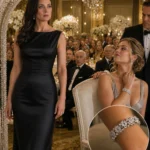
The woman in the black gown.
The wife seated at the wrong place.
The granddaughter who allowed the room to laugh because she knew the truth had already entered through the door.
She had believed she was ending a marriage.
She was beginning an inheritance.
Not of gold.
Not of buildings.
Not of power.
Of freedom.
And freedom was the one treasure no faithless man, no false lover and no raised bidder paddle could ever purchase from her.