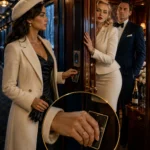
They handed out ivory cards at the Christmas ball like my marriage was a party game.
Not after dinner.
Not in private.
Not with shame.
Right there beneath twelve crystal chandeliers, while a string quartet played “Have Yourself a Merry Little Christmas,” my husband’s mistress walked from table to table with a silver tray and asked the entire Caldwell family to decide whether I still deserved to be invited to holidays.
My husband, Patrick, stood beside the fireplace with a glass of bourbon in his hand and told me not to worry.
“If you’ve treated people well, Clara, you have nothing to fear.”
His mother smiled as if she had personally invented justice.
“This family deserves democracy.”
I looked at the ivory cards.
I looked at the woman sleeping with my husband.
Then I looked at the ballroom my grandmother had built with widow money, railroad stock, and a spine made of steel.
And I waited until every card was collected.
PART 1 — THE CHRISTMAS BALL WHERE THEY STOPPED PRETENDING
Bellemont House always looked most beautiful in December.
The old Newport mansion sat above the black Atlantic like it had grown out of the cliff itself, all pale stone, frost-glazed windows, and wreaths large enough to shame a church door.
By five in the evening, the driveway curved with valet lights and sleek winter cars.
By six, the ballroom smelled of pine, champagne, candle wax, and money old enough to stop introducing itself.
The Caldwells loved bringing people here because Bellemont made them feel richer than they were.
That was the first truth nobody said aloud.
The second was that the Caldwell family had been living off my side of the family for sixteen years while calling me lucky to have married in.
I was thirty-nine that Christmas, old enough to know humiliation has a temperature.
It is cold at first.
Then it burns.
I stood at the top of the marble staircase in a dark green silk dress my grandmother had once told me was the color of women who did not need to ask permission.
My hair was pinned low.
My wedding ring was still on.
Patrick had asked me to wear it “for appearances,” which was the kind of request a man makes when he has already decided appearances matter more than his vows.
May you like
He was waiting below, laughing with his cousins.
Beside him stood Sloane Whitaker.
Twenty-eight.
Blonde.
Polished.
Wrapped in winter-white satin like a bride who had arrived too early and refused to leave.
She had a hand on Patrick’s forearm.
Not resting.
Claiming.
Everyone saw it.
No one corrected it.
That was how wealthy families punished women.
They did not scream.
They rearranged the room until you understood where you no longer belonged.
Patrick looked up and saw me.
For a moment, his face tightened.
Not with guilt.
With annoyance that I still looked like his wife.
Then he smiled the practiced smile he used for donors, judges, and family photographers.
“Clara,” he said, climbing three steps to meet me. “You look beautiful.”
Sloane followed him with her eyes.
His mother, Eleanor Caldwell, was already watching from beside the grand piano.
Eleanor had been beautiful once in the hard New England way, all bone structure and frost.
Now she was seventy, and her beauty had sharpened into something that could cut ribbon or skin.Preview
“Thank you,” I said.
Patrick leaned in as if to kiss my cheek, but I turned slightly so his mouth met air.
He paused.
The smile stayed.
His eyes did not.
“Let’s not make tonight difficult,” he murmured.
“I wasn’t planning to.”
“That’s good.”
He glanced over his shoulder at Sloane.
“She’s nervous.”
I looked past him at the woman who had worn white to my family’s Christmas ball.
“How unfortunate.”
His jaw flexed.
“Clara.”
“No, really. It must be hard attending a party where everyone knows your title but nobody can print it on a place card.”
For the first time that night, Patrick looked almost afraid.
Then Eleanor appeared at his side, carrying her little black velvet clutch like a weapon.
“Clara, darling,” she said.
She kissed the air near my cheek.
“You’re late.”
“I came downstairs at six.”
“The family was asking.”
“The family usually asks before judging.”
Eleanor smiled wider.
That was when I knew something had been planned.
Not guessed.
Known.
Because women like Eleanor do not smile before chaos unless they have ordered it from a caterer.
The ballroom doors opened behind her, and the guests began to turn.
Patrick’s brothers arrived in dark suits with wives in diamonds and daughters in satin bows.
His cousins filled the east side of the room.
His uncles gathered near the bar like old judges.
The Caldwell women kissed me with dry lips and looked over my shoulder to find Sloane.
The younger ones whispered.
The older ones pretended not to.
My brother Daniel stood across the room near the French doors, tall and quiet in a navy tuxedo.
He met my eyes.
I gave one small shake of my head.
Not yet.
He understood.
Daniel and I had learned silence from our grandmother.
Not the weak kind.
The kind that let enemies finish writing the evidence in their own handwriting.
My grandmother, Virginia Hartley, had died eleven months earlier.
Bellemont House had been hers.
Before that, it had been her mother’s.
Before that, it had belonged to a family that lost it in a tax auction after one of their sons gambled away the summer season.
Virginia Hartley bought it at thirty-two with no husband, no apology, and no desire to be accepted by Newport society.
By the time she died at ninety-one, the same women who had once refused her tea were using her ballroom for charity galas.
She left me her emerald ring, her private journals, and a sealed envelope with my name on it.
She left Daniel the family office in Boston and half the trusteeship.
She left Bellemont exactly where she intended.
Hidden in plain sight.
The Caldwells did not know that.
They had never asked.
They assumed.
Assumption is the favorite drug of entitled people.
At seven, dinner began.
At eight, the toasts began.
At eight-thirty, my marriage was placed on a silver tray.
Sloane moved first.
She crossed the ballroom with her chin lifted and a little smile that made it clear she had rehearsed softness in the mirror.
The quartet lowered into something sweet and useless.
A waiter behind her carried a tray stacked with ivory cards embossed in gold.
I recognized the paper immediately.
Hartley stationery.
My grandmother’s stock.
My chest tightened once.
Then it went still.
Sloane reached the center of the ballroom and tapped a champagne flute with a dessert spoon.
The sound rang out bright and delicate.
Every conversation thinned.
Patrick stayed near the fireplace.
Eleanor stood beside him.
Neither looked surprised.
“Good evening, everyone,” Sloane said.
Her voice was warm enough to fool strangers.
“First, I want to thank the Caldwell family for welcoming me tonight during what I know has been a complicated year.”
A complicated year.
That was one way to describe your husband coming home at three in the morning smelling like another woman’s perfume and telling you he needed space in the house you inherited.
That was how cowards named cruelty.
Sloane placed one manicured hand over her heart.
“I know my presence is difficult for some people.”
A few of Patrick’s cousins glanced at me.
I stood near the south wall, beneath the portrait of my grandmother at forty, wearing pearls and the expression of a woman who had never lost a negotiation.
Sloane continued.
“But Eleanor reminded me that the Caldwell family has always believed in honesty, unity, and giving everyone a voice.”
Eleanor nodded solemnly.
Patrick looked into his bourbon.
“We all know the holidays are sacred,” Sloane said.
“They should be peaceful. They should be loving. They should not be held hostage by resentment.”
Someone murmured approval.
My sister-in-law Brooke lowered her eyes.
She had known Patrick was cheating before I did.
Women always know.
Some warn you.
Some enjoy watching you find out.
“So tonight,” Sloane said, “we’re asking the family to help us make a decision together.”
The waiter began handing out ivory cards.
My name was printed on them.
CLARA CALDWELL SHOULD CONTINUE TO BE INVITED TO CALDWELL FAMILY HOLIDAY EVENTS.
Beneath that were two little boxes.
YES.
NO.
For a moment, the room did not move.
Then it moved all at once.
Small gasps.
A chair leg scraping.
A cousin whispering, “Oh my God.”
One of Patrick’s aunts laughed once, then covered it with a cough.
My husband finally looked at me.
Not with horror.
With warning.
As if my reaction would decide whether I was worthy of pity.
He crossed the room slowly.
“Clara,” he said under his breath.
I held the card between two fingers.
The paper was thick and soft.
Expensive.
Stolen.
“Did you approve this?”
He inhaled.
“You need to understand the context.”
“That is not an answer.”
“It’s not about embarrassing you.”
I looked around the ballroom.
At the cards.
At the family.
At his mistress glowing in candlelight.
“What a strange room to choose for not embarrassing me.”