He had never asked me to explain why I stayed with Graham so long.
That was one of the reasons I trusted him.
People who demanded explanations for survival often wanted the story reshaped into something comfortable for them.
Julian understood that captivity did not always have locked doors.
Sometimes it had school schedules, family foundations, shared bank accounts, public expectations, and a child asleep upstairs.
Tonight, he did not walk half a pace ahead.
He did not present me to the room like something he owned.
He entered beside me.
That difference felt more intimate than possession ever could.
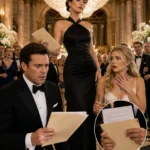
The gala began beneath towering arrangements of white branches and black orchids. A string quartet played near the Temple of Dendur. Screens displayed photographs of students from robotics programs across the country.
Owen sat with his championship team.
He laughed easily.
That sound was the only proof of success I needed.
During dinner, Margaret approached the microphone.
She thanked donors, announced the new Hart Inventor Protection Fund, and introduced me as the original architect of Asterion.
The room stood.
For one disorienting second, I could not breathe.
I had imagined recognition many times.
In my angriest years, I imagined it as a weapon. A room admitting Graham had lied. A world correcting itself.
The reality felt quieter.
Applause could not return the years.
It could not restore the version of me who believed love and credit were separate things.
It could not erase the moment I stood outside the photograph.
But it could create a record.
Sometimes that was enough.
I reached the stage.
“When I was twenty-four,” I began, “I believed that if an idea was good enough, the truth of its creation would protect it.”
The audience listened.
“I was wrong. Ideas do not protect themselves. People protect them. Contracts protect them. Witnesses protect them. Communities protect them. And sometimes, the person who created something must decide that silence is no longer the price of keeping it alive.”
He smiled.
“This foundation will provide legal and technical support to young inventors whose work is vulnerable to exploitation. No child should be taught that gratitude requires surrendering ownership. No partner should be told that love makes attribution unnecessary. And no company should call theft innovation because the thief owns a better suit.”
Laughter moved through the room.
Then applause.
I stepped away from the microphone.
A member of the foundation staff approached quickly and whispered in Margaret’s ear.
Margaret’s expression changed.
She came to me.
“Graham is here.”
The room seemed to narrow.
“He’s under monitoring.”
“His conditions allow legal and medical travel. His attorney says he received an invitation.”
“He did not.”
“He has one.”
Someone had brought him.
Or someone wanted a scene.
I looked toward the entrance.
Graham stood beneath the archway.
He wore a black tuxedo.
For one irrational moment, the years folded together. I saw the man who had taken me to a Cambridge restaurant and listened while I described machine ethics until the staff stacked chairs around us. I saw the young founder who kissed my forehead before investor meetings. I saw Owen as a baby against his chest.
Memory was cruel because it did not erase beauty when love became evidence.
Graham walked into the room.
Conversation died around him.
He appeared thinner. The confidence remained, but it no longer fit his face. Without the machinery of assistants, drivers, security teams, and obedient executives, he looked less like a fallen king than a man who had mistaken the throne for his body.
Julian moved beside me.
I touched his wrist.
I descended from the stage alone.
Graham stopped several feet away.
“You look well,” he said.
“So do you.”
It was not true.
Courtesy did not require truth in every sentence.
He glanced around the room.
“You kept the name.”
“The foundation’s legal name will change after this fiscal year.”
A shadow moved through his expression.
“Of course.”
“Why are you here?”
“To see my son.”
“Owen decides whether he sees you.”
“He is a child.”
“He is the beneficiary you attempted to defraud.”
The nearest guests pretended not to listen.
Graham lowered his voice.
“Must everything become a legal sentence now?”
“Legal sentences are the reason you are not allowed to take him.”
His jaw tightened.
“You have enjoyed humiliating me.”
“Do not lie to me.”
“I wanted you stopped. That is not the same as wanting you humiliated.”
“You stood in my boardroom and took everything.”
“I took responsibility for what you abandoned.”
“You took my company.”
“The company was never only yours.”
He looked toward Julian.
“And now you have him.”
The old possessive grammar.
Have him.
As though love were inventory.
“Julian is not an asset.”
“He waited sixteen years.”
“He respected sixteen years.”
Graham laughed once.
“You think he is better than me?”
“I think he does not need me to be smaller.”
That silenced him.
The quartet had stopped playing.
Across the room, Owen stood beside his table.
He had seen his father.
Graham turned.
For the first time that evening, his face lost all performance.
“Owen.”
My son did not move.
Graham walked toward him.
No one interfered.
This moment belonged to them.
He stopped at the edge of Owen’s table.
“I’ve written to you.”
“You didn’t read the letters.”
“I deserve the chance to explain.”
Owen’s expression remained still.
“You had a chance in the boardroom.”
“That was not an explanation. That was an ambush.”
“You tried to take Blackbird.”
“I was trying to save the company.”
“You tried to take Mom’s name out of the code.”
Graham looked toward me.
Then back at Owen.
“I made decisions under pressure.”
“You always say decisions are character.”
A faint shock crossed Graham’s face.
He had taught Owen that sentence.
Parents often forgot their children were listening when principles were spoken aloud.
“I love you,” Graham said.
“I love you too.”
The room seemed to breathe.
Then Owen continued.
“But I don’t trust you.”
Love without trust.
The most accurate description of our family.
Graham’s eyes closed briefly.
“What do you want me to do?”
“Tell the truth.”
“I am telling you I love you.”
“Tell the whole truth.”
Graham looked around.
He understood what Owen meant.
Not a private apology.
Not a letter sealed away from the people harmed.
A public correction.
His face hardened.
Perhaps pride was the last property he believed no court could seize.
Then he looked at his son.
Something inside him gave way.
He turned toward the stage.
“May I use the microphone?”
Margaret looked at me.
He nodded.
Graham walked beneath the lights.
The room watched the man who had once commanded every gathering he entered.
He took the microphone.
“My name is Graham Sterling,” he said.
“For many years, I allowed the public to believe I created technology I did not create alone.”
His fingers tightened around the microphone.
“The original Asterion architecture was designed by Evelyn Hart before the formation of Sterling Dynamics. I removed and minimized her contribution because I believed the company’s story would be more valuable if it had one founder.”
His voice became rough.
“I also attempted to claim derivative work created by my son.”
Owen stared at him.
“I told myself I was protecting the company. The truth is that I was protecting my control.”
A flash erupted from the press area.
Then another.
Not with love.
Not even apology.
With recognition.
At last.
“Evelyn did not destroy Sterling Dynamics,” he said. “She prevented me from doing it.”
He handed the microphone back to Margaret.
No one applauded.
Some truths did not deserve celebration.
Only record.
Graham descended from the stage.
He paused beside Owen.
“I’m sorry.”
Owen’s eyes filled.
It was not forgiveness.
But it was the first honest thing between them.
Federal officers waited near the entrance.
Graham left with his attorney.
He did not look back.
The quartet began again.
Conversation returned gradually, fragile as glass after thunder.
I stepped onto the museum terrace.
Cold air moved across the stone. Central Park lay dark beyond the avenue. Manhattan rose around me, glittering and indifferent.
Julian joined me.
He did not ask whether I was all right.
He knew better than to reduce complicated feelings to one answer.
“He told the truth,” I said.
“I thought it would feel different.”
“How does it feel?”
“Late.”
Julian rested his hands on the stone railing.
“Late things can still matter.”
“You waited sixteen years to say that?”
“I had several stronger lines prepared.”
“Such as?”
He turned toward me.
“Evelyn Hart, I have loved you in every tense available to the English language.”
I stared at him.
“That is deeply unfair.”
“I warned you they were stronger.”
“You cannot say something like that on a terrace after my husband confesses to fraud.”
“Former husband.”
“Still inappropriate.”
“I can wait another sixteen years.”
The answer came too quickly.
His expression softened.
I stepped closer.
“No more waiting.”
I kissed him beneath the winter sky.
Not like a woman rescued.
Not like a prize transferred between powerful men.
I kissed him as the owner of my name, my work, my body, and my future.
His hands settled at my waist only after mine reached his face.
Inside, the gala continued.
Outside, the city shone.
And for the first time in my life, luxury did not mean chandeliers, townhouses, private cars, or rooms designed to make other people feel small.
Luxury was choice.
Luxury was truth without punishment.
Luxury was standing beside someone who did not require my silence to feel powerful.
When we returned inside, Owen was waiting near the doors.
He looked at Julian.
“Finally,” he said.
Julian appeared offended.
“Were there discussions?”
“Mom is bad at noticing things.”
“After sixteen years.”
“I was busy overthrowing a corporation.”
“That took three months.”
Julian placed a solemn hand over his heart.
“I like him.”
Owen rolled his eyes.
Then he slipped his hand into mine.
We walked back into the light together.
CONCLUSION
THE HOUSE WITH OPEN DOORS
One year later, Blackbird stood beneath glass at the Smithsonian.
Children gathered around it every day.
They pressed their hands to the display and read the names engraved beneath the machine.
OWEN HART STERLING.
EVELYN HART.
Sterling Dynamics became Hart Sterling Technologies after a shareholder vote.
I opposed using my name.
Owen insisted.
“Corrections should be visible,” he said.
Margaret remained chief executive. I served as chair for two years, then transferred active voting authority into an independent stewardship structure that would protect Owen’s shares until he was old enough to decide what he wanted.
I did not raise him to inherit a throne.
I raised him to understand why thrones were dangerous.
Graham pleaded guilty to reduced charges after returning most of the diverted assets and cooperating in related investigations.
He served time.
Owen visited him once before sentencing.
I waited in the car.
When Owen returned, his eyes were red, but his shoulders looked lighter.
“He apologized without explaining,” he said.
“That matters.”
“I’m not ready to forgive him.”
“You do not owe forgiveness on anyone else’s schedule.”
“Do you forgive him?”
I looked through the windshield at the gray courthouse.
“I no longer need to.”
That was the closest word I had for peace.
Celeste moved to Seattle and began consulting for small consumer brands. Six months after the gala, she mailed me a handwritten letter.
She did not ask for forgiveness.
She listed what she had done.
Every lie.
Every payment.
Every moment she chose ambition over decency.
At the end, she wrote:
I thought becoming you meant taking your place. I did not understand that your place was something you had built.
I kept the letter.
Accuracy deserved a record too.
Julian and I did not marry immediately.
After sixteen years inside a beautiful prison, I had no interest in racing toward another set of vows simply because the man waiting was kind.
We traveled.
We argued.
We learned the difference between chemistry and compatibility, and the rarer pleasure of having both.
He kept an apartment downtown.
I kept the Connecticut house my mother had left me.
Eventually, without announcement, his books began appearing on my shelves.
A second toothbrush appeared beside mine.
His suits occupied one corner of a closet.
No conquest.
No merger.
Just a life arriving gently.
The Manhattan townhouse became the Hart Center for Young Inventors.
We removed the formal dining table and replaced it with workbenches. The library became a legal clinic for students and families facing intellectual property exploitation.
The conservatory became a robotics lab.
My mother’s black lacquer desk remained in the center.
Some evenings, I sat there while children built impossible things beneath the glass roof.
Owen worked beside them as a volunteer mentor.
He taught younger students how to create systems that remembered unauthorized changes.
“Machines should know when someone alters the truth,” he told them.
“So should people.”
On the first anniversary of the championship, the center hosted a small dinner.
No reporters.
No sponsors.
No staged photographs.
Owen placed Blackbird’s original control tablet on the table and opened the archived video from Washington.
There I was, standing beyond the velvet rope.
Graham was smiling.
Celeste was dressed in ivory.
Owen was holding the microphone.
“I hate this part,” I said.
“I don’t,” Owen replied.
“Because you think you’re being pushed out of the picture.”
“I was.”
“No.” He paused the video at the moment he turned away from them. “This is the second before everyone realizes the picture belongs to you.”
Julian stood behind my chair.
His hand rested lightly on my shoulder.
Around us, the conservatory glowed with warm evening light. Tools lay scattered across tables. A half-built drone hung from the ceiling. Somewhere upstairs, a child laughed.
The house no longer whispered.
It breathed.
I looked at the frozen image of the woman I had been.
She appeared calm.
Almost invisible.
She did not yet know the empire had already shifted beneath her feet.
She did not know her son was about to speak.
She did not know evidence had been gathering in silent servers, sealed trusts, archived letters, and the memory of a machine named Blackbird.
She did not know a man who had once almost kissed her would one day wait until she was free.
She did not know humiliation was not the end of her story.
It was the moment the witnesses arrived.
Owen pressed play.
On the screen, his younger voice filled the conservatory.
“My mother designed the code with me.”
Then he turned his back on them.
And came home to me.
CAPTION:
He staged a new mother. His son named the real one.
“`