His mistress introduced herself as my replacement during intermission at the ballet.
Not behind my back.
Not in a hotel room.
Not in a whisper over a stolen dinner reservation.
She did it in the donors’ lounge at the Harrington Ballet, beneath a chandelier worth more than her apartment and in front of women who had kissed both my cheeks for nine years.
Celeste Vale lifted a glass of champagne and smiled as if the room already belonged to her.
“Graham deserves someone softer,” she said.
My husband stood three feet away in his midnight tuxedo and did not correct her.
He did not look ashamed.
He did not look sorry.
He looked relieved.
That was the part that almost made me laugh.
Because Graham Whitmore had spent the last decade mistaking my silence for weakness.
He had no idea my name was on the building.
Part 1: The Woman Who Smiled at My Funeral
The donors’ lounge at the Harrington Ballet smelled like white roses, old money, and expensive lies.
It was all marble floors, velvet sofas, crystal flutes, and women with diamonds resting against their collarbones like inherited threats.
Outside the double doors, the orchestra was tuning for the second act of Swan Lake.
Inside, my marriage was being dissected over champagne.
Celeste Vale stood near the fireplace in an ivory silk gown cut low enough to be confident and high enough to pretend it was tasteful.
She was twenty-eight, maybe twenty-nine, with honey-blonde hair swept into a ballerina knot she had not earned.
Her diamonds were new.
I could tell because she kept touching them.
Graham had given me the same necklace in 2018, then called it timeless.
Apparently timeless meant reusable.
“Vivienne has been very dignified about everything,” Celeste said, her voice sweet enough to rot teeth.
Several women went still.
No one looked at me directly.
In rooms like that, cruelty always wore gloves.
I stood by the window in a black satin column dress, holding a glass I had not sipped from.
Below us, Manhattan glittered like it had no interest in human embarrassment.
My husband’s mother, Patricia Whitmore, watched from beside the bar, her lips pressed thin.
She had always treated me like a necessary merger.
Now she looked at Celeste like an unfortunate acquisition.
Graham stood between them, handsome in the effortless way rich men are allowed to be handsome.
May you like
He had silver at his temples, a severe jaw, and the moral depth of a polished spoon.
His eyes met mine once.
There was no apology there.
Only calculation.
Celeste followed his gaze and found me.
Her smile widened.
“Oh,” she said, as if surprised to discover the wife still breathing.
Then she took two steps toward me.
The room turned with her.
I could feel every necklace, every cufflink, every careful breath.
“Vivienne,” she said softly, “I hope this isn’t too uncomfortable.”
It was a beautiful sentence.
It pretended to be concern while putting a knife on the table.
I looked at her champagne glass.
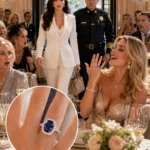
Then I looked at the ring on her right hand.
A blue diamond.
Six carats.
Custom setting.
My husband had terrible taste when he was trying to impress women without history.
“Not at all,” I said.
My voice sounded calm because I had spent three months bleeding privately so I could stand publicly without shaking.
Celeste blinked.
She expected tears.
So did Graham.
That was their first mistake.
“I know this is awkward,” she continued, lowering her voice just enough to make sure everyone leaned in.
“But Graham and I didn’t plan for it to happen this way.”
No one ever planned for betrayal to look cheap.
It simply did.
Graham finally spoke.
“Vivienne, don’t make a scene.”
There it was.
The command.
The warning.
The assumption that I was the dangerous one because I had been wounded.
I turned my head toward him.
“I haven’t said anything.”
His jaw tightened.
That was true, and truth made him uncomfortable.
Celeste touched his sleeve.
Possessive.
Performative.
Pathetic.
“I just think honesty is better,” she said.
“Graham has carried so much pressure for so long, and he needs peace now.”
Peace.
That was what men called betrayal when they wanted applause for abandoning the woman who survived them.
Patricia made a sound under her breath.
One of the older donors, Eleanor Vance, set her glass down with a quiet click.
Eleanor had known me since I was twenty-two and still wore grief like a second dress.Preview
She had been at my wedding.
She had watched Graham put a ring on my hand in St. Bartholomew’s while six hundred guests decided whether I looked more like a bride or a balance sheet.
“Peace,” I repeated.
Celeste smiled.
“Yes.”
I nodded once.
“That must be very important to you.”
“It is,” she said.
Then she delivered the line she must have practiced in a mirror.
“I’ll be taking over as Graham’s partner publicly after tonight.”
A small gasp moved through the room.
Not loud.
The wealthy rarely gasp loudly.
They inhale with judgment.
Graham did not stop her.
He stood there with my wedding ring still on his finger while his mistress announced my replacement at a ballet I had funded.
For a moment, I saw him as clearly as I had failed to see him for years.
Not powerful.
Not tortured.
Not trapped by expectations.
Just small.
A small man dressed in a beautiful tuxedo, standing beside a woman who thought proximity to cruelty was the same thing as power.
Celeste tilted her head.
“I hope you’ll make this transition graceful.”
Transition.
As if I were staff.
As if I were seasonal decor.
As if wives could be moved out with floral arrangements and donor plaques.
I looked past her, toward the stage doors.
The red velvet curtains were closed for intermission.
Soon they would rise.
So would the truth.
“I’ve always preferred grace,” I said.
Celeste looked victorious.
Graham looked wary.
He should have.
Because grace is not mercy.
Grace is control.
The chime sounded, calling guests back to the theater.
People began moving too quickly, desperate to escape the social accident but terrified to miss the aftermath.
Celeste leaned close as she passed me.
Her perfume was gardenia and ambition.
“Don’t worry,” she whispered.
“I’ll take good care of everything you couldn’t hold onto.”
I smiled then.
Not warmly.
Not kindly.
Just enough for her to wonder.
“Be careful what you accept from Graham,” I said.
“Most of it is borrowed.”
Her smile faltered.
Only for a second.
Then Graham placed his hand at the small of her back and guided her toward the aisle.
He used to touch me that way.
Like possession.
Like reassurance.
Like a man guiding a woman through a life he secretly planned to steal from her.
I waited until they disappeared into the theater.
Then I handed my untouched champagne to a passing waiter.
“Mrs. Hart?” he asked quietly.
I had known him for years.
His name was Mateo.
His daughter had once danced in the children’s corps because of a scholarship I funded anonymously.
“Are you all right?”
I looked at the closed doors.
Inside, three thousand people waited for the second act.
My husband thought the performance was onstage.
“No,” I said.
“Not yet.”
Part 2: The Theater My Grandmother Bought with Blood Money and Ballet Shoes
My maiden name was Marlowe.
In New York, the name opened doors quietly.
Whitmore opened them loudly.
That was the difference between old money that survived scandal and old money that needed constant applause.
My grandmother, Beatrice Marlowe, had bought the Harrington Theater in 1976 after the city nearly condemned it.
She was not sentimental.
She was a woman who wore pearls to hostile board meetings and fired men without raising her voice.
But she had loved ballet because her mother had scrubbed floors in a dance school on the Lower East Side, and sometimes little Beatrice had watched from the hallway while rich girls learned to become swans.
“She never got to dance,” my grandmother told me once.
“So I bought her a stage.”
When Beatrice died, people sent lilies and called her a titan.
They did not know she had left the theater to me through the Marlowe Cultural Trust.
They did not know I owned the land beneath the building, the naming rights, the restoration endowment, and thirty-eight percent of the Harrington Ballet’s voting patron board.
They did not know because my grandmother had taught me the most important rule of power.
Never wear all of it at once.
When I married Graham Whitmore, his family assumed I brought polish, connections, and the kind of money that did not need explaining.