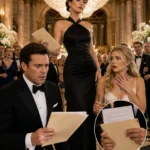
“Did he know Mrs. Vale objected?”
“Did he believe she would react publicly?”
“What did he hope would happen?”
Sloane’s voice dropped.
“He wanted her to become emotional in front of the cameras.”
“So he could use the footage in the competency petition.”
The courtroom was silent.
Julian’s attorney declined to cross-examine her.
On the fourth morning, Ethan told me there was another document.
We stood in a consultation room overlooking Foley Square.
He placed a sealed envelope on the table.
The paper was cream-colored and marked with my grandmother’s handwriting.
TO BE OPENED ONLY IF THE LARKSPUR CONVERSION IS CHALLENGED.
“What conversion?” I asked.
“The Mercer House debt is not the final hidden asset.”
I looked at the envelope.
“What did she do?”
“In 1998, Mercer Hospitality faced bankruptcy after Julian’s father expanded too quickly. Eleanor provided emergency capital through Larkspur.”
“I knew she invested.”
“She did not purchase ordinary debt.”
He opened a folder.
“She purchased convertible preferred interests.”
I read the first page.
The language was dense, but one number stood out.
Forty-one percent.
“Larkspur owns forty-one percent of the original Mercer Hospitality?”
“It owns the right to convert into forty-one percent upon fraud, insolvency, or a material breach involving Vale collateral.”
My pulse slowed.
“The forged resolutions.”
“And the unauthorized collateral pledge,” Ethan said. “Both qualify.”
I turned the pages.
When Vale and Mercer merged, those conversion rights had been rolled into the new company. Julian believed they had expired.
They had not.
Clause Seventeen gave me fifty-eight percent voting authority.
The Larkspur conversion would increase my control to seventy-four percent and eliminate almost all remaining Mercer family influence.
My grandmother had not merely protected the Vale fortune from Julian.
She had placed the Mercer empire beneath mine before I ever met him.
“Why reveal this now?”
“Julian’s attorneys are challenging Larkspur’s standing. That allows us to introduce the original conversion agreement.”
“And the letter?”
“Eleanor left instructions.”
I broke the seal.
Her handwriting remained unmistakable: severe, narrow, elegant.
If this letter has been opened, then either Julian has become the man I feared he might become, or you have become the woman I hoped you would be.
Perhaps both.
You will be angry that I concealed the extent of Larkspur’s position. Be angry. Anger is proof that you understand power should not be exercised invisibly without cause.
I did not purchase the Mercer debt to control your husband.
I purchased it because his father once tried to destroy your grandfather.
In 1987, Malcolm Mercer used confidential financing information to force Vale Hotels into a predatory refinancing agreement. Your grandfather survived the attack but lost two properties and much of his health. Malcolm called it business.
I called it education.
When Mercer Hospitality nearly collapsed eleven years later, Malcolm asked me for help. I gave it to him on terms he never read carefully because he believed a grieving widow could not understand corporate debt.
Men often sign their downfall while congratulating themselves on a woman’s ignorance.
I did not exercise the conversion while Malcolm lived. Revenge is satisfying, but stability feeds families. Thousands of employees depended on both companies.
I gave Julian an opportunity to build something honorable with you.
If he has chosen theft, humiliation, or domination instead, the choice was his.
Do not take Mercer House because you enjoy seeing him homeless.
Take it only if doing so protects those he endangered.
Do not keep the company because you fear losing the name.
Keep it only if you can make the name worth carrying.
And do not confuse becoming hard to destroy with becoming impossible to love.
The first will save you.
The second will become another prison.
Eleanor
For several moments, I could not speak.
Ethan looked toward the window, giving me privacy without leaving.
“She knew,” I said.
“She suspected.”
“About Malcolm.”
“Did Julian know his father attacked my family?”
“I don’t know.”
I folded the letter.
“Yes, he did.”
“How can you be certain?”
“Because Julian once told me my grandfather lacked the courage to survive modern financing.”
I had thought it was an abstract criticism.
It had been inherited contempt.
The courtroom reconvened at eleven.
Rebecca introduced the conversion agreement.
Julian’s lead attorney requested a recess.
The judge denied it.
For the first time during the hearing, Julian turned fully toward me.
His expression contained disbelief.
Then understanding.
Then hatred so pure it almost looked peaceful.
“You knew,” he said across the aisle.
The judge struck her gavel.
“Mr. Mercer.”
He ignored her.
“You knew about the conversion.”
I answered before Rebecca could stop me.
His mouth twisted.
“Liar.”
“I discovered it this morning.”
“You expect me to believe that?”
“I no longer care what you believe.”
He stood.
His attorneys pulled him down.
The judge ordered a fifteen-minute recess.
In the corridor, Julian broke away from his legal team and approached me.
Court officers moved forward.
He stopped six feet away.
“You’re taking my father’s company.”
“You pledged my family’s archive.”
“You set a trap.”
“My grandmother wrote an agreement. You committed fraud.”
“You think you built any of this?” His voice shook. “You hid in a basement touching old fabric while I turned your dying name into a global brand.”
“The Vale name financed every expansion.”
“I made it relevant.”
“You made it loud.”
People watched from both ends of the corridor.
Julian lowered his voice.
“Without me, you would still be Eleanor’s frightened little granddaughter.”
The words found an old wound.
For years, I had feared he was right.
I had believed Julian gave me courage because he enjoyed standing in front of me and calling the shadow protection.
Now I understood.
“I was never frightened of the world,” I said. “I was frightened of becoming a woman who disappointed people she loved.”
He laughed bitterly.
“Now I understand that disappointing you was the first honest thing I did.”
His face tightened.
“What happens to Mercer House?”
“It will be sold.”
“You can’t.”
“I can.”
“My family has lived there for ninety years.”
“The staff will receive pensions and severance. The remaining proceeds will satisfy the debt and restore the funds you removed from employee accounts.”
“You vindictive—”
I stepped closer.
“I could keep it. I could sleep in your mother’s bedroom, host parties beneath your family portraits, and let tourists drink champagne in the room where your father taught you to despise mine.”
His eyes burned.
“But I don’t want your house.”
The words struck harder than possession ever could.
“I want the people you harmed to be paid.”
For the first time, he had nothing to say.
The court issued its ruling the following Monday.
Clause Seventeen was valid.
The forfeiture stood.
The Larkspur conversion was enforceable.
Julian’s challenge to the trust was dismissed.
My forged signatures were referred for further criminal prosecution, along with the diverted funds, the Kells payments, and the concealed corporate loans.
The divorce settlement took another four months.
Julian surrendered all claims to Vale House, the archive, my inherited assets, and his remaining shares in the company. In exchange, I agreed not to pursue certain personal property acquired before the marriage.
I did not leave him poor.
I left him with exactly what he had brought into the marriage after legitimate debts were deducted.
The amount was smaller than the public imagined.
Men who look rich are often merely standing near assets owned by someone else.
Sloane returned the emerald earrings through counsel.
They arrived in a plain security box.
No note.
I placed them beside my grandmother’s portrait and did not wear them.
Some objects deserve time before they return to the living.
Nine months after the gala, Julian pleaded guilty to two financial crimes as part of a broader agreement. He avoided the longest possible sentence but lost his executive licenses, board positions, and access to the circles that had treated his confidence as competence.
Sloane accepted civil liability, surrendered the traceable assets, and testified in the criminal proceedings.
Her online following collapsed, then partially recovered.
The internet is rarely moral for long.
She eventually began speaking publicly about financial coercion and manipulative relationships. Some people believed her. Others did not.
I never commented.
Her story belonged to her.
My silence no longer belonged to anyone.
The company required rebuilding.
I reduced executive bonuses, restored the pension funds, sold two vanity properties, and appointed independent directors with authority that could not be removed by marriage or family name.
Naomi became president of the Vale Foundation.
The archive opened a paid conservation fellowship for students who could not afford unpaid museum work.
The Midnight Magnolia remained in its climate-controlled case.
Its damaged stitches were repaired.
The heritage seal remained inside the lining.
One year after the gala, I stood in the western vault while Naomi adjusted the final lighting for a public exhibition.
The title appeared on the wall:
WOMEN WHO LEFT INSTRUCTIONS.
My grandmother would have pretended to hate it.
She would secretly have loved every word.
Ethan entered carrying two cups of coffee.
He had waited until my divorce was final.
Then he waited another three months.
Not because he doubted me.
Because he wanted my loneliness to stop sounding like permission.
Our first kiss happened in the Vale House garden at the beginning of spring.
There were no photographers.
No diamonds.
No strategy.
He touched my face exactly as he had on the Aurelian rooftop and asked, “Are you choosing?”
“Yes,” I said.
Then I chose him.
Love with Ethan did not arrive like conquest.
It arrived as room.
Room to disagree.
Room to be silent.
Room to change my mind.
He did not rescue me from Julian.
He stood far enough away for me to see that I had rescued myself.
That was how I knew I could love him without disappearing.
He handed me the coffee.
“You’re staring at the gown again.”
“I’m thinking.”
“Dangerous.”
“My grandmother used to say that about men.”
“She was correct.”
We stood before the Midnight Magnolia.
Under the museum lights, the silver flowers appeared almost alive.
“Do you ever want to wear it?” Ethan asked.
“Because of what happened?”
“Because it has already done enough.”
Outside the vault, visitors moved through the exhibition. I heard young conservators explaining beadwork, labor history, and the women whose names had been omitted from fashion records for decades.
The archive no longer felt like a mausoleum.
It felt like a living house.
Ethan set his coffee aside.
“There is something I need to ask you.”
I raised one eyebrow.
He reached into his pocket.
He froze.
“You haven’t heard the question.”
“If you take out a diamond in front of my grandmother’s gown, she will haunt us both.”
His mouth curved.
“Fair.”
He removed his hand from his pocket.
“Dinner tonight?”
“That was the question.”
“You’re lying.”
“Absolutely.”
I laughed.
The sound rose into the vault, warm and unguarded.
Ethan took my hand.
The signet ring no longer felt heavy.
It felt like a key.
# CONCLUSION
## THE BEAUTY THAT REMAINED
We married the following autumn in the Vale House garden.
There were twenty-seven guests.
Naomi cried before the ceremony began and denied it afterward. Rebecca gave a toast in which she threatened to prosecute anyone who leaked photographs. Margaret Kell danced with the head gardener. The archive staff placed tiny silver magnolias on every table.
I did not wear a historic gown.
I wore one designed by a young woman from Detroit who had completed the first Vale conservation fellowship and used her award money to open an independent atelier.
The dress was ivory silk with no visible embroidery.
Inside the lining, she had stitched a single sentence.
Nothing beautiful requires your disappearance.
Ethan discovered it while helping me remove the gown after the reception.
He traced the words with one finger.
“You chose well.”
“The designer?”
“The sentence.”
“I chose that too.”
He looked at me with the quiet expression that still made the rest of the room feel less important.
“Yes,” he said. “You did.”
Mercer House sold the following winter.
A nonprofit arts school purchased it and converted the upper floors into housing for students. The ballroom where Julian’s father had once hosted financiers became a performance hall. The private dining room became a communal kitchen.
I attended the opening anonymously and stood near the back.
Children ran beneath the Mercer portraits.
Someone had placed a vending machine under Malcolm Mercer’s marble bust.
My grandmother would have laughed for a week.
Vale Hotels continued expanding, but slowly.
No more acquisitions made solely to impress magazines.
No more beautiful buildings purchased at the expense of invisible workers.
We measured success by occupancy, wages, preservation, and whether employees could afford to sleep in the cities where they worked.
It was less glamorous than Julian’s vision.
It was more profitable.
Two years after the gala, a reporter asked whether I regretted allowing Sloane to wear the Midnight Magnolia.
We were standing in the archive during the opening of a new exhibition.
Behind us, the gown rested beneath glass.
“I regret that she wanted to hurt me,” I said. “I regret that my husband believed humiliating me would make him powerful.”
“But do you regret not stopping them?”
I looked at the silver magnolias.
“Because people reveal themselves when they believe kindness has made someone defenseless.”
The reporter waited.
“And because?”
I smiled.
“Because my grandmother was very specific.”
That evening, after the visitors left, I returned to the vault alone.
The lights dimmed automatically around me.
For most of my life, I thought inheritance meant receiving what the dead had owned.
Money.
Property.
Names.
Obligations.
I was wrong.
The greatest thing Eleanor Vale left me was not a company, a house, or a garment.
She left me proof that preparation could be an act of love.
She could not prevent my heartbreak.
She could not choose my husband.
She could not force me to recognize betrayal before I was ready.
But she could leave locks.
She could leave evidence.
She could build a door inside the cage and trust that, one day, I would become brave enough to open it.
I touched the glass above the Midnight Magnolia.
Once, Sloane had asked whether I was too old to wear beauty.
I knew the answer now.
Beauty was never the gown.
Beauty was the moment a woman stopped begging those who wounded her to admit that she had bled.
Beauty was choosing truth without turning truth into cruelty.
Beauty was rebuilding the house without preserving the throne.
Behind me, the vault door opened.
Ethan stood there holding his coat over one arm.
“Ready?”
I looked once more at the gown.
Then I turned toward the man who had never asked me to become smaller in exchange for being loved.
He extended his hand.
I took it.
Together, we walked upstairs toward the light, leaving the Midnight Magnolia exactly where it belonged: preserved, protected, and finally free from those who had mistaken access for ownership.
My grandmother’s will forbade the gown from being worn by anyone outside her direct bloodline.
Caption: She wanted the dress. The dead woman left rules.
“`