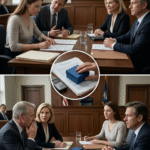
A murmur moved through the courtroom.
Odette testified next.
Preston’s attorney asked whether I had cried frequently after childbirth.
“She had just discovered her husband claimed to have another family,” Odette replied. “I would have been concerned if she ordered champagne.”
Even the judge struggled not to smile.
Then Preston took the stand.
He denied forging Ruth’s waiver.
He denied hiding the founder’s share.
He denied knowing anything about Julian Vale’s brakes or Elliot’s recovered airplane.
“Elliot Nadeir was a bitter, troubled man,” he said. “He could not accept that I transformed a failed workshop into a successful company.”
Josephine approached him.
“Who designed the modular support system that won your first state contract?”
“I don’t remember.”
“Who mortgaged his home to fund the prototype?”
“Who owned the patents?”
“The company.”
She placed the original documents before him.
“They were registered to Elliot Nadeir.”
Preston’s mouth tightened.
“Old paperwork does not build an empire.”
“No,” Josephine said. “People do.”
She displayed the photograph of Elliot and Preston beneath the NADEIR-CALLAWAY sign.
“Why was his name removed?”
“Branding.”
“Why was his voting proxy represented as permanent after it expired?”
“Administrative error.”
“Why did you create a forged waiver in Ruth Nadeir’s name?”
“I did not.”
“Why was Elliot’s missing plane photographed inside your company hangar?”
For the first time, Preston lost control.
He looked at Weston.
Not at his lawyers.
Not at Adele.
At Weston.
“You ungrateful fool,” he said.
The courtroom erupted.
The judge called for order.
Preston’s attorney requested a recess.
It was denied.
Josephine asked the question again.
Preston refused to answer on the advice of counsel.
Then Camille testified.
She told the court about Julian’s safety report, Theo’s surgery, Adele’s payments, and the false claim that Weston had fathered her child.
Adele stared straight ahead.
When Josephine played the recording from the church recorder, several board members seated in the gallery visibly recoiled.
Adele’s own voice described the plan to have me declared unstable.
Preston’s voice discussed preventing me from contacting Josephine.
Weston’s voice agreed to perform the rejection.
When the recording ended, the courtroom remained silent.
Adele requested permission to speak.
Against her attorney’s advice, she took the stand.
She admitted paying Camille but insisted it had been an act of compassion.
She described the hospital plan as an attempt to protect the company from confusion.
“Mrs. Callaway,” Josephine said, “did you instruct your son to claim another woman’s child as his own?”
“I told him to protect his family.”
“Was Sable not his family?”
“She was his wife.”
The distinction hung in the air.
“And Marlo?”
Adele’s lips tightened.
“A newborn cannot understand corporate responsibility.”
“Neither, apparently, can an adult.”
Preston’s attorney objected.
The judge sustained the objection but allowed Josephine to continue.
“Why did the child’s sex matter?”
“Because institutions require continuity.”
“Girls cannot provide continuity?”
“I did not say that.”
“You did in the hospital.”
Adele looked at me.
Her calm finally cracked.
“You think this is about one little girl?”
My entire body went still.
“This is about preserving what generations built,” she continued. “Men sacrificed their lives for that company.”
“Men like Elliot?” Josephine asked.
Adele said nothing.
“Men like Julian?”
Still nothing.
“Or only men named Callaway?”
Adele turned toward Weston.
“He was supposed to understand.”
Weston’s attorney called him next.
He walked to the witness stand with the measured steps of a man approaching his own sentence.
Josephine established that he had known about the plan, concealed information from me, and falsely claimed Theo as his son.
“Why?” she asked.
“To convince my parents I remained loyal.”
“Did you understand that your words would cause your wife severe emotional harm?”
“Did you believe you had the right to make that decision for her?”
“At the time, yes.”
“And now?”
“Do you claim Marlo as your biological daughter?”
His voice shook.
My breath caught.
“Do you seek parental control over the Nadeir trust?”
“Do you seek any beneficial interest through her?”
“Do you seek appointment as co-custodian?”
“Do you understand that this disclaimer may be permanent?”
Adele stood abruptly.
“Do not answer another question.”
The judge ordered her to sit down.
Weston looked at Marlo’s empty seat beside me, where the diaper bag rested.
His voice grew steadier.
“I claim the responsibility of having failed her mother.”
He looked at me.
“I claim the shame of what I said on the night she was born.”
Then he faced the judge.
**“But I claim no right to profit from the daughter I refused to hold.”**
Josephine entered his notarized disclaimer and transfer of personal shares into evidence.
Preston leaned toward his attorney, whispering furiously.
Weston’s lawyer then called Malcolm Reed.
Malcolm described Weston’s cooperation with federal investigators, the storage unit, the financial records, and the photograph of Elliot’s airplane.
He confirmed that federal authorities had reopened investigations into Julian’s death, financial fraud, witness intimidation, and obstruction.
Preston stared at his son with naked hatred.
“I gave you everything,” he said.
Weston turned toward him.
“You gave me a name and taught me to fear losing it.”
“You would be nothing without that name.”
Adele made a strangled sound.
Then she said the sentence that stopped everyone.
**“He is nothing because he is not even yours.”**
Preston froze.
Weston slowly turned toward her.
“What did you say?”
Adele realized too late that fury had broken the lock on another secret.
Preston rose.
“Be quiet.”
She laughed, but the sound was ragged.
“Why protect it now?”
“Adele.”
“You want bloodlines?” she demanded. “Tell him about blood.”
Weston stared at Preston.
“Am I your son?”
Preston’s silence answered.
Adele gripped the edge of the witness stand.
“I could not have children,” she said. “Not after the surgeries.”
Her voice became distant, almost dreamy.
“A young woman at one of our properties died during childbirth. She had no husband and no family willing to take the baby.”
Weston’s face emptied.
“You adopted me.”
“We saved you.”
“Who was my mother?”
“I don’t remember her name.”
The lie was obvious.
“You don’t remember?”
“You became a Callaway. That was all that mattered.”
Weston looked at the parents whose approval had governed his entire life.
“You built your legacy around blood,” he whispered. “And there was never a drop of it in me.”
Preston slammed his hand against the table.
“Names matter more than blood.”
“Then why did you destroy everyone who carried another one?”
No one answered.
The judge ordered another recess.
Before we left the courtroom, two federal agents approached Preston’s table.
They did not arrest him yet.
They handed his attorneys warrants covering company offices, residences, aircraft records, and private financial accounts.
For the first time since I had known him, Preston Callaway looked old.
The final ruling came three days later.
The court upheld the Nadeir founder’s share.
Ruth’s alleged waiver was declared fraudulent.
My appointment as emergency custodian was confirmed, and Weston’s disclaimer permanently barred him and all Callaway family entities from obtaining authority through marriage or paternity.
The judge ordered an independent audit and prohibited Preston and Adele from entering company property.
Outside the courthouse, reporters shouted questions.
I stepped to the microphones.
Preston had spent years teaching people that power required loudness.
I had learned the opposite.
“A company is not a throne,” I said. “It is a responsibility held in trust for every person whose labor keeps it alive.”
Cameras flashed.
“The name on a building does not prove who built it, and wealth does not turn theft into history.”
I thought of Elliot, Julian, Harold Pike, Camille, and thousands of employees whose retirement money had been treated as private Callaway property.
“Beginning today, every account will be audited, every stolen pension dollar will be restored, and every employee who reported wrongdoing will be invited to speak without fear.”
A reporter called out, “Will you change the company’s name?”
I looked up at the silver letters mounted across the tower.
“Yes,” I said.
Adele, standing several yards away, closed her eyes.
Preston was indicted two weeks later on charges connected to fraud, obstruction, and conspiracy in Julian’s death.
Adele was charged with witness coercion, falsifying medical evidence, and conspiracy to obtain trust assets.
The investigation into Elliot’s disappearance remained open.
Weston moved out of our Charleston home.
He did not ask me to return.
He provided a DNA sample confirming he was Marlo’s biological father, then signed every document necessary to preserve my sole control of the trust.
He saw Marlo once, at my request, in Josephine’s office.
Marlo was four months old.
Weston sat in a plain chair and waited while I held her.
“You may touch her hand,” I said.
“Only her hand?”
“For today.”
He extended one finger.
Marlo gripped it immediately.
Weston stopped breathing.
Tears rolled down his face without sound.
“Hello,” he whispered.
Marlo stared at him with the grave curiosity babies reserve for people whose sorrow they do not yet understand.
“I am your father,” he said.
He looked at me for permission before continuing.
“I was also the first man to fail you.”
I nearly told him not to place his guilt on a child.
Then he added, “I will spend the rest of my life making sure it is not your burden.”
Marlo released his finger and reached for the light reflecting from his watch.
Weston gave a broken laugh.
After ten minutes, I stood.
“That is enough.”
He did not argue.
At the door, he turned toward me.
“Do you believe I ever loved you?”
The question hurt because part of me still needed the answer.
Hope entered his face.
I ended it gently.
**“But love without trust can become another form of control.”**
“I understand.”
“I don’t think you did before.”
He left.
That evening, Josephine called.
“The sealed beneficiary schedule is ready to be opened,” she said.
“I thought the court already confirmed the trust.”
“It confirmed your authority as custodian.”
“What remains?”
“The identity of the beneficial owner.”
“I assumed it was me.”
“So did the Callaways.”
A strange unease moved through me.
“When do we open it?”
“Tomorrow.”
“Where?”
“Elliot’s original workshop.”
“I thought it was demolished.”
“So did Preston.”
The next morning, Josephine drove Odette, Marlo, and me to an abandoned industrial road north of Charleston.
Weston followed in a separate car because Josephine said his presence had been requested in Elliot’s instructions.
At the end of the road stood a brick warehouse hidden behind pine trees.
The faded outline of old lettering remained above the doors.
NADEIR-CALLAWAY ENGINEERING.
Josephine unlocked the building.
Inside, dust floated through shafts of morning light.
Old drafting tables, machine tools, and metal cabinets stood exactly as they had decades earlier.
On one wall hung photographs of Elliot beside bridges, factories, and construction crews.
It was the life Preston had erased.
Josephine placed the sealed trust schedule on a worktable.
Before she opened it, we heard a sound from the rear of the warehouse.
A cane struck concrete.
Once.
Then again.
A man stepped from the shadows.
He was thin, silver-haired, and older than the face in my memory.
A pale scar crossed his forehead.
His left leg dragged slightly when he walked.
I stopped breathing.
Odette whispered my name.
The man looked at Marlo, then at me.
His eyes were the same warm brown eyes that had watched me graduate from college and walked me down the aisle after my mother died.
“Hello, Sable,” he said.
The warehouse tilted around me.
He stopped several feet away.
“I’m sorry.”
My knees weakened.
Weston caught the back of a chair but did not touch me.
I stared at the man whose funeral I had attended nine years earlier.
“Uncle Elliot?”
His mouth trembled into a smile.
**“Reports of my death were useful,” he said. “But not entirely accurate.”**
## PART FIVE — THE CHILD WHO INHERITED THE TRUTH
For several seconds, no one moved.
Marlo made a soft sound against my chest, unaware that a dead man had just walked into the morning.
I crossed the warehouse slowly.
Then I struck Elliot across the face.
The sound echoed among the old machines.
He did not defend himself.
“You let me bury you,” I said.
“You let me grieve.”
“You knew I was pregnant.”
“You knew what they were doing to me.”
“Not until the final weeks.”
I struck his chest with both hands.
“You could have called.”
“If Preston learned I was alive, every person helping me would have been exposed.”
“I was your family.”
“That is why I stayed dead.”
I began sobbing.
The grief I had carried for nine years returned, collided with relief, and became something too large for my body.
Elliot opened his arms but did not move toward me.
I entered them only because I could no longer stand alone.
He held me carefully around Marlo.
“I am sorry,” he whispered into my hair.
I stepped back.
“Sorry is becoming the favorite word of men who decide what women are allowed to know.”
Weston looked away.
Elliot accepted the rebuke.
“You are right.”
Josephine brought chairs to the old worktable.
We sat beneath a row of dusty windows while Elliot told us what had happened.
Nine years earlier, he had discovered that Preston was using the company pension fund to finance private developments.
Elliot intended to expose him and reclaim the founder’s share before the temporary proxy expired.
Two nights before he was scheduled to meet federal investigators, someone tampered with his plane.
The engine failed shortly after takeoff.
Elliot survived by bringing the aircraft down in shallow coastal water.
A fisherman found him before Callaway security teams arrived.
“Why was the plane later in their hangar?” Weston asked.
“Preston’s men recovered it before federal authorities reached the site,” Elliot said. “They believed I had died in the crash.”
“Why let them believe it?”
“Because Josephine had already discovered two witnesses who died after threatening Preston.”
Julian had not been the first.
Elliot entered protective custody and began working with investigators to trace the money Preston had moved through foreign accounts.
The fake funeral protected the investigation.
The sealed coffin protected the lie.
“I thought the case would take months,” Elliot said. “Then Preston buried records, bought witnesses, and changed political friends whenever pressure approached.”
“It took nine years,” I said.
“And you never sent me a message?”
“I sent Josephine.”
“She called me about paperwork.”
“She could not tell you more until the trust activated.”
I looked at Josephine.
“Because Elliot’s survival was tied to an active federal investigation,” she said. “Any unauthorized disclosure could have endangered him and invalidated years of work.”
“So everyone protected me by lying.”
Elliot closed his eyes.
I looked at Weston.
“Apparently it is contagious.”
Elliot turned toward him.
“You were not instructed to tell her you had another child.”
Weston’s expression hardened with shame.
“What were you instructed to do?” I asked.
Elliot answered.
“To sign the disclaimer and separate his financial identity from yours before Marlo’s birth.”
“Why the performance in the hospital?”
Weston spoke quietly.
“My mother expected me to break you before she arrived with the agreement.”
“You could have refused.”
“If I refused openly, she would have known I had turned against them.”
“She would have moved the company money before the trust vested. She might also have acted against you.”