“So you decided to give her what she wanted.”
“The lie about Camille?”
“My idea.”
Elliot studied Weston.
“You bought fourteen hours,” he said.
“I thought that was enough.”
I stared at them both.
They spoke about those hours like soldiers discussing a bridge destroyed during war.
To me, those hours contained the birth of my child and the death of my marriage.
“Was all of this necessary?” I asked.
No one answered immediately.
Finally, Elliot said, “The legal separation was necessary.”
“The cruelty?”
Weston’s face tightened.
Elliot continued.
“He believed your pain would make your refusal absolute.”
“It did.”
“He believed your anger would keep you from trusting Adele.”
“He believed being hated by you was safer than being loved by you.”
“And was it?”
“No,” he said. “It was easier for me.”
The answer surprised me.
He continued before I could speak.
“If I had told you, I would have had to watch you choose danger with open eyes.”
“I was too afraid to let you be brave.”
Not heroism.
Not sacrifice alone.
Fear.
Weston had loved me, but he had not believed love required equality.
He had believed his terror entitled him to become the author of my life.
“I may understand you someday,” I said. “That does not mean I will return to you.”
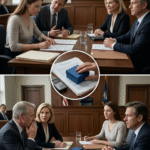
Elliot placed his hand on the sealed trust schedule.
“There is one truth none of you know.”
Josephine broke the wax seal.
Inside was a single cream-colored page.
She handed it to me.
The legal language was brief.
The founder’s share, including fifty-one percent of voting authority in Callaway Holdings, had vested at 12:01 on the morning after the live birth of my first child.
I read the beneficiary’s name.
Then I read it again.
It was not mine.
It was not Weston’s.
It was not Elliot’s.
**BENEFICIAL OWNER: THE FIRST LIVING CHILD BORN TO SABLE RUTH NADEIR.**
My arms tightened around Marlo.
“She owns it?”
Elliot smiled.
“Every share.”
“I’m only the custodian.”
“You are her trustee, guardian, and voting representative until she reaches thirty years of age.”
Weston stared at Marlo.
Adele and Preston had spent months fighting me for control of a company that had never become mine.
They had rejected the person who owned it.
“Why leave an empire to a baby?” Odette asked.
“Because adults had already proved what they would do for it,” Elliot said.
He looked at Marlo.
“A child created time.”
“I don’t understand.”
“Preston could intimidate partners, buy directors, pressure spouses, and manipulate courts. But he could not negotiate with someone who could not yet speak.”
Elliot tapped the trust schedule.
“The ownership could not be sold, pledged, transferred, or merged during Marlo’s minority.”
“Even by me?”
“Even by you.”
Relief moved through me.
Elliot had not handed me unlimited power.
He had given me a duty with boundaries.
“What if Weston had signed the birth certificate?” I asked.
“He would have been eligible to petition as co-trustee.”
Weston nodded.
“That was the path my parents wanted.”
“Your disclaimer closed it,” Josephine said.
“And the hospital rejection?” I asked.
“Legally unnecessary,” Elliot replied. “Strategically useful, perhaps, but morally his own decision.”
Weston absorbed the judgment without protest.
I appreciated Elliot for refusing to turn him into a martyr.
“What happens to the company now?” Odette asked.
“That is for Sable to decide as trustee,” Elliot said.
I looked around the workshop where the company had truly begun.
Machines rusted beneath tarps.
Elliot’s drawings remained stacked in cabinets while Preston’s portrait hung in a marble lobby across the city.
“No,” I said. “It is not only for me.”
“We form an employee advisory council.”
She nodded.
“We restore the pension fund before distributing executive bonuses.”
“Agreed.”
“We create independent safety oversight.”
“We compensate Julian’s family and every whistleblower Preston punished.”
Elliot’s eyes shone.
“And the name?” he asked.
I thought of Callaway Holdings.
Removing the name entirely would have satisfied my anger.
Keeping it unchanged would have preserved a lie.
“We tell the whole history,” I said. “Both names.”
Three months later, new letters were installed across the tower.
NADEIR-CALLAWAY GROUP.
Beneath them, a bronze plaque named Elliot as co-founder and listed the engineers, laborers, accountants, and early employees whose work had built the company.
Preston’s portrait was moved from the lobby to an evidence archive.
His criminal case expanded after Elliot testified.
Adele accepted a plea agreement that required her to admit the medical conspiracy and her coercion of Camille.
She lost her foundation positions, her social influence, and the carefully maintained reputation she had valued more than people.
Camille became director of the company’s new ethics office.
Some employees objected because she had participated in the deception.
She agreed with them.
“I cannot undo what I did,” she said at her appointment hearing. “But I know what fear looks like when it arrives wearing the face of generosity.”
Her honesty persuaded more people than innocence would have.
Theo’s medical trust was placed under independent supervision.
Elliot moved into a small house near Odette’s home.
I did not forgive him quickly.
Some mornings, we drank coffee together and spoke about Marlo.
Other days, I could not bear to look at him.
He never demanded that relief erase grief.
That patience slowly repaired what secrecy had damaged.
Weston resigned from the company board.
He took a position with a nonprofit that helped employees report corporate fraud, though he refused all publicity.
He visited Marlo under an agreement we created together.
At first, the visits lasted fifteen minutes.
Then thirty.
He learned to warm bottles, change diapers, and walk the floor when she refused to sleep.
He never referred to his surrender of shares as a gift.
He never asked me to praise him for doing what should have been done.
When Marlo was nine months old, he sat beside her on Odette’s living room rug.
She crawled toward him, pulled herself upright using his knee, and said her first clear word.
“Da.”
Weston covered his face.
Odette began crying.
I stood in the doorway with my arms folded, but tears reached my eyes too.
Marlo slapped Weston’s knee.
“Da,” she repeated impatiently.
He lowered his hands.
“Yes,” he whispered. “I’m here.”
Later, after Marlo fell asleep, Weston and I walked beneath the live oaks.
Summer insects hummed in the grass.
“I filed the final divorce papers,” I told him.
He stopped walking.
“I received them.”
“I need the marriage to end.”
He nodded slowly.
“I don’t know what happens years from now.”
“I won’t ask.”
“I loved you.”
“Part of me may always love you.”
His eyes filled, but he remained silent.
“That part is not enough to build a marriage on,” I said.
“You taught me that love can exist beside fear, secrecy, and terrible decisions.”
“I wish I hadn’t.”
“So do I.”
We continued walking.
At the road, he touched my arm lightly.
“May I tell you one thing?”
“The night Marlo was born, when you said it was the last moment I would ever get, I believed you.”
“It nearly was.”
“I went outside and vomited behind the hospital loading dock.”
Despite myself, I laughed.
He smiled sadly.
“My father found me there.”
“He told me weakness was expensive.”
“And what did you say?”
“I told him he had no idea what it was about to cost him.”
I looked toward Odette’s house, where Marlo slept safely beneath an open window.
“You were right.”
“No,” Weston said. “You were.”
On Marlo’s first birthday, we held a small gathering in Elliot’s restored workshop.
Employees had transformed part of the building into a museum and training center.
Children ran between old drafting tables while music played beneath the steel rafters.
Camille came with Theo.
Josephine brought a cake shaped like a stack of books because she said every heir should inherit stories before money.
Weston arrived without a suit, carrying a wooden box.
He asked my permission before giving it to Marlo.
Inside was the moon he had carved for her nursery.
The listening device had been removed.
Across the back, he had carved a new sentence.
MAY NO ONE EVER MAKE YOU SMALL ENOUGH TO FIT INSIDE THEIR FEAR.
I traced the words.
“It’s beautiful,” I said.
“I almost burned it.”
“I’m glad you didn’t.”
Elliot tapped a glass and asked everyone to gather near the original company sign.
He held Marlo while Josephine presented the first annual report of the trust.
Pension losses had been restored.
Executive compensation had been reduced.
Safety complaints had tripled, which Camille called good news because it meant employees finally believed they could speak.
Profits had dipped, then stabilized.
For the first time, the company’s annual report listed the beneficial owner.
MARLO NADEIR, AGE ONE.
The room applauded.
Marlo tried to eat the corner of the report.
Elliot laughed.
“She already has opinions about paperwork.”
As sunset entered through the high windows, I stood beneath the faded sign where two young men had once believed they could build something lasting.
One of them had tried to own the future.
The other had finally learned to entrust it to someone new.
Weston joined me, keeping a respectful distance.
“Do you ever wonder what would have happened if I had held her that night?” he asked.
“Every day.”
“I do too.”
I looked at Marlo in Elliot’s arms.
“She might have grown up inside the Callaway structure.”
“My parents would have fought for control.”
“And you?”
“I would have spent years believing I could protect her while remaining part of the machine that threatened her.”
He watched Marlo smear icing across Elliot’s collar.
“She saved me from becoming my father.”
“No,” I said. “You chose not to become him.”
“That distinction matters.”
“It always does.”
A delivery woman entered carrying a long package addressed to me.
There was no return name.
Inside was an old framed photograph.
It showed Elliot, my mother Ruth, Josephine, and a group of early workers standing before the original workshop.
On the back, my mother had written a message in blue ink.
SABLE, SOMEDAY THEY MAY TELL YOU POWER BELONGS TO THE PERSON WHOSE NAME IS ON THE DOOR.
REMEMBER THAT DOORS ARE BUILT BY HANDS WHOSE NAMES ARE OFTEN FORGOTTEN.
Under her message was a recent line in Adele’s handwriting.
I AM SORRY I SPENT MY LIFE GUARDING A NAME THAT NEVER GUARDED ANYONE.
I showed the photograph to Elliot.
He studied Adele’s words for a long time.
“Do you believe her?” I asked.
“I believe prison gives people time to meet themselves.”
“That isn’t the same as change.”
I turned the picture over again.
Taped beneath the frame was a small envelope.
Inside was a copy of Preston’s original birth certificate.
He had not been born Preston Callaway.
His name at birth had been Preston Wade.
His father was listed as unknown.
A notation showed that he had legally taken the Callaway name at twenty-three after marrying Adele.
I stared at the page.
All his speeches about blood, generations, and inheritance had been built around a name he had married into.
Elliot read the document over my shoulder.
Then he began to laugh.
Not cruelly.
Sadly.
Weston approached.
When he saw the certificate, he closed his eyes.
“He knew,” he said.
“Of course he knew,” I replied.
“He called me nothing because I was adopted.”
“He was no more born a Callaway than you were.”
Elliot shook his head.
“Preston did not protect his bloodline.”
He looked across the workshop at Marlo.
“He protected the story that made him feel less afraid.”
I folded the certificate and returned it to the envelope.
For years, one frightened man had forced thousands of people to live inside his invention of himself.
He had buried a partner, stolen a company, controlled a wife, deceived a son, endangered workers, and rejected a newborn girl to preserve a lineage that had never existed.
Marlo squealed across the room.
She had pulled the paper birthday crown from her head and placed it on Theo.
Everyone laughed.
No one corrected her.
I watched my daughter clap for the little boy the Callaways had once used as a counterfeit heir.
The sight brought a peace I had not expected.
Neither child knew what had been done in their names.
Perhaps that was our greatest victory.
We could tell them the truth without teaching them the hatred.
Weston stood beside me.
“What will you tell Marlo about the night she was born?” he asked.
“The whole story.”
“Even what I said?”
“Especially what you said.”
“She should know that people can fail her.”
“And that they can change?”
“That will depend on what you do next.”
He accepted the answer.
Across the workshop, Elliot lifted Marlo high above his head.
Sunlight surrounded her small body.
Her laughter rose into the rafters where the old company name had once gathered dust.
On the night of her birth, powerful people had looked at her and seen an obstacle, a girl, an inconvenience, and a threat to their imagined future.
They had believed refusing her would erase her.
They had believed a name could determine her value.
They had believed an empire belonged to the loudest man in the room.
**They were wrong about all of it.**
Marlo had entered the world without property, language, status, or even a father’s signature.
Yet before she survived her first night, she had done what generations of adults could not.
**She had broken the Callaway dynasty simply by being born.**
I crossed the room and took my daughter into my arms.
Her fingers found the hospital bracelet I had tied around my wrist.
She pulled at it until I removed it.
For one year, I had carried that bracelet as proof of the moment Weston refused her.
I placed it inside the wooden box beneath the moon he had carved.
Then I closed the lid.
Some memories must be preserved.
Others must be denied the power to remain open forever.
Marlo leaned against my shoulder and watched the people gathered in the workshop her family had reclaimed.
Not the family defined by blood.
Not the family protected by money.
The family formed by truth, responsibility, and the difficult courage to repair what love alone could not save.
“Happy birthday,” Weston whispered to her.
Marlo reached toward him.
I allowed him to take her.
He held her with both arms, carefully and without entitlement.
This time, he did not look toward a camera, a lawyer, a parent, or a document.
He looked only at his daughter.
“I remember the moment,” he told her.
“I will remember it for the rest of my life.”
Marlo touched his face.
Then she turned toward me and smiled.
Beyond the windows, workers were removing the last silver CALLAWAY letters from the old warehouse wall.
Beneath them, the original name had survived in faded paint.
NADEIR.
Elliot stood beside me, watching the past emerge.
“What do you see?” he asked.
I looked at my daughter in Weston’s arms.
I looked at Theo beneath his paper crown.
I looked at Odette, Josephine, Camille, and the employees whose names would no longer be erased.
Then I looked at the empty space waiting beside the old lettering.
**“Not an empire,” I said.**
**“A beginning.”**