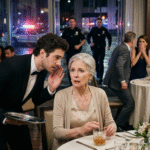
Instead, I walked into the light.
A murmur rose through the room.
Sloane stood near the stage stairs.
Her smile disappeared.
Celeste gripped the edge of her table.
Behind me, the giant screen displayed the gold Whitmore Crown crest.
For years, I believed the crest belonged to Graham.
At that moment, I understood that symbols belong to whoever survives them.
“Good evening,” I said.
The room quieted.
“Fourteen years ago, this company opened its first hotel in a building with no roof, no heat, and more ambition than money.”
A few longtime executives smiled.
“We believed luxury was not marble, champagne, or a famous address.”
“We believed luxury was the feeling of being safe inside a beautiful room.”
I paused.
“Tonight, that principle matters to me more than ever.”
Graham stood at the back of the ballroom.
He had removed his identification pin.
Without it, he looked less like a founder and more like a guest who had arrived under false pretenses.
“This evening, the board of Whitmore Crown Hospitality accepted the resignation of Graham Whitmore as chief executive officer.”
The room erupted in whispers.
Cameras lifted.
Sloane turned toward him.
He did not move.
“For the immediate future, I will serve as executive chair while the board conducts a search for new leadership.”
The whispers grew louder.
Celeste stood.
“This is outrageous.”
Her voice carried across the ballroom.
Every camera turned toward her.
I looked at the woman who had worn my pearls while helping her son erase me.
“Please sit down, Celeste.”
She did.
Not because I was louder.
Because the security team beside the doors was waiting for my instruction.
I continued.
“The company remains financially strong.”
“Our hotels will remain open.”
“Our employees will be paid.”
“Our partners will be protected.”
That was what power sounded like.
Not revenge.
Continuity.
I did not mention the affair.
I did not mention the stolen money.
I did not mention the mistress standing in gold with my husband’s ring on her finger.
I did not need to.
The truth was already moving through the ballroom faster than I could have spoken it.
When I stepped off the stage, reporters crowded near the velvet barrier.
Margaret and security guided me toward a private corridor.
Sloane followed.
Her voice cracked.
I stopped.
Up close, she looked younger than she had at the luncheon.
Not innocent.
Simply unprepared.
“What did you do?” she asked.
“I protected my company.”
“You destroyed Graham.”
“He made decisions.”
“You waited for him to fail.”
I looked at the diamond on her hand.
“I waited for him to finish proving what he was willing to do.”
Her eyes filled with tears.
“He told me you had no relationship.”
“That is what married men tell women who need permission.”
“He said you stayed because of the money.”
I almost laughed.
Instead, I said, “Whose money?”
She looked away.
From the ballroom came the noise of hundreds of people pretending not to watch us.
Sloane lowered her voice.
“The baby is his.”
“I did not ask.”
“He has a right to build a family.”
“He already had one.”
“He was miserable.”
“Then he should have left before entering your bed.”
Her face tightened.
“You think you are better than me.”
I stepped closer.
“I think you knew I existed.”
For the first time, shame reached her.
Only briefly.
Then fear replaced it.
“What happens to the apartment?”
“The Manhattan apartment?”
She nodded.
“It is leased by the company.”
Her hand moved toward her throat.
“And the Palm Beach house?”
“Mine.”
“The jet?”
“Also not his.”
She looked toward Graham.
He was speaking urgently to his mother near the ballroom entrance.
Everything Sloane thought she had won was being inventoried around her.
“He said we would live at the estate,” she whispered.
“Graham says many things in houses he does not own.”
I walked away.
In the private elevator, Margaret handed me a sealed envelope.
“We received the medical records subpoena response.”
“The pregnancy?”
“The pregnancy is real.”
I felt no relief and no new pain.
“And the paternity?”
“Not yet established.”
“Then why the envelope?”
“She underwent fertility treatment.”
My eyes lifted.
Margaret continued carefully.
“The records show an embryo transfer six weeks before Graham claims their relationship became physical.”
I stared at her.
“Whose embryo?”
“We do not know.”
“Does Graham?”
“That is the question.”
The answer arrived twenty minutes later.
Graham found me in the presidential suite.
He entered without knocking before security could stop him.
His bow tie hung open.
His face was pale with fury.
Margaret stood near the desk.
Two guards waited outside.
“You humiliated me in front of the world,” he said.
“You announced our separation to investors before telling our daughter.”
“I had not announced anything.”
“You planned to tonight.”
He stopped.
I saw confirmation in his eyes.
The gala speech had included more than the Avalon expansion.
He had intended to present Sloane publicly.
Possibly as his fiancée.
Possibly as the future Mrs. Whitmore.
“You had no right to remove me,” he said.
“The board disagreed.”
“The board belongs to you.”
“The company belongs to its shareholders.”
“Do not speak to me like an attorney.”
“Then stop behaving like a defendant.”
He crossed the room.
“You think this makes you powerful?”
“I think ownership makes me powerful.”
His face twisted.
For one dangerous second, I saw the man beneath the tailoring.
Then he noticed the envelope in Margaret’s hand.
“What is that?”
I watched his expression carefully.
“Sloane’s fertility records.”
He froze.
Not confusion.
Recognition.
“You invaded her medical privacy.”
“The records were obtained through a lawful court process related to misuse of corporate funds.”
Margaret placed the envelope on the table.
“The company paid the clinic.”
Graham looked toward the door.
“She needed help.”
“With whose child?”
He turned back to me.
“That is none of your business.”
“You charged the treatment to my company.”
His mouth tightened.
“The child is mine.”
“Then why did the treatment begin before your affair?”
Silence.
Margaret studied him.
I suddenly understood.
“You knew,” I said.
Graham looked away.
The truth came together slowly and then all at once.
Sloane had not become pregnant by accident.
The pregnancy had been planned before Graham claimed their relationship began.
Perhaps before he even decided to leave me.
The baby was not the consequence of a reckless affair.
It was part of the strategy.
“Why?” I asked.
His answer was almost too quiet to hear.
“My mother wanted an heir.”
I stared at him.
“You have a daughter.”
“She wanted a grandson.”
The cruelty of it struck deeper than the affair.
Lily, with Graham’s gray eyes and stubborn chin, had not been enough for the Whitmores.
Celeste had wanted a boy to carry the name Sloane was asking me to return.
“And Sloane agreed?”
“She wanted a child.”
“With you?”
He hesitated.
Margaret’s eyes narrowed.
“Mr. Whitmore, whose genetic material was used?”
He said nothing.
I felt the room become very cold.
“The embryo was created before I met her.”
The words fell heavily.
“Sloane had frozen embryos with her former fiancé.”
I remembered the man.
Andrew Hale, a surgeon from Boston.
Their engagement had ended two years earlier.
“Does Andrew know?” I asked.
“Does Sloane know you told everyone the child is yours?”
“She agreed.”
“Why?”
“Because we were building a family.”
My voice remained calm, but something inside it changed.
“You were building an announcement.”
He looked at me with exhausted contempt.
“You would never understand.”
“Explain it.”
“My mother’s trust releases the Greenwich property and family investments when a male Whitmore heir is born.”
Margaret went still.
There was the second theft.
Not from me.
From his own family documents.
Graham and Celeste intended to present Sloane’s child as a biological Whitmore heir in order to trigger a trust distribution.
“You were going to commit trust fraud,” Margaret said.
“The child would have been raised as mine.”
“That is not the same thing.”
“It would have harmed no one.”
“Your daughter,” I said.
He looked at me.
“You erased your daughter for property.”
“I did not erase Lily.”
“You told her another woman would make change exciting.”
His eyes shifted.
He had not expected me to know about Christmas.
“She told you.”
“She is twelve.”
“She misunderstands things.”
“She understands you perfectly.”
For the first time that night, Graham looked ashamed.
It arrived too late to matter.
Margaret picked up her phone.
“The family trustees need to be notified.”
Graham stepped toward her.
The guards entered the room.
“Claire, listen to me.”
I almost smiled at the change in his voice.
For months, I had been unreasonable, distant, vindictive, and irrelevant.
Now I was Claire again.
“Do not involve Lily in this,” he said.
“You involved her when you decided she was not the right kind of heir.”
His face collapsed.
Not fully.
Men like Graham rarely collapsed all at once.
They lost themselves room by room.
First the company.
Then the money.
Then the name.
Then the child who once believed them.
Security escorted him out.
At the door, he turned.
“Did you ever love me?”
The question was cruel in a new way.
It asked me to prove the past while he stood inside its ruins.
“Yes,” I said.
“That is why you had so much to steal.”
PART FIVE: THE NAME SHE COULD NOT TAKE
The divorce filing became public Monday morning.
By noon, every major financial newspaper had reported Graham’s removal.
By evening, photographs from the luncheon appeared online.
One showed Sloane leaning across the table.
Another showed me smiling.
The caption beneath it read:
SHE WANTED THE NAME CLEAN.
THE WIFE WANTED THE ACCOUNTS CLEAN.
The line spread across Facebook, Instagram, and every corner of the internet where women shared stories about men who underestimated them.
People invented dialogue.
They exaggerated the diamonds.
They called me an ice queen, a genius, a victim, and a villain.
I ignored all of it.
Real revenge is administrative.
It arrives through certified mail.
It appears as frozen accounts, canceled keys, and signatures witnessed by people who charge by the hour.
The emergency court hearing took place in New York.
Graham entered through the front steps with three attorneys.
Sloane used a side entrance.
Celeste did not attend.
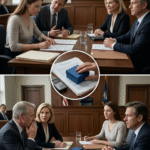
Margaret and I sat at the petitioner’s table beneath fluorescent lights that made everyone look more honest than they were.
Graham’s attorneys argued that the corporate transfers were legitimate.
They argued that the postnuptial agreement was unfair.
They argued that my control of the family trust gave me an unreasonable advantage.
The judge listened.
Then Margaret presented the recordings, the invoices, the shell-company documents, and Graham’s signed acknowledgment of the misconduct clause.
She did not raise her voice.
She did not insult him.
She simply placed the truth in chronological order.
That was enough.
The court upheld the temporary freeze.
The Manhattan apartment returned to the company.
The Palm Beach house remained with the Ellison Trust.