The Fifth Avenue townhouse was confirmed as my separate property.
Graham received access to a personal account containing less than he had spent on Sloane in one year.
The yellow diamond was classified as a corporate asset pending further review.
Sloane removed it before leaving the courthouse.
I never saw her wear it again.
Custody was harder.
Money can be traced.
Damage to a child hides in pauses.
Lily refused to see Graham for six weeks.
I did not encourage her refusal.
I also did not force forgiveness for the comfort of adults.
A family therapist helped us build careful boundaries.
Graham received supervised visits at first.
He hated the condition.
He hated that a professional sat in the room while he tried to explain why he had missed her winter concert to attend a fertility appointment with another woman.
Lily did not cry during that conversation.
She had inherited my stillness.
That frightened me more than tears.
After one session, she climbed into the car and stared out the window.
“Dad said he never wanted to replace me.”
“What did you say?”
“I told him wanting is not the same as doing.”
Twelve years old.
Already learning the cost of adult language.
I took her hand.
“You are allowed to love him.”
She leaned against the seat.
“I know.”
“You are also allowed to be angry.”
“And none of this happened because you were not enough.”
Her fingers tightened around mine.
“Grandmother wanted a boy.”
“Your grandmother was wrong.”
“Dad wanted the money.”
“Your father was weak.”
She looked at me.
“Do weak people know they are weak?”
“Usually after the strong people stop carrying them.”
The trust investigation moved quietly.
Andrew Hale was informed that Sloane had transferred one of their embryos.
He filed his own legal action.
A private paternity test confirmed that Graham was not the biological father.
The child was a boy.
The Greenwich trust did not release.
Celeste lost the property months later because she had borrowed against expenses she expected the trust to cover.
She moved into a smaller house in Rye and stopped attending luncheons.
She returned my grandmother’s pearls through an attorney.
No note.
No apology.
I had them restrung for Lily.
Sloane gave birth in a private hospital overlooking the East River.
For two days, reporters waited outside.
Graham did not appear.
Andrew did.
I learned this from Margaret, not the newspapers.
Sloane had contacted Andrew after the paternity results.
Whatever passed between them belonged to their child, not to me.
I felt no triumph at the hospital photographs.
A baby had entered a story created by frightened, selfish adults.
He deserved better than our scandal.
Months later, Sloane wrote to me.
The envelope arrived at the hotel office with no return address.
Her handwriting was precise.
I owe you an apology, though I understand apologies do not erase choices.
Graham told me you had never loved him.
He said you controlled him through money and that the marriage existed only for appearances.
I believed him because it allowed me to become the heroine of a story in which I was actually helping him betray his wife and daughter.
I should have known better.
I did know better.
I asked you for a name I had not earned.
I am sorry.
Sloane
I read it twice.
Then I placed it in a drawer.
I did not answer.
Forgiveness is not always a conversation.
Sometimes it is the decision to stop carrying someone’s ugliness into your next room.
Graham fought the divorce for eleven months.
He challenged the trust.
He appealed the board decision.
He accused Margaret of conspiracy.
He hired a publicist who described him as the visionary founder forced out by a vindictive heiress.
The story lasted four days.
Then a former executive released photographs of the first hotel’s closing documents.
My signature appeared on every page.
My trust’s wire transfer appeared beside it.
A photograph showed twenty-eight-year-old Graham holding a ceremonial key.
I stood behind him in jeans, construction dust on my coat, smiling as though his dream had become ours.
The publicist resigned.
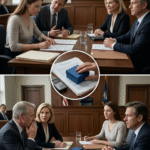
The final settlement was signed in a private conference room overlooking the Hudson.
Graham looked older.
Not dramatically.
Just accurately.
His hair had silvered at the temples.
The expensive suit no longer created authority around him.
It merely fit.
Margaret sat beside me.
His attorney placed the final documents on the table.
Graham signed first.
Then he pushed the papers toward me.
Our marriage ended beneath the sound of pen against paper.
No music.
No shouting.
No final confession.
When I finished signing, he remained seated.
“Are you changing your name?” he asked.
It was the question beneath everything.
The luncheon.
The ring.
The public humiliation.
The empire.
He still wanted to know what I would do with the word he thought belonged to him.
His expression shifted.
“Sloane does not want it.”
“She is using Mercer.”
“Good.”
He glanced toward the windows.
“What will happen to the company?”
“It will grow.”
“Under the Whitmore name?”
“For now.”
He looked almost relieved.
Then I added, “The board approved a rebrand.”
His eyes returned to mine.
“What rebrand?”
“Ellison Crown Hospitality.”
The silence between us was different from the silence at the luncheon.
That one had contained shock.
This one contained recognition.
He finally understood.
The name he used to define the empire had never been the foundation.
It was only the sign above the door.
“You’re erasing me,” he said.
I closed the folder.
“I’m removing a false attribution.”
His face tightened.
“I built those hotels.”
“You helped build them.”
“I gave that company everything.”
“So did I.”
“But you get to keep it.”
“I protected it.”
He looked at me for a long time.
“Was there ever a moment when you would have forgiven me?”
The honest answer surprised us both.
Hope moved briefly across his face.
“Before Sloane?”
“Before the money.”
It disappeared.
The affair had broken my heart.
The fraud had revealed his.
He nodded once.
Then he asked the question I knew he had rehearsed.
“What do I do now?”
Fourteen years earlier, I would have answered.
I would have made a plan.
Called someone.
Moved money.
Opened a door.
That had been my role in his life.
The unseen woman who turned disasters into temporary inconveniences.
“You learn what your life costs when I am not paying for it.”
I left him in the conference room.
Outside, the afternoon light stretched across the river.
Margaret joined me near the elevators.
“How do you feel?” she asked.
“Quiet.”
“That is not a feeling.”
“It is today.”
The elevator doors opened.
Before stepping inside, I removed my wedding ring.
I expected the gesture to hurt.
It did not.
The mark beneath it was pale but already fading.
CONCLUSION: THE ROOMS THAT BELONGED TO ME
One year after the luncheon, I returned to Charleston.
The first hotel stood beneath live oaks near the harbor.
Its shutters were painted dark green.
Jasmine climbed the brick courtyard walls.
The roof no longer leaked.
The ballroom floor held.
We renamed it Ellison House.
On opening night, Lily stood beside me in a pale blue dress wearing her great-grandmother’s pearls.
She was taller than I remembered.
Children grow even while adults are busy surviving.
The guest list included hotel employees, local artists, longtime investors, and women receiving grants from the new Ellison Foundation for Financial Independence.
The foundation provided legal assistance, temporary housing, and financial education to women leaving marriages complicated by hidden debt or economic control.
I did not create it because every betrayed wife owned hotels.
Most did not.
I created it because every woman deserved to know what was signed in her name.
During the reception, Thomas approached with two glasses of champagne.
“The quarterly numbers are excellent,” he said.
“Margaret already sent them.”
“Of course she did.”
He handed me a glass.
“Do you miss him?”
The question was gentle.
I looked across the courtyard.
Lily laughed with two school friends near the fountain.
Employees carried trays beneath strings of warm lights.
Music drifted through the open ballroom doors.
I thought about Graham.
He now worked as a consultant for a boutique development firm in Denver.
He rented an apartment.
He saw Lily twice a month.
Their relationship remained careful, imperfect, and real.
He had apologized to her without asking for immediate forgiveness.
That mattered.
Sloane moved to Boston with her son.
Andrew shared custody.
She had not become Mrs. Whitmore.
Neither had anyone else.
“Sometimes I miss who I believed he was,” I said.
Thomas nodded.
“That is not the same as missing him.”
It was not.
Later that evening, Lily and I walked through the hotel after the guests left.
The ballroom chandeliers had been dimmed.
Moonlight entered through the tall windows.
Near the staircase hung a restored photograph from the original opening.
Graham held the key.
I stood behind him, smiling.
Lily stopped.
“Why did you keep this?”
“Because it happened.”
“You could have taken him out.”
“I could have.”
“Why didn’t you?”
I studied the young woman I had been.
She looked happy.
Not foolish.
Not weak.
Happy.
“I do not want to punish her for loving someone.”
Lily slipped her arm through mine.
“Are you happy now?”
I looked around the ballroom.
Every light, deed, contract, and decision belonged where it should.
But that was not why the answer was yes.
I was happy because I no longer needed anyone to misunderstand my strength in order to feel loved.
“I am.”
The next morning, I stood alone on the hotel balcony while the city woke beneath me.
Church bells rang in the distance.
The harbor shone silver under the early sun.
My new passport had arrived the day before.
The name printed inside was Claire Ruth Ellison.
My own name.
My grandmother’s name.
The name I had before Graham gave me his and decided that meant he could take everything attached to mine.
I thought back to Sloane at the luncheon.
Her sharp eyes.
Her diamond ring.
The soft voice she used to ask me to disappear politely.
What she never understood was that I had been the one cleaning it for fourteen years.
I cleaned it after Graham’s failed investments.
I cleaned it after his father’s debts.
I cleaned it in boardrooms, banks, construction sites, and magazine interviews.
I carried it through every room until he forgot the rooms belonged to me.
In the end, I gave the name back.
I kept the hotels.
I kept the company.
I kept the house, the evidence, the trust, and the future.
Most importantly, I kept the part of myself that did not beg to be chosen by a man who had already chosen badly.
His mistress once asked me to return his last name.
I smiled and told her the truth.