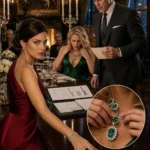
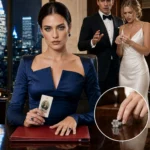
The cameras caught my husband squeezing his mistress’s hand three seconds before I accepted the award that saved his company’s reputation.
Graham Vale sat at the front table beneath a chandelier worth more than most homes, dressed in a midnight Brioni tuxedo and wearing the expression of a man who believed consequences were things that happened to poorer people.
Beside him sat Sloane Mercer, the company’s thirty-two-year-old vice president of public relations.
She was sitting in my chair.
Her fingers were laced through my husband’s beneath the white linen tablecloth, but not far enough beneath it to escape the camera mounted near the stage.
When the announcer said my name, Graham tightened his grip on her hand.
Sloane tilted her face toward him with a private smile.
Then she looked directly at me.
She did not flinch.
She wanted me to see.
The ballroom of the Larkmont Hotel glittered with old money, political influence, and the kind of polished cruelty that never raised its voice.
Six hundred guests applauded as I walked toward the stage.
Governors, surgeons, investors, board members, television anchors, and women wearing diamonds that required armed security all rose to their feet.
They believed they were honoring the devoted wife who had rescued her husband’s collapsing healthcare empire.
They did not know that my marriage had already ended.
They did not know that my attorney was waiting in the private library upstairs.
They did not know that the voting control of Vale Meridian Health no longer belonged to the Vale family.
Most importantly, Graham did not know.
I reached the podium and placed both hands beside the crystal award.
The applause softened.
Behind me, a screen displayed my name in gold letters.
EVELYN ROWAN VALE.
RECIPIENT OF THE 2026 NATIONAL ETHICS AND LEADERSHIP MEDAL.
I looked across the ballroom at the man I had loved for fourteen years.
Graham’s hand had disappeared from view, but Sloane’s smile remained.
I thanked the medical teams who had refused to stay silent.
I thanked the families who had trusted us with their grief.
I thanked the board members who had chosen transparency over protection.
Then I paused.
Every camera moved closer.
“I would also like to thank every woman who has survived public humiliation without kneeling,” I said.
A silence moved through the ballroom like cold air beneath a locked door.
May you like
Sloane’s smile weakened.
Graham’s jaw tightened.
I lifted the award.
“And finally, I would like to thank my husband for making my next chapter obvious.”
The room stopped breathing.
Graham stood so quickly that his chair struck the marble floor.
I smiled at him for the last time as his wife.
Then the giant screen behind me changed.
The company logo vanished.
In its place appeared a single sentence.
EFFECTIVE AT MIDNIGHT, EVELYN ROWAN VALE WILL ASSUME CONTROLLING OWNERSHIP OF VALE MERIDIAN HEALTH.
That was the moment Graham finally let go of his mistress’s hand.
It was already too late.
PART ONE — THE WOMAN IN MY CHAIR
Four hours earlier, Graham had watched me fasten a pair of diamond earrings in the mirror of our Manhattan penthouse and told me not to embarrass him.
He said it casually.
That was his favorite form of cruelty.
The cruelest things Graham said were delivered while checking his cuff links, answering emails, or choosing a bottle of wine.
“Tonight matters to the company,” he said.
I studied his reflection.
He looked exactly as he had on our wedding day, only more expensive and less human.
His black hair was threaded with silver at the temples, and age had sharpened rather than softened his face.
“You mean the company I kept out of federal receivership?” I asked.
He adjusted his collar.
“I mean my family’s company.”
The lie landed between us with the ease of a well-practiced habit.
Vale Meridian had carried his surname for nearly eighty years, but surnames were not the same as ownership.
That distinction would become very important before midnight.
Graham crossed the bedroom and reached for the watch I had given him on our tenth anniversary.
The engraving on the back read, THROUGH EVERY STORM.
I almost laughed.
For three years, I had mistaken endurance for loyalty.
I had believed that staying calm made me strong.
In truth, I had been standing inside a burning house, congratulating myself for not coughing.
“Where is Nora?” he asked.
The question came nine days after our eleven-year-old daughter’s school recital.
He had missed it.
“She’s staying with my sister tonight.”
“Good.”
He did not ask whether Nora had been nervous before going onstage.
He did not ask whether she had played well.
He did not know she had looked toward the empty seat beside me after every song.
Graham sprayed cologne onto his wrist.
The scent had once meant home to me.
Now it reminded me of the guest suite at the Halcyon Club, where Sloane’s perfume had been found on one of his shirts.
He caught me watching him.
“What?”
“Nothing.”
That answer had become my armor.
Nothing was safer than the truth when the truth was still being organized into exhibits.
Graham checked his phone and turned the screen away too late.
Sloane’s name appeared above a message.
I’M WEARING THE RED ONE.
He deleted the notification.
“You should leave before me,” he said.
“Why?”
“Photographers are downstairs, and separate arrivals create more coverage.”
“We arrived together last year.”
“Last year we weren’t managing an international reputation campaign.”
I placed my lipstick into a silver clutch.
“Is that what we’re calling it?”
His eyes hardened.
“Do not start something tonight, Evelyn.”
I had once wondered what Graham would do if I confronted him.
Would he apologize?
Would he deny it?
Would he blame me?
By then, I knew the answer.
He would do whatever protected his comfort.
Men like Graham did not fear losing their wives.
They feared losing the version of themselves their wives made possible.
I had made him look loyal.
I had made him look intelligent.
I had made him look like a man worthy of inheriting an empire.
For more than a decade, I had stood one step behind him in photographs while quietly correcting the mistakes that could have destroyed him.
When Vale Meridian’s surgical robotics division falsified safety reports, Graham wanted to call it a data discrepancy.
I called the families first.
When three regional hospitals concealed infection outbreaks, Graham wanted confidential settlements.
I demanded an independent investigation.
When the Justice Department opened its inquiry, Graham disappeared to Aspen with Sloane and told the press he was consulting overseas stakeholders.
I spent eighty-six days rebuilding the company’s compliance system.
I met grieving parents in hospital conference rooms.
I sat beside nurses who had been threatened with termination for telling the truth.
I convinced the board to create a nine-hundred-million-dollar compensation fund.
I testified under oath for seven hours.
By the time the investigation ended, Vale Meridian had survived.
More importantly, the patients had finally been heard.
The award being presented that night was not for saving a corporation.
It was for refusing to save it with lies.
Graham had called the award “useful publicity.”
The first time I saw proof of the affair was forty-two days before the gala.
I had entered his home office looking for Nora’s passport.
On his desk sat a cream envelope from a private jeweler on Madison Avenue.
Inside was an invoice for a ruby bracelet.
The piece had cost eighty-four thousand dollars.
The delivery address belonged to Sloane.
Beneath the invoice was a handwritten card in Graham’s familiar slanted script.
FOR THE WOMAN WHO MAKES ME FEEL LIKE MYSELF AGAIN.
I did not cry.
Not then.
I returned the papers exactly as I had found them.
Then I walked into the bathroom, turned on the shower, and sat on the marble floor fully dressed.
I stayed there until the water became cold.
My grief did not arrive as screaming.
It arrived as arithmetic.
Fourteen years of marriage.
Eleven years since Nora’s birth.
Thirty-six missed dinners in the previous year.
Nine business trips Sloane had also attended.
One bracelet.
One lie too many.
When I finally stood, I looked at myself in the mirror.
My mascara had not moved.
Neither had my face.
Something inside me had shattered so cleanly that no one could see the broken edges.
That night, Graham came home at one in the morning.
He kissed my forehead and told me the board meeting had run late.
Sloane’s red lipstick marked the inside of his collar.
I helped him remove his coat.
Then I asked whether he wanted coffee.
He smiled, relieved by my obedience.
“Yes.”
I made it exactly the way he liked it.
While the machine warmed, I forwarded the jeweler’s invoice to a secure account.
The next morning, I hired Naomi Pierce.
Naomi was a divorce attorney whose reputation caused wealthy men to rediscover religion.
She had silver hair, a quiet voice, and no patience for theatrical pain.
We met in the private reading room of a library on the Upper East Side.
I expected her to ask whether I was certain.
Instead, she placed a legal pad between us.
“What does he think you know?” she asked.
“Keep it that way.”
I looked down at my wedding ring.
“What should I do first?”
Naomi uncapped her pen.
“Stop thinking like his wife.”
That was the beginning.
By the night of the gala, I had become very good at it.
Graham left the penthouse without kissing me.
I waited seven minutes before following.
Downstairs, photographers shouted my name as I stepped into the waiting car.
The driver closed the door, and the city disappeared behind tinted glass.
My phone vibrated once.
A message from Naomi appeared.
EVERYTHING IS SIGNED.
I typed back one word.
PROCEED.
When I arrived at the Larkmont, the ballroom looked like a jewel box designed by people who had never been denied anything.
White orchids spilled from crystal vases.
A string quartet played beneath a ceiling painted with angels.
Champagne moved through the room on silver trays.
The Vale family occupied the front table.
Graham’s mother, Lenora, wore black velvet and an emerald necklace that had belonged to three generations of unhappy women.
His father, Charles, had the stiff posture of a man who believed wealth was evidence of virtue.
Neither of them stood when I approached.
Lenora’s gaze traveled over my gown.
“You wore silver,” she said.
“It was the requested color.”
“White would have photographed more softly.”
“Then I’m fortunate I didn’t wear white.”
Her lips tightened.
Charles glanced around me.
“Where is Graham?”
“I assumed he was with you.”
Lenora lifted her champagne.
“He has been under enormous pressure.”
“So have the families whose children died.”
Her glass stopped halfway to her mouth.
“We are not discussing that tonight.”
“No,” I said.
“Tonight, you’re receiving an award because I did.”
Charles leaned closer.
“You should remember that your public role exists because of this family.”
I smiled.
“And you should remember that families are not corporations.”
At the time, he thought I was making a philosophical point.
I was not.
A photographer called us toward the step-and-repeat wall.
Lenora slipped her arm through mine.
Her grip was firm enough to bruise.
“Whatever problems exist between you and Graham,” she murmured, “you will not damage this family in public.”
I faced the cameras.
“Of course not.”
The flashbulbs burst.
“I would never take what belongs to you.”
That was also true.
I only intended to take what belonged to me.
Twenty minutes before dinner, an event coordinator hurried toward our table with panic in her eyes.
“Mrs. Vale, there seems to be an issue with the seating chart.”
I looked past her.
Sloane had arrived in a red silk gown.
The fabric clung to her body with deliberate precision.
At her wrist glittered the ruby bracelet.
She crossed the ballroom as though she had been invited to inherit it.
Graham met her beside the table.
He placed a hand at the small of her back.
The gesture lasted less than a second.
It lasted long enough.
The event coordinator lowered her voice.
“Mr. Vale requested that Ms. Mercer be seated beside him for press coordination.”
“My name is on that chair.”
“And where would he like me to sit?”
The young woman swallowed.
“There is an open place at Table Twelve.”
Table Twelve was near the service doors.