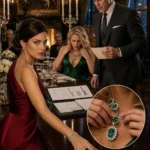
It was where junior donors and assistants were placed when someone important canceled.
Graham approached before she could say more.
“This is only for the first course,” he said.
Sloane stood behind him, making no effort to hide her satisfaction.
“You moved your wife from the head table at her own award ceremony?” I asked.
“It’s a company table.”
“The award has my name on it.”
“This is exactly the kind of emotional reaction I was trying to avoid.”
His voice was low, but Charles and Lenora heard every word.
Neither intervened.
Sloane touched Graham’s sleeve.
“I can move.”
Her tone was soft and generous.
Her eyes were not.
Graham turned toward her immediately.
“No, you need to stay close in case the press needs a statement.”
I looked at the four of them.
My husband.
His mistress.
His mother.
His father.
They expected me to absorb the insult because I always had.
They expected elegance to make me harmless.
I turned to the event coordinator.
“Please leave the seating arrangement exactly as Mr. Vale requested.”
Relief crossed Graham’s face.
He mistook my calm for defeat.
“Thank you,” he said.
I leaned closer and straightened his bow tie.
“You should enjoy your seat.”
Then I walked to Table Twelve.
PART TWO — AN EMPIRE BUILT ON BORROWED GOLD
I met Graham Vale when I was twenty-nine and still believed powerful men were less dangerous when they loved you.
We were introduced at a hospital foundation dinner in Boston.
I was a healthcare attorney investigating billing fraud.
He was the charming heir to a medical network with a smile that made strangers feel chosen.
He asked me to dance before dessert.
I declined.
He sent coffee to my office the next morning.
I returned it.
He sent another cup the next day with a note.
I ADMIRE CONSISTENCY.
I sent it back with my own note.
THEN CONSISTENTLY STOP.
He laughed when he told that story years later.
He called it proof that I had challenged him from the beginning.
What he never understood was that I had not been playing hard to get.
I had been trying to avoid him.
Graham pursued me for six months.
He attended public lectures I gave.
He donated to the legal clinic where I volunteered.
He learned my mother’s favorite flowers and sent them to her hospital room during her final round of chemotherapy.
He made kindness look effortless.
My mother, Margaret Rowan, watched him carefully.
She had built her career as a cardiothoracic surgeon in rooms where men assumed her silence meant permission.
She was not easily impressed.
After Graham left her room one evening, she looked at me and said, “He enjoys winning.”
“That doesn’t make him cruel.”
“No.”
She turned toward the rain against the hospital window.
“But someday, losing might.”
My mother died three months before our wedding.
At the funeral, Graham held my hand through the entire service.
I remember thinking that I would never be alone again.
Grief makes promises on behalf of people who never agreed to keep them.
We married at St. Catherine’s Church in Newport.
The ceremony appeared in three society magazines.
My dress had been sewn by hand in Paris.
The Vale family hosted eight hundred guests at their oceanfront estate.
Lenora changed the flowers without telling me because she said white roses looked more appropriate than my mother’s peonies.
Charles gave a speech about welcoming me into a dynasty.
No one mentioned that my mother had once saved that dynasty from bankruptcy.
In 1998, Vale Meridian had been a regional hospital chain drowning in debt.
My mother developed a minimally invasive cardiac valve technique that attracted investors, research grants, and national attention.
She accepted stock instead of a traditional licensing fee.
Charles Vale offered her twelve percent of the company.
She negotiated for twenty-two.
Over the following years, she acquired more shares through a private holding trust.
She never advertised her stake.
She said public recognition was expensive and rarely worth the bill.
When she became ill, she transferred her voting rights into the Rowan Legacy Trust.
The trust documents remained sealed under the management of Bellweather Fiduciary Partners.
I knew about the original shares.
I did not know how much they had grown.
Six months after my wedding, Bellweather sent a representative named Samuel Ortiz to meet me.
He was a patient man with kind eyes and a habit of aligning every document perfectly with the edge of the table.
“Your mother structured the trust in an unusual way,” he explained.
“She wanted you to receive dividends, but not voting control, until one of three conditions occurred.”
He pushed a page toward me.
“The death or permanent incapacity of Charles Vale.”
“The sale of Vale Meridian.”
“Or a documented ethical crisis that threatened the company’s mission.”
I frowned.
“What would qualify as an ethical crisis?”
Samuel met my eyes.
“Your mother left you the authority to decide.”
At twenty-nine, I thought using that power would be a betrayal of my marriage.
I signed the acknowledgment and placed the documents in a bank vault.
For more than a decade, I never invoked the clause.
I let Graham believe the trust contained sentimental shares with no real influence.
I let the Vale family call me fortunate.
I let Lenora remind me that I had married above my station.
I let Charles introduce me as “Graham’s capable wife” to men who had once requested private consultations with me.
Silence can be dignity.
It can also become participation.
The first real fracture in our marriage appeared after Nora was born.
I nearly died during delivery.
A hemorrhage began before dawn.
The hospital room filled with blue gowns, stainless steel instruments, and voices trying not to sound afraid.
Graham stood beside my bed until his phone rang.
It was Charles.
A lender in London wanted to discuss an acquisition.
Graham kissed my forehead and stepped into the hallway.
He did not return for three hours.
When I woke after surgery, my sister Rachel was holding my hand.
Graham was on television in the corner of the room, announcing the largest hospital purchase in company history.
He came back that evening carrying roses.
“You understand,” he said.
I did.
That was the problem.
I understood every absence.
I translated every cruelty.
I softened every selfish choice until it became ambition, pressure, legacy, or duty.
Graham loved Nora when loving her was photogenic.
He attended birthday parties with professional photographers.
He carried her onto private jets.
He posted photographs from ski trips he left after one day.
At home, he did not know the name of her piano teacher.
He once asked whether she was still allergic to shellfish.
She had never been allergic to shellfish.
I managed the family calendar, the staff, the charitable foundation, and every emergency Graham created.
He managed the appearance of command.
Then came the deaths at St. Anne’s Medical Center.
Seven patients developed fatal infections following procedures involving Vale Meridian surgical equipment.
Internal reports showed the sterilization alerts had been ignored.
A compliance officer named Marisol Vega had warned executives three months earlier.
Her report disappeared.
She was demoted.
When the story reached the press, Graham called an emergency meeting at our penthouse.
Charles wanted to blame an outside supplier.
Lenora wanted to express sympathy without accepting liability.
Sloane, who had recently been promoted, presented a thirty-page reputation strategy.
The word “patients” appeared twice.
The word “brand” appeared forty-seven times.
I closed the report.
“This is not a messaging problem.”
Sloane smiled at me.
“With respect, Evelyn, every corporate crisis becomes a messaging problem.”
“Seven people are dead.”
“And if the company collapses, sixty thousand employees lose their jobs.”
Graham nodded.
“She has a point.”
That was the first time I saw how he looked at her when he thought no one noticed.
His expression contained admiration, hunger, and relief.
Sloane offered him a world without moral weight.
She made cowardice sound strategic.
I made consequences impossible to ignore.
Within a week, more documents surfaced.
The equipment defect had been known.
Charles had approved delays in the recall.
Graham had signed an executive summary without reading the attached safety report.
Sloane advised them to discredit Marisol.
When I confronted Graham, he paced across our bedroom.
“You have no idea what it takes to protect a company this size.”
“I know what it takes to protect a patient.”
“This company supports our life.”
I pointed toward the city beyond the glass.
“It supports your identity.”
He stopped.
For one second, something cold and unguarded appeared in his face.
“You would be nothing without the Vale name.”
The sentence was quiet.
That made it unforgettable.
The next morning, I activated my mother’s ethical-crisis clause.
Samuel Ortiz came to my office with three locked cases of documents.
The Rowan Legacy Trust held thirty-eight percent of Vale Meridian’s voting shares.
That alone did not give me control.
However, my mother had included another provision.
During an ethical crisis, the trust could purchase any emergency preferred shares issued to stabilize the company.
Graham needed two billion dollars to prevent lenders from seizing Vale Meridian’s assets.
Traditional investors demanded control.
I offered the money through a private entity called Northstar Clinical Partners.
Graham never asked who owned Northstar.
He saw the capital and signed.
Northstar received fourteen-point-four percent of the voting shares.
Combined with my trust, I held fifty-two-point-four percent.
Samuel placed the final transfer document in front of me.
“Once this is executed, you will control the company.”
I stared at the signature line.
My mother had built the door.
Graham had handed me the key.
I signed.
For the next seven months, I kept my ownership confidential while the investigation unfolded.
I forced the company to cooperate.
I restored Marisol’s position and placed her in charge of independent compliance.
I removed three executives.
I negotiated the compensation fund.
I met with regulators before Graham could mislead them.
Public trust slowly returned.
The board began speaking to me before speaking to him.
The stock recovered.
Vale Meridian survived.
Graham received congratulatory calls.
Sloane received a bonus.
I received an award.
By then, Graham had begun sleeping with her.
The affair was not a single betrayal.
It was an alliance.
He gave her access to company strategy.
She gave him a version of reality in which I was the enemy.
Together, they began planning my removal.
They believed the woman saving them was too heartbroken to protect herself.
They were wrong.
PART THREE — THE FILE BEHIND THE CHAMPAGNE WALL
At Table Twelve, I was seated between a pediatric surgeon from Denver and the widow of a senator.
Neither asked why the guest of honor had been moved away from her husband.
People in elite rooms were trained not to acknowledge blood until it stained the carpet.
From my seat, I could see Graham laughing at something Sloane whispered.
Her hand rested near his.
The ruby bracelet flashed each time she lifted her champagne.
Lenora watched them with disapproval but no surprise.
That mattered.
A wife always discovers the affair last, but she is rarely the last person to know.
Three weeks after finding the jeweler’s invoice, I had visited Lenora at the Vale estate in Greenwich.
The mansion sat behind iron gates on thirty acres of winter gardens.
Portraits of dead Vale men covered the library walls.
Their wives appeared only in group paintings.
Lenora poured tea into porcelain cups brought from France.
“You look tired,” she said.
“So does Graham.”
“He has always worked too hard.”
“He has been spending a great deal of time with Sloane.”
The teapot remained perfectly still in her hand.
“Public relations is demanding.”
“Is adultery part of the job description?”
Lenora set down the pot.
For the first time that afternoon, she looked directly at me.
“Lower your voice.”
“There is no one else in the room.”
“There is always someone listening in a house like this.”
I almost smiled.
She had no idea how right she was.
“Did you know?” I asked.
Lenora turned her wedding ring.
Her emerald was larger than mine.
It had not made her happier.
“Men under pressure sometimes seek uncomplicated companionship.”
The words were so polished that they had clearly been inherited.
“You mean women who ask nothing of them.”
“I mean women who understand their place.”
“And what is my place?”
“Beside your husband.”
“Even while he is in someone else’s bed?”