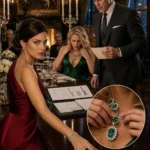
Sloane had stood in the second row wearing champagne silk.
Now I understood why she had smiled.
Grant crossed his arms.
“I did not come here to argue.”
“Then why did you come?”
His expression softened with practiced sorrow.
“I came because we need to discuss what happens next.”
There it was.
Not remorse.
Logistics.
He had rehearsed this conversation somewhere, perhaps while Sloane chose calligraphy for my door.
“I assume Sloane already has a schedule,” I said.
“You don’t have to be cruel.”
I looked at him.
It takes a remarkable kind of man to bring his mistress into his wife’s family suite and then complain about cruelty.
“I want a divorce,” he said.
Behind him, my father’s heart monitor continued its measured rhythm.
“And Sloane?” I asked.
“She deserves a chance to be happy.”
I nearly laughed.
“So do you.”
“Yes.”
“And I don’t?”
He looked almost offended.
“You have everything.”
That was the moment the last tender thing inside me went quiet.
Not when I saw the hotel photographs.
Not when I heard the recordings.
Not when I discovered the apartment.
It happened when my husband looked at me beside my sick father and decided my pain did not count because I had money.
He believed comfort canceled betrayal.
He believed wealth meant I could not bleed.
“You’re right,” I said.
Grant blinked.
He had expected resistance.
“I have everything.”
He studied my face.
“You’re agreeing?”
“I’m saying I understand.”
Relief loosened his shoulders.
For a fraction of a second, he looked grateful.
That was when I knew he had no idea what was coming.
“I want this handled privately,” he said.
“Of course.”
“No public fight.”
“Certainly not.”
“We can release a statement after the Mercer Foundation gala.”
The gala was twelve days away.
Grant was scheduled to announce the acquisition of three boutique hotels in Boston, Charleston, and Napa.
The purchase depended on a nine-figure credit facility secured by Ashford Capital.
Without my family’s guarantee, the deal would collapse.
Grant assumed the guarantee had already been signed.
It had not.
“What statement do you suggest?” I asked.
He hesitated.
“That we separated with mutual respect.”
“Mutual respect.”
“And Sloane?”
“We will not confirm anything immediately.”
“How considerate.”
His eyes narrowed.
“Evelyn, I’m trying to protect your dignity.”
“No, Grant.”
I looked toward the orchids.
“You are trying to schedule it.”
He left ten minutes later.
He kissed my forehead again because the nurse was watching.
At the door, he turned.
“Please tell Matthew to stop embarrassing Sloane.”
I met his gaze.
“She embarrassed herself.”
His mouth tightened.
Then he walked away.
My father opened his eyes after the door closed.
“He thinks you will negotiate,” he said.
My father gave a faint smile.
“You will inventory.”
PART TWO — GOLD LETTERS AND PAPER KNIVES
The next morning, I met my attorney in the private dining room of the Ashford Club.
The club occupied the top three floors of a building my grandfather bought before Midtown learned to look upward.
No sign marked the entrance.
The elevators required a brass key.
Inside, men who publicly claimed to hate privilege drank forty-year whiskey beneath portraits of their grandfathers.
My attorney, Vivian Cole, was waiting beside the windows.
Vivian was fifty-six, silver-haired, and incapable of wasting a sentence.
She wore navy wool, no visible jewelry, and the expression of a woman who had already read everyone’s lies before breakfast.
On the table sat three leather folders.
“Tell me you did not confront him,” she said.
“I informed him I knew.”
“That is not what I asked.”
“I did not show him evidence.”
She opened the first folder.
“Our investigator confirmed the affair began fourteen months ago.”
“Before the vow renewal.”
“Three months before.”
The fact landed without surprise.
Pain becomes quieter when it has somewhere useful to go.
Vivian slid a photograph toward me.
Grant and Sloane were entering a brownstone on East Seventy-Third Street.
The building had been purchased through an LLC called Lark House Holdings.
The registered manager was one of Grant’s college roommates.
The down payment had come from Mercer Hospitality.
“Company apartment?” I asked.
“Officially, it is a corporate hospitality residence.”
“Unofficially?”
“Sloane lives there.”
Another photograph showed Grant carrying grocery bags through the front door.
In our own home, he had not entered a grocery store in seven years.
I placed the photograph back on the table.
“What else?”
Vivian opened the second folder.
“Unauthorized transfers.”
“How much?”
“Eleven point four million dollars over eighteen months.”
Even I needed a moment.
“From where?”
“Mercer Hospitality’s development reserve.”
“That reserve contains Ashford investment capital.”
“Sixty-eight percent of it.”
I looked toward the skyline.
Grant had not simply betrayed me.
He had financed the betrayal with money held under a restricted investment agreement.
“What did he use it for?”
“The brownstone.”
She turned a page.
“Jewelry.”
Another page.
“Travel.”
Another.
“A design consulting contract paid to Bennett Creative Studio.”
“Sloane’s company?”
“Formed six weeks before the first payment.”
“Three point two million.”
“For what services?”
“The invoices say emotional brand architecture.”
I stared at Vivian.
She stared back.
“That is not a legally recognized construction material,” she said.
Despite myself, I smiled.
She opened the third folder.
“This is more serious.”
Inside was a copy of our prenuptial agreement.
Grant had signed it three days before our wedding.
At the time, he had joked that the document was longer than our vows.
He had also insisted he would never take anything from me that I did not freely give.
The prenup protected all Ashford family assets.
It also contained a marital misconduct clause Grant’s attorney had aggressively negotiated because he believed it would reassure my father.
If either spouse committed adultery and used marital or protected business assets to support the affair, the unfaithful spouse waived all claims to trust distributions, marital appreciation tied to family capital, and certain equity grants.
Grant’s ownership in Mercer Hospitality had begun at forty-nine percent.
Over the years, performance awards increased it to fifty-eight.
Or so he believed.
The equity grants contained clawback provisions tied to fraud, misuse of restricted funds, and reputational harm.
Together, the prenup and shareholder agreement formed something Grant had apparently forgotten existed.
A trap made entirely of his own signatures.
“He loses the appreciation,” I said.
“Based on current valuation, approximately eighty-three million dollars.”
I felt no triumph.
Only clarity.
“And the company?”
Vivian folded her hands.
“Your family trust currently owns thirty-four percent directly.”
“I know.”
“Ashford Capital’s convertible note can be triggered by financial misconduct.”
“How much would it convert to?”
“An additional twenty-two percent.”
Fifty-six percent.
Control.
Grant had built Mercer Hospitality using my family’s money, my family’s hotel portfolio, and my family’s reputation.
He called himself self-made in interviews.
I had allowed the myth because I loved him.
Love had made me generous with credit.
It would not make me careless with control.
“Can we trigger conversion before the gala?” I asked.
“We can trigger it today.”
“Don’t.”
Vivian’s brows lifted.
“He is planning to announce the acquisitions.”
“The lenders believe Ashford Capital will guarantee the facility.”
“You want him onstage when he discovers it will not.”
I met her gaze.
“I want every person he misled to be in the room.”
Vivian closed the folder.
“That is not revenge.”
“It is disclosure with excellent lighting.”
My phone vibrated.
SLOANE BENNETT.
I had never spoken to her privately.
Her message contained a photograph of a gold plaque mock-up.
Beneath it, two roses curved around each other like a wedding emblem.
SLOANE: I know this may feel emotional for you.
SLOANE: But Grant believes new memories can heal old spaces.
SLOANE: I hope someday you’ll understand that love cannot be owned.
I read the messages twice.
Then I handed the phone to Vivian.
She looked at the photograph.
“Subtle.”
“She thinks the suite belongs to Grant’s company.”
“Grant probably told her it does.”
“He told her more than that.”
I opened Sloane’s social media page.
Her latest post showed her hand resting on a marble counter.
On her ring finger sat an emerald surrounded by diamonds.
My mother’s emerald.
The ring had disappeared from our townhouse safe five months earlier.
Grant told me the insurance company had removed it for appraisal.
I had been too consumed with my father’s health to verify the story.
The caption read, Some promises arrive before the world is ready to understand them.
Vivian’s expression changed.
“That ring is listed in the Eleanor Ashford Trust inventory.”
“Did you authorize its removal?”
“Do you want the police involved?”
“Not yet.”
“Evelyn.”
“I said not yet.”
The emerald had belonged to my grandmother before my mother.
It was not simply valuable.
It was trust property, which made Grant’s theft a criminal matter.
But an arrest in a townhouse would let him look persecuted.
A return demanded in front of four hundred donors would look like what it was.
Ownership being restored.
Vivian handed back the phone.
“Reply carefully.”
I typed one sentence.
ME: Love may not be owned, but stolen jewelry usually is.
The typing indicator appeared.
Disappeared.
Appeared again.
Then nothing.
Vivian almost smiled.
“Now she knows.”
I locked the screen.
“Now she suspects.”
That afternoon, Sloane came to the hospital.
She arrived wearing a camel coat, pearl earrings, and my mother’s emerald.
The audacity was nearly architectural.
I was in the family lounge reviewing trust documents when she entered carrying a pale pink bakery box.
She stopped when she saw me.
For one second, fear passed across her face.
Then it became pity.
Mistresses like Sloane survive by turning their shame into another woman’s failure.
“Evelyn,” she said softly.
“Sloane.”
“I brought macarons for the nurses.”
“How generous.”
She placed the box on the table.
“I heard your father was ill.”
“From my husband?”
Her cheeks warmed.
“Grant is worried about both of you.”
“He has a strange way of showing concern.”
She touched the emerald unconsciously.
I noticed she had turned the stone inward, as if that made it less stolen.
“I did not come here to fight,” she said.
“Then you came poorly dressed for peace.”
Her hand dropped.
“I know you hate me.”
“I don’t know you well enough to hate you.”
“You know enough.”
I closed the folder in front of me.
“I know you entered my suite.”
“Grant said it was part of the Mercer portfolio.”
“Grant says many things when he wants a woman to feel chosen.”
Her eyes flashed.
“He loves me.”
“Then why are you here explaining him?”
She lifted her chin.
“Because I think women should be honest with each other.”
“Excellent.”
I gestured toward the chair across from me.
“Sit down and be honest.”
She did not move.
“Did Grant tell you the suite belonged to him?”
“He said the hotel would eventually be under his control.”
“Eventually is where dishonest men store impossible promises.”
Her mouth tightened.
“He said you never cared about the company.”
“I funded it.”
“You inherited money.”
“And he inherited access to me.”
The words struck where I intended.
She stepped closer.
“You have no idea what our relationship is.”
“I know it began before my vow renewal.”
Her face changed.
That was confirmation.
I continued.
“I know about Lark House.”
Her pupils widened.
“I know about the transfers to Bennett Creative Studio.”
She said nothing.
“And I know you are wearing my mother’s ring.”
Her hand closed around the emerald.
“Grant gave this to me.”
“He stole it from a trust.”
“He said it was his.”
“Do you often accept heirlooms from men whose wives are still alive?”
She looked toward the hall.
The smugness had begun to crack.
“He told me you were divorcing.”
“When?”
“Last year.”
“What month?”
“October.”
“In November, he renewed his vows to me in front of three hundred guests.”
“He said it was for the foundation.”
“Did he also say the emerald was his?”
She swallowed.
“He said your mother gave it to him.”
“My mother died four years before you met Grant.”
Sloane’s face lost color.
For the first time, I saw not a rival but a woman confronting the possibility that the fantasy she had decorated might have been built from stolen furniture.
Then she made her choice.
She straightened.
“He may have handled things badly.”
“Badly?”
“But that does not change what he feels.”
“Feelings will be difficult to introduce as evidence.”
Her eyes narrowed.
“You think contracts can save you?”
I stood.
“They save property.”
She looked at me with something between contempt and confusion.
“You’re so cold.”
I walked past her and stopped beside the door.