“No, Sloane.”
“I was warm for eight years.”
“This is what remains.”
As I left, she called after me.
“Grant says you can’t have children.”
The hallway seemed to narrow.
There are cruelties meant to wound.
Then there are cruelties meant to establish rank.
She wanted me to know Grant had given her my most private grief.
Three years earlier, I had miscarried at sixteen weeks.
The loss nearly destroyed me.
Grant held me in the Beaumont Suite while I bled through a white hotel robe waiting for the private physician to arrive.
He had cried into my hair and promised the child would remain ours alone.
Now Sloane stood in a hospital lounge using that child as a weapon.
I turned slowly.
She rested one hand over her stomach.
The gesture was deliberate.
“I’m pregnant,” she said.
The words did hurt.
Not because I still wanted Grant.
Because once, I had wanted his child more than anything in the world.
I looked at her hand.
“How far along?”
“Twelve weeks.”
“Has he seen the medical report?”
Her expression shifted.
“That is none of your business.”
“It became my business when you walked into my father’s hospital wearing my mother’s ring and announced your pregnancy.”
“He wants this baby.”
“Then I hope, for the baby’s sake, that you have told him everything.”
“I have.”
“Have you?”
A flicker.
Small, but present.
I had not known there was anything to tell.
Now I knew there was.
Sloane recovered quickly.
“You’re trying to frighten me.”
I opened the door.
“I’m trying to understand how much you have lied to each other.”
That evening, I called the investigator.
“Look into the pregnancy,” I said.
“Medical records are protected.”
“I’m not asking you to steal records.”
“What are you asking?”
“Find out who she dated before Grant.”
PART THREE — THE GALA OF BEAUTIFUL LIES
The Mercer Foundation gala took place at the Beaumont Grand every February.
That year’s theme was Legacy in Light.
Sloane had designed it.
The ballroom was transformed into a winter garden filled with suspended crystal branches, mirrored tables, and ten thousand white orchids.
Each centerpiece cost more than the average American family spent on groceries in a year.
Grant called it philanthropy.
The actual donations went toward pediatric cardiac care.
The spectacle went toward Grant.
For weeks, society pages had teased the evening as the moment Mercer Hospitality would become a national luxury brand.
Grant planned to announce three acquisitions.
He also planned to present Sloane with an award for visionary leadership.
He had not told me that part.
Matthew had.
I arrived twenty minutes after the first guests.
My gown was black silk with a high neckline and long sleeves.
No diamonds.
No emeralds.
Nothing that could be mistaken for an attempt to compete.
The Beaumont lobby glowed beneath its restored crystal chandeliers.
Photographers crowded behind velvet ropes.
Senators, actors, investors, and old families moved across the marble floor carrying champagne.
Above them hung a portrait of my mother.
She had been twenty-six when it was painted.
Her expression was serene, but her eyes looked amused, as though she knew every secret in the room and had chosen not to interrupt dinner.
Grant was posing for photographs beside Sloane.
She wore ivory.
Of course she did.
Her dress clung to her narrow waist before flowing over the slight curve of her abdomen.
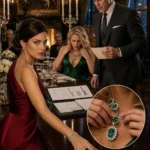
My mother’s emerald glittered on her hand.
Grant saw me first.
The smile on his face faltered.
Sloane followed his gaze.
For a moment, all three of us stood connected by the camera flashes.
The wife in black.
The mistress in white.
The husband between them, already dressed for his own collapse.
Grant crossed the lobby quickly.
“You came,” he said.
“I am the foundation chair.”
“I wasn’t sure, after our conversation.”
“Our donors did nothing wrong.”
He glanced at my gown.
“You look beautiful.”
“You sound surprised.”
“That’s not what I meant.”
Sloane approached with the careful grace of someone entering a photograph she expected to keep.
“Evelyn,” she said.
Her smile was polished.
She held a champagne glass without drinking.
The emerald faced outward again.
“I hope your father is improving.”
“He is.”
Grant looked between us.
“You’ve spoken?”
“At the hospital,” Sloane said.
His jaw tightened.
I could see him calculating what she might have revealed.
Sloane rested a hand on his arm.
The gesture was small enough to deny and intimate enough to be photographed.
Three cameras captured it.
Grant removed her hand gently.
Too late.
“We should go inside,” he said.
“Not yet,” I replied.
I reached for Sloane’s left hand.
She froze.
I did not pull or grip.
I simply turned the emerald toward the light.
It shone deep green beneath the chandeliers.
Several nearby guests noticed.
“What are you doing?” she whispered.
“Confirming something.”
Grant stepped closer.
“You removed this ring from my townhouse safe.”
His face became still.
Sloane pulled her hand away.
“You gave it to her,” I continued.
“Not here.”
“Where would you prefer to discuss theft?”
A photographer’s flash burst behind us.
“The ring was in our marital home.”
“It belongs to the Eleanor Ashford Trust.”
“I planned to replace it.”
“With what?”
His silence answered.
Sloane’s confidence had begun to fracture.
“You said it was yours,” she whispered to him.
Grant did not look at her.
“Take it off,” I said.
Sloane’s eyes filled with anger.
“I will not be humiliated by you.”
“You put my mother’s ring on your hand.”
“You arrived wearing white to a gala hosted by my family.”
“And you tried to rename my private suite after your affair.”
I held out my palm.
“You organized your own humiliation.”
The lobby had grown quiet around us.
Not silent.
Luxury spaces are never silent during scandal.
They murmur.
Sloane looked at Grant.
“Say something.”
Grant’s expression hardened.
“This is not the time.”
“That is what guilty people say when witnesses arrive,” I replied.
His eyes flashed.
“Give her the ring,” he told Sloane.
She stared at him.
“You said—”
“Give it to her.”
Her face went pale beneath the makeup.
Slowly, she twisted the emerald from her finger.
For one terrible second, it caught against her knuckle.
Then it came free.
She dropped it into my palm.
The ring was warm.
My mother’s ring had been warmed by the hand of my husband’s pregnant mistress.
I closed my fingers around it.
“Thank you,” I said.
Sloane looked as though I had struck her.
I walked into the ballroom without turning back.
That was the photograph that appeared online the next morning.
Not Sloane surrendering the ring.
Not Grant watching.
Me walking away beneath the chandeliers with my fist closed at my side.
The caption read: EVELYN ASHFORD MERCER ARRIVES ALONE.
By nine o’clock, the ballroom was full.
Grant recovered quickly.
He moved from table to table, shaking hands and promising investors a new era.
Sloane disappeared into the powder room for twenty minutes, then returned with perfect makeup and colder eyes.
She sat beside Grant at the head table.
My place card had been moved to the opposite side.
I left it there.
Power does not need to fight over seating arrangements when it owns the building.
Vivian sat two tables away.
Matthew stood near the ballroom doors.
My father’s empty chair remained beside mine.
Most guests assumed his illness explained his absence.
Only six people in the room knew he had signed a proxy that morning transferring all Ashford Capital voting rights to me for the duration of his recovery.
At nine-thirty, the orchestra stopped.
Grant stepped onto the stage.
Applause rose beneath the crystal branches.
He looked magnificent.
That was always one of his gifts.
Even while lying, Grant could make the room feel chosen.
“Tonight,” he began, “we celebrate second chances.”
My gaze moved to Sloane.
She smiled.
He continued.
“A second chance for children born with fragile hearts.”
“A second chance for families facing impossible diagnoses.”
“And a second chance for beautiful institutions to be reborn.”
The screens behind him displayed photographs of the three hotels Mercer Hospitality planned to acquire.
A coastal mansion in Newport.
A historic property in Charleston.
A vineyard resort in Napa.
Guests applauded.
Grant extended one hand toward Sloane.
“None of this would be possible without the creative courage of someone who taught our company to imagine not only what luxury has been, but what it can become.”
Sloane rose.
The spotlight found her ivory dress.
Grant smiled at her with the tenderness he once reserved for me.
The applause was polite but curious.
People had seen the lobby.
They had seen the ring.
They knew scandal when it wore couture.
Sloane joined him onstage.
He presented her with a crystal award engraved with the words ARCHITECT OF RENEWAL.
The irony was so complete it required no help from me.
Then Grant approached the podium again.
“Tonight, I am proud to announce that Mercer Hospitality has secured financing to acquire these three extraordinary properties.”
More applause.
Across the room, the lead banker lowered his glass.
He knew the financing had not been secured.
Grant did not.
The term sheet expired at midnight unless Ashford Capital executed the guarantee.
I had instructed Vivian to delay formal notice until the announcement began.
Grant lifted his champagne.
“To the future.”
The sound of my chair moving across the floor was soft.
It still reached the stage.
Grant saw me.
His smile tightened.
I walked toward the podium.
For one hopeful moment, he believed I was joining him.
He extended his hand.
I did not take it.
Instead, I faced the room.
“Before we toast the future,” I said, “we should clarify who is paying for it.”
The ballroom became still.
Grant leaned toward me.
“Evelyn, this is my announcement.”
I looked at the screens.
“It was your assumption.”
A few guests shifted in their seats.
The lead banker placed his napkin on the table.
“Mercer Hospitality has not secured financing for the acquisitions shown behind us.”
Grant’s face changed.
“That is incorrect.”
“Ashford Capital declined to guarantee the facility at four forty-two this afternoon.”
The room seemed to inhale.
Grant turned toward the banker.
The man gave a small, regretful nod.
Sloane stood motionless beside the crystal award.
“We discussed this.”
“You discussed it with my father.”
“He agreed.”
“He agreed to review the final terms.”
“He gave me his word.”
“My father also required audited financial statements.”
Grant’s eyes sharpened.
“This is not appropriate.”
“What is not appropriate?”
I spoke calmly into the microphone.
“Refusing to guarantee a hundred-and-eighty-million-dollar loan after discovering eleven point four million dollars in unauthorized transfers?”
A sound moved through the room.
Not a gasp.
Something quieter and more expensive.
Concern.
Grant gripped the edge of the podium.
“You have no idea what you’re talking about.”
“The transfers financed a brownstone on East Seventy-Third Street.”
Sloane’s face went white.
“They funded personal travel.”
“And three point two million dollars in payments to Bennett Creative Studio for services that were not approved by the board.”
Investors began looking at one another.
One of Grant’s directors stood halfway, then sat down again.
Sloane approached the microphone.
“Those contracts were legitimate.”
I turned to her.
“Then you will have no objection to an independent audit.”
Her mouth opened.
Nothing came out.
Grant stepped between us.
“This is a private marital dispute.”
I looked at the guests.
“This became a corporate matter when restricted investment funds paid for the affair.”
The words traveled through the ballroom like a blade beneath silk.
Grant’s control broke.
“You vindictive bitch.”
The microphone carried every syllable.
Four hundred people heard him.
Cameras captured the instant he realized it.
I looked at him without blinking.
“Thank you for clarifying the tone of our separation.”
He reached for the microphone.
Matthew signaled to security.
Two men in dark suits moved closer to the stage.
Grant noticed.
“You planned this.”
“Nineteen days.”
His face twisted.
“You destroyed my company over an affair.”
“You endangered your company through fraud.”
“The affair only explained why.”
The screens behind us changed.
The hotel photographs disappeared.
In their place appeared a simple corporate chart.
ASHFORD FAMILY TRUST — 34%.
MERCER HOLDINGS — 58%.
OTHER INVESTORS — 8%.
Grant stared at it.
“Take that down.”
I nodded to Vivian.
The chart changed again.
CONVERTIBLE MISCONDUCT NOTE ACTIVATED.
ASHFORD FAMILY TRUST — 56%.
MERCER HOLDINGS — 36%.
For the first time since I had known him, Grant Mercer looked ordinary.
Not charming.
Not powerful.
Just frightened.
“What is this?” he whispered.
“The note your company signed six years ago.”
“That note was never meant to convert.”