Aunt Patricia sent me a long message saying she had “always sensed something was unfair” and hoped we could “start fresh as women.”
I did not respond.
Fresh starts are not owed to people who watered the rot.
The hardest part was Rosemere.
Not legally.
Emotionally.
I met my parents there six weeks after the gala with Andrew present. We sat in the dining room where Camden had been toasted for every almost-achievement of his life. The white hydrangeas outside the window had begun to bloom, round and artificial-looking.
Dad looked smaller in daylight.
Mom looked tired, her makeup carefully done around swollen eyes.
Camden was not there.
“He’s staying with a friend in Chicago,” Mom said, though I had not asked. “He’s devastated.”
I sat across from her.
“So was I,” I said.
She looked down.
Andrew placed the occupancy agreement on the table.
“As stated in Mrs. Harrington’s trust, Richard and Vivian may remain in Rosemere for six months from probate certification. That period began three weeks ago. After that, Ms. Harrington will determine use of the property.”
Dad stared at the papers. “This is absurd. I grew up in this house.”
“So did I,” I said.
He looked at me sharply.
I held his gaze.
“You grew up being promised it,” I continued. “I grew up cleaning up after the person you wanted to give it to.”
Mom’s lips trembled. “Nora, please. Don’t make us leave your home.”
My home.
The words were convenient now.
“You never called it my home when you asked me to sleep in the guest room because Camden wanted my bedroom after Exeter,” I said. “You never called it my home when you told me not to come for Christmas unless I could be pleasant about Camden’s engagement to his future. You never called it my home when Grandma died and you packed her room without asking me.”
Mom closed her eyes.
“I was grieving.”
“So was I.”
Dad rubbed his forehead. “What do you want?”
The question came out exhausted, almost angry.
I realized he truly did not know.
For years, he had assumed I wanted what they withheld: approval, affection, apology, a chair at the table. He thought I had revealed the truth to force them to love me correctly.
I looked around the dining room.
The silver cabinet.
The portrait of great-grandfather Harrington.
The polished table where I had learned that hunger could sit beside abundance.
“I want the house emptied by the deadline,” I said. “I want Camden’s belongings removed from Grandma’s suite. I want all foundation materials transferred to Andrew’s office. I want no direct contact unless it goes through counsel for the next ninety days.”
Mom began to cry.
Dad looked stunned.
“You would cut us off?”
I almost laughed at the innocence of it.
“No,” I said. “I am ending your access to me. That is not the same thing.”
Mom reached across the table.
I did not take her hand.
“Nora, I am your mother.”
“I know.”
“I love you.”
“I believe you love the version of me that costs you nothing.”
She pulled her hand back as if burned.
Dad’s voice roughened. “We made mistakes.”
“We were trying to protect Camden.”
“He was always more… sensitive.”
“No,” I said gently. “He was always more protected. There’s a difference.”
The room went quiet.
Outside, a gardener trimmed the hedges with mechanical precision.
Mom wiped her eyes. “Can you ever forgive us?”
The question people ask when consequences begin to hurt.
I thought about Grandma. About Lily and Mateo and Jonah. About Hopkins. About the forged signature. About Camden onstage, telling a ballroom I was jealous while holding an award built from my life.
“I don’t know,” I said honestly. “But forgiveness will not include returning to the role that made forgiveness necessary.”
Andrew’s pen stilled for half a second.
Dad looked away first.
The six months passed.
My parents moved to a luxury condo in Back Bay, which they described to friends as “downsizing after Richard’s board transitions.” Camden moved twice, then disappeared from family gossip after a failed attempt to apply to Caribbean medical schools with a personal statement about “surviving public defamation.”
No one serious believed him.
I moved into Rosemere on a rainy October morning.
Not because I wanted to live in a mansion.
Because I wanted to decide what happened to the place where I had once felt most powerless.
The first thing I did was remove Camden’s photos from the main staircase.
I did not destroy them.
I boxed them carefully and sent them to my mother.
Then I took down the staged Christmas card portrait and replaced it with Grandma’s garden photographs—the old ones, before the landscapers erased the wild roses.
The second thing I did was open every window.
The house smelled like dust, furniture polish, and old obedience.
I let rain air come in.
Over the next year, Rosemere changed.
The formal dining room became the headquarters of the Evelyn Harrington Service Scholars Trust. The library became a study space for first-generation pre-med students volunteering at St. Catherine’s. The guest rooms hosted out-of-town families whose children were receiving long-term treatment and needed somewhere quiet between hospital shifts.
The ballroom, once used for donor dinners and Camden’s birthday parties, became a training space for volunteers.
I brought back the wild roses.
They climbed the stone wall with stubborn, undisciplined beauty.
St. Catherine’s invited me to speak at the first scholarship ceremony after the trust reopened. I almost said no. Public attention still made my skin feel tight. I did not want to become a symbol. Symbols are often just people others flatten into lessons.
But Dr. Whitlock called me personally.
“The students should know whose standards they’re meeting,” she said.
So I went.
The ceremony was held in the hospital auditorium, not a private club. No ice sculpture. No string quartet. Just folding chairs, coffee in paper cups, nervous students, proud parents, nurses coming off shifts, and a row of children from the pediatric wing who had insisted on attending because there would be cake.
The first scholarship recipient was a young woman named Maya Rodriguez from Worcester. She had spent four years translating discharge instructions for Spanish-speaking families while working weekends at her aunt’s grocery store. Her volunteer record was immaculate. Her essay was plain and beautiful and entirely hers.
When I handed her the award, her hands shook.
“I don’t know what to say,” she whispered.
“Say thank you,” I whispered back. “Then go become who you already are.”
She laughed through tears.
After the ceremony, Dr. Whitlock walked me to the pediatric wing.
The Blue Cart was still there.
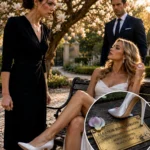
New paint. Better wheels. More books. A small brass plaque on the side read:
The Nora Harrington Blue Cart Program
For the children who wait, and the volunteers who stay.
I touched the plaque with one finger.
For a moment, I was twenty again, pushing that cart down a dim hallway at midnight while my phone buzzed with texts from my mother asking why I had not picked up Camden’s dry cleaning.
I wished I could go back and tell that girl the truth.
Not that everything would be okay.
Some things had not been okay.
Some losses were real.
Some doors stayed closed.
Some parents did not wake up in time.
I would tell her something better.
You are not invisible. You are only standing among people committed to not seeing you.
There is a world beyond them.
Keep walking.
That winter, Mom wrote me a letter.
A real one.
No subject line. No guilt disguised as concern. No request hidden inside an apology.
She wrote about finding my old science fair ribbon in a storage box and realizing she did not remember the project, only that Camden had been upset that day because his baseball game was canceled. She wrote that she had spent years calling me strong because it excused her from being gentle. She wrote that Camden was still angry and Dad was still defensive, but she was beginning to understand that the family’s peace had always been purchased with my silence.
At the end, she wrote:
I do not expect you to come back. I only want you to know I finally see the door we kept closing.
I read the letter twice.
Then I placed it in a drawer.
Not the drawer where I used to keep Hopkins.
A different one.
One that did not feel like a grave.
I did not call her that day.
I did not rush to heal what she had only begun to name.
But I did not throw the letter away.
That was enough.
For now.
Warm Conclusion: The Table I Chose
Two years after the gala, Rosemere was almost unrecognizable.
Not smaller.
Not less elegant.
Just alive.
On Saturday mornings, scholarship students filled the library with laptops, anatomy flashcards, coffee cups, and nervous ambition. Families from the hospital ate soup in the sunroom. Volunteers sorted donated books in the old music room. Children recovering from surgeries painted birdhouses on the terrace while nurses pretended not to cry.
The house that had once taught me my place now made room for people still finding theirs.
One spring afternoon, I stood in the garden watching wild roses climb over the stone wall when Dr. Whitlock arrived with Jonah.
He was tall now, awkward and smiling, holding a small paper crane made from blue paper.
“For old times,” he said.
I laughed, and this time the sound came easily.
He told me about college, about engineering, about how he wanted to design hospital equipment that did not frighten children. His mother hugged me for so long that I stopped counting seconds and simply let myself be held.
Later, after everyone left, I walked through Rosemere alone.
The evening light moved across the floors. The house was quiet, but not empty. There were signs of life everywhere—children’s drawings, scholarship folders, coffee mugs, a stack of thank-you cards, fresh roses in a chipped blue vase from the hospital gift shop.
A message from Dad.
Nora, your mother showed me the scholarship article. Your grandmother would be proud.
I looked at the words for a long time.
Then I typed:
She is.
I did not add more.
Peace, I had learned, did not always arrive as forgiveness.
Sometimes peace was a locked door.
Sometimes it was a bank record, a signed will, a badge log, a forged name exposed beneath a chandelier.
Sometimes it was a mansion full of strangers who felt more like family than the people in your childhood photos.
Sometimes it was your mother finally seeing you and you finally understanding that being seen too late did not obligate you to step backward.
And sometimes, peace was simply standing in a garden your grandmother loved, wearing her pearls, watching roses return to a wall someone once tried to make perfect.
I thought about Camden now and then.
Not with hatred.
Hatred is still a kind of attachment, and I had worked too hard for freedom.
I hoped he became honest someday. I hoped he learned that charm was not character, that applause was not love, and that stealing someone’s service did not make you compassionate.
But I no longer needed to witness his lesson.
That was the difference.
For most of my life, my family had made me responsible for Camden’s consequences, my parents’ emotions, the family reputation, the unpaid bills, the quiet lies, the empty chair, the broken glass.
Now I was responsible for my own life.
And my life, finally, felt like mine.
On the anniversary of Grandma’s death, I hosted the scholarship dinner at Rosemere. Not a gala. Not a performance. Just a long wooden table in the garden beneath strings of warm lights.
Maya came. Jonah came. Dr. Whitlock came. Nurses came straight from shifts, still wearing sneakers with their dresses. Parents from the hospital brought casseroles. Students brought flowers from grocery stores and apologies for being late from work.
At the head of the table, Grandma’s photograph stood in a silver frame.
No one gave a speech about legacy as if it were marble.
We talked about it as if it were bread.
Something to pass.
Something to share.
Something that mattered only if it fed someone.
When dessert was served, a little girl from the pediatric wing tugged my sleeve.
“Miss Nora,” she said, “is this your family?”
I looked down the table.
At Dr. Whitlock laughing with Maya.
At Jonah folding cranes for two children near the roses.
At Andrew Vale cutting cake badly while nurses teased him.
At the students comparing volunteer schedules.
At the house glowing behind us, no longer a monument to who had been favored, but a shelter for who might become.
I felt the old ache rise.
Then soften.
The little girl nodded seriously, as if she had suspected.
Then she ran back to the cake.
I stayed where I was, beneath the garden lights, listening to voices fill the evening.
Years ago, Camden had stood in a ballroom and claimed he showed up when no one was watching.
But people had been watching.
Nurses.
Children.
Grandmothers.
Lawyers.
Bankers.
Hospital directors.
And some part of me, the part I had nearly abandoned, had been watching too.
Waiting for the day I stopped begging my family to remember my name.
Waiting for the day I let the truth speak it instead.
Nora Harrington.
Volunteer ID NX-441.
Trustee.
Daughter of no one’s denial.
Owner of Rosemere.
Founder of a scholarship Camden could never touch.
And finally, beautifully, free.
Comments 5
Thank you for a great story
Thank you for a wonderful story
Thank you. Great story, well written.
A great story Nora is finally getting seeny
The story was well built. It was maddening at that the self absorbed ones seemed to push a head of the caring one. But the truth came out. And a very wonderful ending. Good writing made for a wonderful read