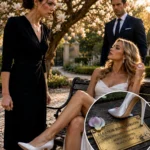
My mother wore navy. No jewelry except her wedding ring.
My father held a folder.
I sat across from them.
Not beside.
Across.
My mother’s eyes filled immediately. “I don’t know how to begin.”
“The truth usually works,” I said.
She flinched.
My father opened the folder and pushed several papers toward me.
“We’ve issued written corrections,” he said. “To family members, foundation board members, major donors, and everyone present at the benefit who received misinformation.”
I glanced at the papers.
Formal. Careful. Legally acceptable.
Not warm.
But public enough.
My father continued. “I have also notified the company board that Wesley is suspended indefinitely.”
My mother let out a soft sob.
He looked at her, then back at me. “His access to family office accounts has been removed.”
“That is appropriate.”
The words sounded like Margaret.
Maybe dignity is partly borrowed until it becomes yours.
My mother reached across the table.
I did not take her hand.
She withdrew it slowly.
“Claire,” she whispered, “I am sorry.”
Two small words.
I had imagined them so many times as a child that hearing them as an adult felt almost unreal. I had imagined crying. Running into her arms. Becoming the daughter she loved because she finally understood.
Instead, I felt sad.
Only sad.
“I know you are,” I said.
Hope flashed across her face.
I hated that I had to extinguish it.
“But sorry is not a bridge you get to cross immediately after burning one.”
She closed her eyes.
My father’s face tightened. “We were wrong.”
“We failed you.”
He looked down.
I had never seen him accept a sentence without editing it.
My mother cried harder. “I thought I was protecting the family.”
“You were protecting Wesley,” I said. “And your image. Sometimes Dad. Sometimes yourself. But not the family.”
She shook her head. “I loved you.”
The sentence hit a place I thought had scarred over.
I breathed through it.
“I believe you loved the version of me that needed very little and gave a lot,” I said. “I don’t think you knew what to do with the rest.”
My father’s eyes reddened.
“I don’t expect forgiveness today,” he said.
“That’s good.”
He nodded once, accepting the blow.
My mother looked terrified. “Does this mean you’re leaving us?”
I almost laughed, but gently this time.
“I left years ago,” I said. “You’re only noticing because I stopped holding the door open.”
They stayed for twenty-seven minutes.
My father explained practical matters. Company governance. Legal cooperation. Preservation of documents. The board meeting scheduled for Monday.
My mother asked whether I would come to Sunday dinner.
“No,” I said.
“Thanksgiving?”
“No.”
“Christmas?”
“We will talk about that when I know whether talking to you costs me my peace.”
She folded into herself.
I did not comfort her.
That was the hardest part.
Not the footage. Not the gala. Not Wesley’s hatred.
Not comforting my mother felt like cutting a wire inside my own chest.
But I let it stay cut.
After they left, I sat in conference room B until Maya came in with coffee.
She placed it in front of me.
“Do you want me to say something supportive or insulting about rich people?”
I smiled for the first time in days.
“Surprise me.”
She thought about it. “Your family has the emotional depth of a golf course pond.”
I laughed.
It hurt.
It helped.
The legal process moved slowly, as truth often does once it enters paperwork.
Wesley was arrested in October on charges related to arson, insurance fraud, and falsifying business records. His attorney negotiated aggressively. My parents paid for his defense, because love and consequence are rarely clean in families like mine.
But my father did not lie for him.
That mattered.
Not enough to fix the past.
But enough to prove the present had changed.
During preliminary proceedings, the prosecution presented the Caldwell footage, accelerant analysis, emails to Marissa, and financial records showing Wesley’s debt. The forged authorization letter became part of a separate civil claim. Priya’s forensic report revealed more than we expected: vendor kickbacks, unauthorized advances, and debt hidden under “strategic consulting expenses.”
The board removed Wesley permanently.
My father stepped down as CEO six months later.
Not because I forced him.
Because the bank did.
The company restructured under a professional management team. My voting shares became the difference between liquidation and survival. For once, I did not rescue my family by erasing myself.
I negotiated.
Coldly.
Clearly.
The east acreage would be placed under permanent conservation easement. The guesthouse would be rebuilt according to Nana’s original architectural plans, not as a luxury rental, not as townhouses, not as a monument to family vanity.
As a residence for women aging out of emergency housing programs.
Four suites. A shared kitchen. Legal counseling office. Garden.
The Eleanor House.
My mother thought it was “too public.”
I said, “So was accusing me of arson.”
She stopped objecting.
The groundbreaking took place the following spring.
Not with champagne.
With coffee, folding chairs, local reporters, nonprofit partners, construction workers, my staff, Judge Caldwell, Margaret, Priya, Marissa, and six women from the shelter who helped choose paint colors for rooms they would one day sleep in without fear.
My parents came.
They stood near the back.
My mother cried quietly when the first shovel entered the earth.
This time, I did not resent her tears.
I simply did not organize myself around them.
After the ceremony, my father approached me.
He looked older outside the architecture of power. Smaller without a podium, boardroom, or Wesley beside him.
“Nana would have liked this,” he said.
“Yes,” I replied. “She would have corrected the landscaping, but she would have liked it.”
A smile moved across his face and disappeared.
“I found something,” he said.
He handed me an envelope.
Inside was a photograph.
I was nine years old, sitting beside Nana on the guesthouse porch, both of us holding lemonade. I had dirt on my knees. Nana was looking at me, not the camera, with fierce tenderness.
On the back, in her handwriting:
Claire sees what others avoid. That will be lonely until it becomes her freedom.
I read it twice.
Then I held the photograph to my chest.
“Thank you,” I said.
My father nodded.
He seemed to want to say more.
Maybe another apology. Maybe an explanation. Maybe a request to be forgiven in the warm spring air because the setting was beautiful and people like my father trusted beautiful settings to soften hard things.
I did not help him.
Finally, he said, “Will you let us try?”
I looked across the lot where the burned guesthouse had once stood.
The air smelled like fresh-cut lumber and rain.
“You can try,” I said. “But I’m not coming back to who I was.”
He swallowed.
“No,” he said. “I suppose you’re not.”
My mother came over then.
For once, she did not reach for me dramatically.
She stood beside my father and looked at the photograph in my hand.
“She loved you very much,” she said.
My mother’s face crumpled slightly. “I wish I had known how.”
It was the closest she had come to telling the full truth.
I looked at her, this woman who had taught me that love could be present and still unsafe, beautiful and still selfish, real and still not enough.
“I do too,” I said.
Then I walked away to join the others.
Conclusion: The House That Did Not Burn
Eleanor House opened in November.
The first resident was a seventy-two-year-old retired school librarian named Mrs. Alvarez, who had spent eight months sleeping in her car after medical debt swallowed her savings. She cried when she saw the built-in bookshelves.
The second was a woman named Tanisha who kept touching the bedroom door because it had a lock only she controlled.
The third was Ruth, who planted rosemary by the porch and told me the house felt like someone had argued with sadness and won.
On opening day, we placed Nana’s photograph in the entryway.
Not a formal portrait.
Not the oil painting from the main house where she looked stern and wealthy and far away.
The porch photograph.
Lemonade. Dirt on my knees. Her eyes on me.
Under it, a small brass plaque read:
Eleanor Whitmore believed homes should protect the people inside them.
The first time I stood in that entryway alone, I thought I would feel the fire again.
I did not.
I smelled lemon oil on the floors. Fresh paint. Coffee from the kitchen. Rosemary from the porch.
I heard laughter upstairs.
A house can remember pain without becoming a shrine to it.
So can a person.
Wesley eventually pleaded guilty to reduced charges after the financial evidence made a trial too dangerous. He received prison time, restitution, and the unbearable punishment of being known accurately.
My parents visited him.
Not out of hatred.
Out of freedom.
There were letters from him at first. Angry ones. Then pleading ones. Then one that said, You ruined my life.
I mailed it back unopened after reading only that line through the fold.
No, Wesley.
I stopped letting you ruin mine.
My relationship with my parents became something quieter than reconciliation and more honest than estrangement. We spoke sometimes. We met in public places. They learned not to summon me. They learned not to use illness, guilt, reputation, or Wesley’s pain as a leash.
Some days, I believed they were changing.
Some days, I remembered that change does not refund childhood.
Both things were true.
On the first anniversary of the fire, I drove to Greenwich alone.
The main estate was still there beyond the hedges, grand and cold, with its stone facade and perfect lawn. But my car did not turn toward the mansion.
It turned toward Eleanor House.
The porch lights were on.
Inside, Mrs. Alvarez was leading a book club. Ruth had made soup. Tanisha had hung paper stars in the hallway because she said every safe house deserved a little sky.
I stood outside for a moment, looking at the rebuilt guesthouse.
The fire had destroyed cedar, glass, wiring, furniture, and old letters.
It had not destroyed proof.
It had not destroyed Nana’s love.
It had not destroyed me.
For years, my family had called me unstable because I refused to balance their lies on my back.
They called Wesley successful because he knew how to smile while taking what was not his.
They called my silence loyalty.
They called my pain strength.
They called my sacrifice duty.
But on the night the ballroom went silent, when the footage played and the truth stood taller than the Whitmore name, I finally understood something my grandmother had tried to teach me.
Dignity is not loud.
It does not need to beg.
It does not need to convince people determined to misunderstand.
Sometimes dignity is a woman in a black dress pressing a button.
Sometimes it is a signed trust document.
Sometimes it is a bank record, a camera angle, a witness who finally stops being afraid.
Sometimes it is walking away while the people who taught you to carry them realize they no longer know how to stand.
I opened the front door of Eleanor House.
Warm air reached for me.
Someone in the kitchen called my name.
Not like an accusation.
Not like a warning.
Like welcome.
And for the first time in my life, I entered a Whitmore house without bracing myself to be blamed for whatever was broken.
The house had burned.
The lie had burned with it.
And I was still standing.
Comments 2
Great story!