But there he stood.
Thinner.
Paler.
One hand gripping the banister.
Rosa beside him.
Vivian Shaw at his other side.
Every conversation died.
My father descended slowly.
Each step was a verdict.
Wells looked like the floor had opened beneath him.
“Conrad,” he said, recovering first.
“You should be resting.”
My father reached the bottom of the stairs.
He looked at Wells.
Then at Camille.
Then at the necklace.
His voice, when it came, was rough but clear.
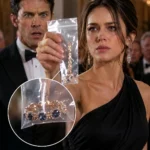
“Take off my wife’s diamonds.”
The ballroom inhaled as one animal.
Camille went scarlet.
Wells stepped forward.
“Conrad, this is not—”
My father raised one finger.
Wells stopped.
That was the difference between borrowed power and real power.
Borrowed power needs volume.
Real power can silence a room with arthritis and a raised hand.
Camille touched the clasp at her neck.
Her eyes filled with furious tears.
“But Wells said—”
“I do not care what Wells said.”
My father looked at her like she was furniture delivered to the wrong house.
“Take them off.”
No one moved.
Then Vivian opened her clutch and removed a small velvet pouch.
She held it out.
Camille’s hands shook as she unclasped the necklace.
For one second, the diamonds caught on a strand of her hair.
She winced.
I did not.
She dropped the collar into Vivian’s pouch.
The sound was tiny.
Final.
Wells’s face darkened.
But he was too smart to explode in front of donors.
So he smiled.
“I think emotions are high tonight.”
My father turned to him.
“You have no idea.”
Then he looked at me.
For a moment, I was six years old again, standing in his office after breaking my mother’s porcelain swan, expecting rage and receiving a lesson on insurance.
He held out his hand.
I crossed the ballroom.
He kissed my forehead.
Not gently.
Firmly.
As if reminding the room I was not abandoned property.
A photographer’s flash went off.
Then another.
Then twenty.
By midnight, the photo was everywhere.
CONRAD MONTGOMERY RETURNS TO PUBLIC LIFE AMID FAMILY DRAMA.
MISTRESS FORCED TO REMOVE HEIRLOOM DIAMONDS AT NEWPORT GALA.
PREGNANT ALEXANDRA MONTGOMERY STUNS IN BLACK AS FAMILY WAR ESCALATES.
Wells called me twelve times.
I did not answer.
At 1:17 a.m., he sent one text.
You have no idea what you just did.
I replied at 1:18.
Neither do you.
The next morning, Vivian received the paternity results.
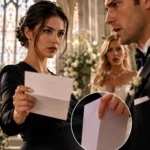
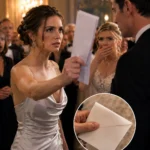
She came to my bedroom with a sealed envelope and no expression.
My father sat near the window, a blanket over his knees.
He had been exhausted by the gala, but his mind was returning in fragments sharper than before.
Rosa brought tea and pretended not to eavesdrop.
Vivian handed me the envelope.
My fingers felt numb.
I did not know why I was nervous.
Camille’s child was not my child.
Her truth was not my truth.
Still, I understood that whatever sat inside that envelope would alter the battlefield.
I opened it.
The words were clinical.
The conclusion was not.
Wells Whitaker was excluded as the biological father of Camille Hart’s fetus.
I read it once.
Then again.
The room seemed to tilt.
My father closed his eyes.
Rosa whispered something in Spanish that sounded like a prayer and a threat.
Vivian sat down across from me.
“There is more.”
Of course there was.
There is always more when betrayal is organized.
She placed a second document on the table.
Bank records.
Wire transfers.
Emails.
A draft amendment to the Montgomery Family Trust prepared by Wells but never executed.
The amendment proposed recognizing Camille’s unborn child as a presumptive Whitaker-Montgomery heir.
That child, had the amendment been approved, would have been eligible for future trust distributions and symbolic family standing.
Wells had known there was doubt.
He had paid Mason Vale to disappear.
Then he tried to insert Camille’s baby into my family’s inheritance structure anyway.
My voice sounded far away.
“Why?”
Vivian’s answer was quiet.
“Leverage.”
My father opened his eyes.
“Control.”
He looked older than I had ever seen him.
But not weak.
Never weak.
“If Alexandra’s child could be challenged, and Camille’s child could be presented as stable, legitimate, and publicly accepted, Wells could pressure the board to keep him in control until both children’s claims were resolved.”
I placed the test results on my lap.
My son kicked once.
A sharp, living punctuation.
“So he wasn’t just leaving me.”
“No,” Vivian said.
“He was replacing you.”
That should have broken something in me.
Maybe it did.
But the sound it made was not a sob.
It was a lock turning.
Wells had not fallen in love with another woman.
That would have been ordinary.
Painful, but ordinary.
He had engineered a succession crisis using two pregnancies, one real heir, one false claim, and enough public humiliation to make me look too unstable to fight.
He had brought Camille into my hospital room not to hurt me.
To provoke me.
He had invited me to the gala not to include me.
To expose me.
He had scheduled the wedding in my chapel not because he was reckless.
Because he needed witnesses.
If he could make Camille look like the future Mrs. Whitaker-Montgomery before the court ruled, he could argue public reliance, family acquiescence, reputational damage, and continuity.
He could make theft look like tradition.
I looked at Vivian.
“Can we stop the wedding?”
“Can we stop it quietly?”
“Of course.”
My father looked disappointed.
I smiled back.
“But I would prefer not to.”
PART 4: THE COURT ORDER AT THE ALTAR
The morning of the wedding was violently beautiful.
Newport looked scrubbed clean by God and money.
The sky was a hard blue.
The ocean glittered behind Montgomery House.
White tents spread across the lawn like surrender flags.
Florists unloaded roses by the truckload.
Security guards checked names at the gate.
Reporters waited on the road, pretending to photograph the coastline.
By ten o’clock, Camille’s bridesmaids were posting champagne selfies from my mother’s dressing room.
By eleven, a stylist uploaded a video of Camille’s veil being steamed beneath my sister’s portrait.
By noon, someone leaked the seating chart.
I was in the third pew.
Left side.
Close enough to be seen.
Far enough to be dismissed.
Wells had done that on purpose.
So had I.
Vivian and I had debated my attendance for exactly four minutes.
She warned me it would be brutal.
I told her brutality loses power when you stop pretending it is accidental.
My father wanted to attend.
His doctors said no.
He cursed with such elegance that one of them apologized.
In the end, he remained in the library with Rosa, two nurses, three monitors, and a live feed from a security camera hidden in the chapel balcony.
He wore a suit anyway.
That was my father’s version of prayer.
I dressed alone.
Black again.
This time, a long-sleeved silk dress with a high neck and a narrow waist, the kind of dress that did not ask for attention but held it once it arrived.
My hair was pulled back.
My makeup was soft.
My wedding ring remained on its chain.
In my clutch, I carried nothing but lipstick, tissues, and a copy of my son’s ultrasound.
I did not need to carry evidence.
Vivian had that.
At 1:35 p.m., I walked into the chapel.
The whispering began before the usher offered his arm.
There she is.
She came.
God, she’s pregnant.
How humiliating.
How strong.
How sad.
I heard all of it.
Or maybe I imagined some of it.
It did not matter.
Public pity and public cruelty sound almost identical when you are the woman at the center of both.
I took my seat in the third pew.
The chapel smelled of lilies, wax, and old stone.
Sunlight poured through the stained glass, turning the aisle red and blue and gold.
The altar was drowned in roses.
Wells stood beneath them.
For a second, I saw the man I had married.
The one who danced with me barefoot in the kitchen the night we found out I was pregnant.
The one who cried at my mother’s grave and promised her he would protect me.
The one who used to tuck my hair behind my ear before kissing me.
Then he looked at my stomach with calculation instead of tenderness.
The memory died cleanly.
He leaned toward his best man, Senator Andrew Pike’s son, and said something that made them both smile.
A few pews ahead, Aunt Patricia refused to turn around.
My cousin Blake did.
He gave me a look that was half apology and half investment strategy.
Blake had always gone wherever power smelled freshest.
Today, he thought it smelled like Wells.
I smiled at him.
He looked away first.
The music changed.
Everyone stood.
Camille appeared in the doorway.
I will give her this.
She knew how to enter a room.
Her gown moved like smoke.
Her veil trailed fifteen feet behind her.
Her bouquet was white orchids and tiny blue forget-me-nots, which made me want to laugh because subtlety had clearly died during fittings.
And around her throat, once again, were my mother’s diamonds.
A fake pair.
Vivian had the originals locked in a bank vault by then.
But Camille wanted the image.
The flash.
The message.
She wanted the world to see her wearing what she believed she had earned.
As she passed my pew, her eyes flicked to mine.
She smiled.
Not kindly.
Not nervously.
Triumphantly.
Then she looked at my stomach and whispered so softly only I could hear.
“Don’t worry.”
I turned my head slightly.
She paused.
“I’ll be a better mother to the heir than you would have been.”
There are moments when violence presents itself as a clean, reasonable option.
I did not move.
I did not slap her.
I did not stand.
I simply looked at her until her smile faltered.
Then I said, “Walk carefully.”
She misunderstood me.
She thought I meant the dress.
The ceremony began.
The minister spoke about love.
The room pretended not to rot.
Wells held Camille’s hands and looked at her as if she were redemption instead of evidence.
I watched his thumb stroke her knuckles.
I wondered when tenderness had become a tool to him.
Maybe it always had been.
Maybe the tenderness had never been false, just temporary.
That is the cruelest kind of love.
Not the kind that never existed.
The kind that existed and still was not enough to make someone decent.
The minister turned to Wells.
“Do you, Wells Alexander Whitaker, take Camille Elise Hart to be your lawfully wedded wife?”
Wells looked briefly at me.
He should not have.
That glance gave him away.
It held victory.
It held warning.
It held the assumption that my presence was proof of defeat.
“I do,” he said.
His voice was steady.
Camille exhaled like a queen receiving a crown.
The minister turned to her.
“Do you, Camille Elise Hart, take Wells Alexander Whitaker—”
The chapel doors opened.
Not dramatically.
No thunder.
No scream.
Just the deep wooden groan of old doors obeying a hand with authority.
Everyone turned.
Vivian Shaw stood in the entrance wearing a navy suit, red lipstick, and the calm expression of a woman about to ruin a very expensive afternoon.
Beside her stood a Newport County sheriff’s deputy.
Behind them stood Mason Vale.
Tanned.
Nervous.
Alive in the worst possible way.
Camille made a sound so small it almost disappeared.
Wells did not move.
The minister lowered his book.
Vivian walked down the aisle at a measured pace.
Her heels struck the stone floor like a countdown.
I stayed seated.
My son moved beneath my ribs.
Wells recovered first.
“Vivian,” he said.
“This is a private ceremony.”
“No,” she said.
“It is an attempted legal fraud in a chapel.”
Gasps moved through the pews.
The deputy handed Wells a document.
Vivian handed one to the minister.
“I have a temporary restraining order issued by the Rhode Island Family Court and an emergency injunction from the Chancery Court preventing this marriage from proceeding until questions of fraud, marital status, trust interference, and child-related misrepresentation are resolved.”
Camille’s bouquet trembled.
Wells glanced at the document.
His face changed by degrees.
First annoyance.
Then calculation.
Then something close to fear.
“This is absurd,” he said.
“The divorce is in process.”
“Not finalized,” Vivian replied.
“And bigamy is still frowned upon in most coastal communities.”
A strangled laugh came from the back pew.
Someone shushed it.
Wells’s voice sharpened.
“There was a religious ceremony today, not a civil filing.”
“Then you will not mind postponing it.”
His eyes cut to me.
For the first time that day, he did not look victorious.
He looked exposed.
Camille turned to him.
He did not answer.
Vivian addressed the room.
“The court has also ordered preservation of all financial records related to Montgomery Holdings, Whitaker Legal Consulting, Hart Image Group, Vale Hospitality Ventures, and any trusts, proxies, or amendments involving unborn beneficiaries.”