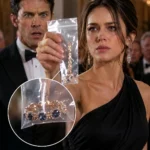
Mason Vale shifted behind her.
Camille saw him fully then.
Her face collapsed.
Not into sorrow.
Into rage.
“You,” she hissed.
Mason lifted both hands.
“Don’t look at me like that.”
The chapel exploded into whispers.
Wells stepped off the altar.
“Enough.”
The deputy moved one hand toward his belt.
Not grabbing anything.
Just reminding Wells that money does not outrank court orders.
Vivian continued.
“Furthermore, the court has accepted preliminary DNA evidence indicating that Mr. Whitaker is excluded as the biological father of Ms. Hart’s unborn child.”
Camille went white.
A bridesmaid dropped her phone.
The minister whispered, “Lord have mercy.”
I almost admired the timing.
Wells turned to Camille slowly.
It was the first honest expression I had seen on his face in months.
Disbelief.
Then disgust.
Then the sharp panic of a man realizing he had been cheated while committing fraud.
“Is that true?” he asked.
Camille’s mouth opened.
Nothing came out.
Mason cleared his throat.
“Probably, yeah.”
The chapel erupted.
Aunt Patricia actually stood.
Blake said, “Jesus Christ,” loud enough for three generations of Montgomery ancestors to hear.
Camille grabbed Wells’s sleeve.
“You said it didn’t matter.”
The silence after that sentence was spectacular.
Wells looked at her hand.
Then at the room.
Then at Vivian.
Then at me.
I saw him understand too late that Camille had not betrayed him privately.
She had done it into a microphone made of marble, roses, and three hundred witnesses.
Vivian looked pleased.
Only slightly.
“Thank you, Ms. Hart,” she said.
“That statement will be useful.”
Camille’s eyes filled with tears.
This time, I believed them.
Not because she was sorry.
Because she was losing.
Wells walked toward me.
The deputy stepped again.
Wells stopped at the edge of my pew.
His voice was low enough to pretend intimacy.
“You did this.”
I looked up at the man I once loved.
The man who had placed his hand on my belly and whispered to our son at night.
The man who had tried to take that same child’s name, money, future, and safety because another woman offered him a cleaner story.
“You did.”
His eyes burned.
“You think a court order saves you?”
I stood slowly.
Every eye in the chapel followed.
My body felt heavy, but my voice did not.
“It saved my son from being erased before he was born.”
For one second, the room went very still.
There was no performance left in me.
No ice.
No polished Montgomery restraint.
Just truth, quiet and bright as a blade.
“You brought your pregnant wife into a hospital room and threatened her competency.”
I turned slightly, so the board members could hear.
“You tried to seize her family company while her father was recovering from a stroke.”
I looked at Camille.
“You placed another man’s child inside my family’s inheritance and called it love.”
Then I looked back at Wells.
“You wore a tuxedo over a crime.”
His face twisted.
“That is defamation.”
Vivian sighed.
“Oh, Wells.”
The way she said his name was almost maternal.
If your mother had cross-examined you for sport.
“It is only defamation if it is false.”
The deputy handed Wells another set of papers.
“Mr. Whitaker, you have been served.”
Wells did not take them.
They fell against his chest and then to the floor.
Camille began crying then, loudly now.
Her veil slipped from her hair.
One of the fake diamond clasps at her neck came loose, and the necklace tilted sideways.
She looked suddenly very young.
Not innocent.
Just young.
That difference matters.
“Alexandra,” she said.
I hated the way my name sounded in her mouth.
“Please.”
The word Wells had wanted from me.
I had never given it to him.
She gave it to me in a chapel full of witnesses.
I looked at her for a long moment.
Then I said, “No.”
Not cruelly.
Not loudly.
Just no.
The word women are taught to decorate until it becomes unrecognizable.
I left the chapel before anyone else moved.
Vivian followed.
The deputy stayed.
Behind me, the room began to detonate.
Voices rose.
Phones flashed.
Someone cried.
Someone laughed.
Someone said the wedding cake had already been cut in the catering tent.
Outside, the sun hit my face.
The ocean wind lifted my hair.
For the first time in months, I took a full breath.
My phone buzzed.
A text from Rosa.
Your father is standing.
He is clapping.
I pressed the phone to my chest and closed my eyes.
Inside me, my son kicked once.
As if applauding too.
PART 5: THE COURTROOM WHERE HE LOST EVERYTHING
The chapel video hit the internet before sunset.
By midnight, it had eight million views.
By morning, every headline had teeth.
BILLIONAIRE HEIR’S EX STOPS WEDDING WITH COURT ORDER.
PREGNANT MISTRESS EXPOSED AT ALTAR IN NEWPORT SCANDAL.
MONTGOMERY HEIRESS SERVES HUSBAND DURING VOWS.
I did not watch the clips.
I did not read the comments.
Rosa read them for me in the kitchen while making soup.
“People like your dress,” she said.
“That is not the point.”
“They also hate him.”
“That is closer.”
She stirred the pot.
“One woman says you walked like a queen carrying a subpoena.”
I smiled despite myself.
“Tell her thank you.”
The internet loves a public collapse.
But courts prefer paper.
And Vivian had paper.
Lots of it.
Over the next six weeks, Wells’s world unraveled in rooms with fluorescent lights and bad coffee.
The first hearing was in family court.
Wells arrived with three attorneys, a navy suit, and the expression of a man practicing remorse without admitting liability.
I arrived with Vivian, my doctor’s affidavit, the prenup, and a blood pressure monitor in my purse because pregnancy has no respect for dramatic timing.
Camille did not attend.
Her attorney claimed medical distress.
Mason did attend.
He wore loafers without socks and looked like a man who had discovered subpoenas were less fun than bottle service.
The judge was a woman named Honora Bell.
She had silver hair, no visible patience, and a reputation for making fathers who hid assets wish they had chosen honesty as a lifestyle.
Wells tried to frame the issue as marital misunderstanding.
Vivian framed it as coercive control, financial misconduct, fraud, and attempted interference with an unborn child’s protected trust interests.
Guess which one sounded better with exhibits.
The hospital visit became Exhibit 1.
The divorce papers became Exhibit 2.
My medical records confirming competence became Exhibit 3.
The text messages where Wells called me unstable became Exhibit 4.
His emails to board members saying I might require institutional rest became Exhibit 5.
The draft trust amendment naming Camille’s unborn child as a potential Montgomery beneficiary became Exhibit 12.
By Exhibit 19, Wells had stopped looking at me.
By Exhibit 26, one of his attorneys requested a recess.
Judge Bell denied it.
Vivian questioned Mason first.
She did not need to destroy him.
He had arrived pre-damaged.
“Mr. Vale,” she said.
“Did you have an intimate relationship with Ms. Hart during the likely conception window of her pregnancy?”
Mason glanced at Wells.
Wells looked at the table.
“Did Ms. Hart tell you she was uncertain who fathered her child?”
“Did you receive a payment of two hundred thousand dollars from an entity controlled by Mr. Whitaker?”
Wells’s attorney objected.
The judge allowed the question.
Mason swallowed.
“What was the payment for?”
He looked miserable.
“To leave town.”
A sound moved through the courtroom.
The judge’s eyes narrowed.
Vivian tilted her head.
“Did you perform consulting services for that payment?”
“Did you design anything?”
“Did you provide any legitimate business value to Mr. Whitaker or any entity he controlled?”
Mason rubbed his face.
Vivian nodded.
“Thank you.”
That was all.
Sometimes the cleanest kill is the shortest one.
Then she called Wells.
He took the oath like a man offended that truth had become procedural.
Vivian approached the lectern.
“Mr. Whitaker, did you have an affair with Camille Hart while married to Alexandra Montgomery Whitaker?”
He looked at his attorney.
The attorney stared straight ahead.
“Was your wife pregnant during part of that affair?”
“Were you aware the prenuptial agreement contained an infidelity penalty triggered by adultery during pregnancy?”
A small smile touched Vivian’s mouth.
“But you signed it.”
“As an attorney.”
His jaw tightened.
“An attorney who chose not to read the contract protecting the assets of the woman he married.”
Wells said nothing.
The judge wrote something down.
Vivian moved on.
“Did you tell members of the Montgomery Holdings board that my client was emotionally unstable?”
“I expressed concern.”
“Did a medical doctor tell you she was incompetent?”
“Did any psychiatrist tell you she was unable to manage her affairs?”
“Did you petition the court for competency review before attempting to obtain voting control?”
“Did you threaten to do so if she refused to sign the divorce papers?”
“I would not characterize it as a threat.”
Vivian lifted the hospital folder.
“Then characterize this sentence for the court.”
She read it.
Wells stared ahead.
“I was trying to protect the company.”
“No, Mr. Whitaker.”
Vivian’s voice cooled.
“You were trying to protect your access to it.”
His mask cracked.
“You have no idea what that family is like.”
The room stilled.
Vivian waited.
Wells leaned forward.
“Do you know what it is like to be treated like hired help by people who inherited everything?”
My father, seated behind me in his wheelchair, did not move.
“I saved Montgomery Holdings after Conrad’s stroke.”
“You billed Montgomery Holdings after Conrad’s stroke,” Vivian said.
“I ran it.”
“You exploited it.”
“I earned my place.”
“You married it.”
The judge looked up.
Wells’s attorney placed a hand on his arm.
Wells shook it off.
There, at last, was the wound he had dressed as love.
He had not wanted me because I was rich.
He had hated me because I was born rich.
And somehow, in the twisted arithmetic of his pride, betraying me had become justice.
I felt sadness then.
Not longing.
Not weakness.
Just the dull ache of realizing the person you loved had built an entire private religion around resenting you.
Vivian let the silence work.
Then she asked, “Did you know there was uncertainty regarding the paternity of Ms. Hart’s child?”
Wells did not answer.
The judge said, “Mr. Whitaker.”
His voice came flat.
“Did you still attempt to prepare documents that could position that child as a beneficiary connected to the Montgomery family trust?”
“My intent was to avoid future conflict.”
Vivian’s eyebrows rose.
“By inserting a child you knew might not be yours into another family’s inheritance structure?”
“By concealing paternity concerns from your pregnant wife?”
Nothing.
“By paying the potential biological father to leave?”
“By holding a wedding in the Montgomery Chapel before your divorce was finalized?”
His mouth tightened.
“That ceremony was symbolic.”
Vivian looked toward the judge.
“Fraud often is.”
The ruling came two days later.
Temporary restraining order extended.
Wells’s proxy authority revoked.
All Montgomery Holdings voting rights restored to me under the prenup and trust structure.
Emergency protective order preventing Wells from contacting me outside attorneys and court-approved custody channels.
No claim by Camille Hart or her unborn child to any Montgomery trust, inheritance, family office benefit, residence, or symbolic standing.
Forensic audit authorized.
Prenatal and postnatal paternity protocols preserved for my son, not because Wells questioned him anymore, but because Vivian wanted his legitimacy documented beyond future manipulation.
Then came the sentence that made Wells close his eyes.
“Given the evidence of coercive conduct, attempted financial interference, and public misrepresentation, the court finds that Mr. Whitaker has not acted in the best interest of the unborn child of the marriage.”
Custody would not be his weapon.
Not now.
Not later.
Not ever, if I could help it.
The company investigation took longer.
Fraud is rarely a single door.
It is a hallway.
The forensic audit found irregular payments to shell vendors, unauthorized legal fees, duplicate consulting retainers, and a planned restructuring that would have diluted my voting control after delivery if Wells had obtained temporary proxy authority.
He had not stolen the company yet.
But he had drawn the map.
That was enough.
The board removed him unanimously.
Blake voted last.
Cowardice always waits to see which side is winning.
My father watched from the head of the table, one hand resting on his cane.
I sat beside him, eight months pregnant, wearing a cream blazer and the diamond collar Camille had once believed would make her untouchable.
Not because I needed the diamonds.
Because symbols matter.
Wells attended by video from his attorney’s office.
He looked smaller on a screen.
Or maybe he had always been small, and I had loved him large.
When the vote passed, he leaned toward the camera.
“Alex.”
The room went silent.
I looked at him.
For a moment, I remembered the first time he said my name.