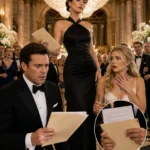
But Grandma had asked me, before she died, to protect the family from unnecessary scandal if I could.
“Truth does not always need a stage,” she told me from her hospital bed. “But when it does, don’t be afraid of the lights.”
So I stayed quiet.
For seven years, I managed the Margaret House Fund.
Quietly.
No plaques. No ribbon cuttings. No pastel sweaters. The fund paid for winter coats, asthma inhalers, emergency rent, summer camp fees, school supplies, eyeglasses, therapy sessions, and more cafeteria balances than I could count.
I learned the language of quiet need.
Negative lunch account.
Medication not covered.
Mother between jobs.
Grandfather raising three children on disability.
Student unable to attend field trip.
Every month, I reviewed requests with Marisol and Harlan. Every month, I signed checks. Every month, the world remained full of children whose lives could tilt because one adult decided not to look away.
My family never asked what I did with the trust.
They only accused me of using Grandma’s money to feel superior.
Then came Brantley Elementary.
Noah transferred there in second grade after I moved us into a small townhouse fifteen minutes from my office. Brantley was a good public school, but the district was split between wealthy neighborhoods and families living so close to the edge that one missed paycheck became a crisis.
I first noticed the lunch problem on a rainy Wednesday.
I had arrived early to pick up Noah for a dentist appointment. In the hallway outside the cafeteria, a boy stood with his shoulders hunched while a cafeteria cashier spoke softly to him. I could not hear every word, but I heard enough.
Negative balance.
Call home.
Alternative meal.
The boy stared at the floor.
He was not crying, which made it worse.
Children who cry still believe someone might comfort them.
That evening, I asked Noah if kids ever had trouble buying lunch.
He shrugged, then said, “Sometimes they get cheese sandwiches. Trevor hates them. He says they taste like wet paper.”
The next morning, I emailed Principal Alvarez.
She answered with cautious professionalism at first. Schools are careful with shame. But after I explained the Margaret House Fund, she invited me to her office.
She was a woman in her fifties with silver-streaked black hair, kind eyes, and the exhausted posture of someone who had caught too many children before they hit the ground.
“The total for Brantley alone is $18,742.63,” she said, sliding a folder across her desk. “District-wide, including all elementary and middle schools, it is higher.”
“How much higher?”
She hesitated. “A little over $146,000.”
I thought of the hotel ballroom where my mother had once spent eighty thousand dollars on flowers for a cancer benefit.
I thought of Madison’s birthday brunch, where guests drank champagne under a custom floral arch.
I thought of Trevor’s face.
“Send me the official account summary,” I said. “All of it.”
Principal Alvarez stared at me.
“All of it?” she repeated.
“Yes.”
The Margaret House Fund could cover it, but not without reducing reserves. I reviewed the numbers for three nights. Then I used part of my own savings too, because Grandma’s fund was meant to continue after me, and because some debts feel personal even when they are not yours.
The first payment cleared Brantley’s cafeteria balances.
The second cleared the middle schools.
The third cleared the remaining elementary schools in the district.
I requested anonymity.
Principal Alvarez cried when I told her.
Not until later, in my car, where no one could see.
For six months, no child in our district carried lunch debt.
Noah came home one afternoon and told me Trevor got hot lunch again.
“He smiled today,” Noah said.
That was enough.
It should have stayed enough.
Then Madison found the school.
Not the debt.
The camera-friendly version of the school.
A board member at my mother’s garden club mentioned that Brantley needed volunteers for a literacy fundraiser. Madison arrived two weeks later with a photographer, three boxes of pastries from a bakery she did not pay, and a caption about “showing up for children.”
My parents praised her for days.
When I told my mother that volunteering was good but Madison should coordinate with the actual school needs, she sighed.
“Evelyn, must you diminish everything your sister does?”
“I’m not diminishing it.”
“You are. Madison is trying. Why can’t you be happy for her?”
Because Madison was not trying.
She was posing.
But I had learned long ago that truth without documents was just noise to my family.
So I said nothing.
And Madison grew bolder.
She launched the Brantley Children’s Initiative through the Whitmore Family Foundation, though the foundation had not yet donated anything beyond promotional materials. She gave interviews about food insecurity without knowing how lunch accounts worked. She posted photos with children whose parents had not been properly asked for permission until Principal Alvarez intervened.
When Principal Alvarez corrected her, Madison complained to my mother that the school was “hostile to donors.”
My mother blamed me.
“She says the principal acts strangely around her because of you,” Mom said over the phone.
“Because of me?”
“You can be very territorial, Evelyn. Madison is allowed to care about your son’s school.”
“My son’s school is not a stage.”
There was a silence.
Then my mother said the sentence she always used when she wanted me to shrink.
“You have become so hard.”
Maybe I had.
Soft things do not survive being stepped on forever.
Chapter 3: The Family Table Where I Was Always the Bill
The week before the fundraiser, my mother summoned me to Sunday dinner at the mansion.
Summoned, not invited.
The text arrived in the family group chat, where Madison’s messages were full of heart emojis and my replies were usually ignored.
Mom:
Sunday dinner at 6. Madison has exciting news. Evelyn, please make an effort to be on time.
I stared at the message while Noah built a Lego spaceship on the floor.
“Are we going to Grandma’s?” he asked.
He looked up. “Do I have to wear the itchy shirt?”
“No.”
“Will Aunt Madison be there?”
His face changed.
Children know when adults are unsafe long before they have language for it.
“She always asks if I’m still shy,” he said.
“I’m not shy. I just don’t like talking to her.”
I sat beside him. “You don’t have to perform for anyone.”
He nodded, too serious for seven.
That evening, the Whitmore dining room looked exactly as it had when I was a child: twelve chairs, polished mahogany, oil portraits, silver candlesticks, my mother’s blue-and-white china. Even the air felt expensive, scented with lemon polish and lilies.
Madison arrived twenty minutes late and received applause.
Not real applause. Worse. The emotional version.
My mother rose to kiss her. My father smiled. My aunt Celeste exclaimed over her sweater. My cousin Blair asked about her Instagram campaign. Madison apologized dramatically, saying she had been “on a call about the children.”
No one asked which children.
No one asked what the call accomplished.
I had arrived ten minutes early with Noah and a container of soup for my father, whose blood pressure medication made him nauseous. I put it in the refrigerator without mentioning it.
No one noticed.
At dinner, Madison announced that the Brantley fundraiser had outgrown the school gym and would now be held at the Bellwether Hotel.
“It gives the cause dignity,” she said, lifting her wineglass.
Principal Alvarez had not wanted the hotel. She worried it would alienate the families the event was meant to help. But Madison had persuaded my mother, and my mother had persuaded two board members, and suddenly the fundraiser became a gala.
A gala for school lunch debt that Madison still did not know existed.
My father beamed. “Excellent. Presentation matters.”
“It’s not just presentation,” Madison said. “It’s leadership. People need someone they can trust to represent the cause.”
Her eyes flicked toward me.
I cut Noah’s chicken into smaller pieces.
My mother noticed. “Noah is old enough to cut his own food, Evelyn.”
“He asked me to.”
“I didn’t hear him.”
I looked at her.
She looked back, elegant and cold.
Madison smiled. “Mom just means you baby him.”
Noah went still.
I set down the knife.
“He is seven,” I said evenly.
Madison laughed. “And yet somehow I survived childhood without being treated like glass.”
I wanted to say that Madison had not survived childhood. She had been carried through it on pillows and excuses.
Instead, I reached for my water.
My father cleared his throat. “Let’s not start.”
That meant I should not respond.
It never meant Madison should stop.
Madison leaned back in her chair. “I just think children need resilience. That’s why this school project matters. Some parents create dependency, and then society has to fix it.”
I felt Noah look at me.
My mother added, “It is refreshing to see Madison taking a mature approach to charity.”
A mature approach.
Madison had called Marisol the day before and demanded the names of “the poorest kids” for a video segment.
Marisol refused.
Madison told my mother I had hired rude staff.
I looked down the table at my father. “Has the foundation actually transferred funds to the school yet?”
Silence.
Madison’s smile sharpened. “We are building awareness first.”
“Awareness doesn’t feed children.”
My mother’s fork hit her plate.
“Evelyn,” she warned.
Madison put one hand to her chest. “Wow. I didn’t realize compassion had to be competitive.”
“It doesn’t.”
“Then why are you acting like I’m doing something wrong?”
“Because you’re talking about hungry children like they’re branding material.”
The room froze.
My aunt Celeste inhaled.
My father’s face darkened. “That is enough.”
Madison’s eyes watered instantly.
It was impressive, really. If tears were currency, my sister would have been the richest woman in North Carolina.
“I’m trying to help,” she whispered. “And she hates me for it.”
My mother reached for her hand.
My father turned to me. “Apologize.”
His chair creaked as he sat back. “Excuse me?”
“I said no.”
Noah stared at his plate.
My father’s voice lowered. “You come into my home, insult your sister at my table, and refuse to apologize?”
“I answered a question.”
“You attacked her character.”
“She attacked mine first. You just don’t count it when she smiles.”
My mother gasped as if I had thrown wine on the portrait wall.
Madison cried harder.
My father stood.
Noah flinched.
That was the moment something inside me went very quiet.
Not broken.
Finished.
I placed my napkin beside my plate and stood too.
“Noah,” I said gently, “get your coat.”
My mother looked panicked now, not because I was hurt, but because I was no longer playing my assigned role.
“Evelyn, don’t be dramatic.”
“I’m leaving.”
My father’s jaw worked. “Sit down.”
Madison sniffed. “This is what she does. She makes everything uncomfortable and then leaves so we all feel guilty.”
I turned to her.
For one second, I saw the real Madison underneath the tears: satisfied, bright-eyed, eager.
She wanted me to explode.
She wanted me to prove the story she told about me.
Jealous Evelyn. Angry Evelyn. Difficult Evelyn.
I smiled.
It was small, and it frightened her more than anger would have.
“Enjoy your fundraiser,” I said.
Then I took Noah home.
That night, after he fell asleep, I opened my laptop.
There are moments in life when you do not decide to fight. You simply stop preventing the truth from defending you.
I emailed Harlan Pierce.
Subject: Authorization for Disclosure
Harlan called me ten minutes later.
His voice was rough with age. “Evie, are you certain?”
I stood at my kitchen counter in the dark, one hand wrapped around a mug of tea gone cold.
“I’m not going to announce everything,” I said. “But if the school wants to thank the donor, they can use my name.”
“And the source of funds?”
“If asked, you may confirm the Margaret House Fund and personal contribution.”
He was quiet.
Then he said, “Your grandmother would approve.”
I closed my eyes.
“I hope so.”
“She would,” he said. “She was tired of watching you carry people who complained you were standing in their way.”
I laughed once, softly, but it hurt.
“There’s more,” Harlan said.
The tone of his voice changed.
I opened my eyes.
“What?”
“I received the preliminary audit from the Whitmore Family Foundation.”
I straightened.
Two months earlier, Harlan had warned me that Madison’s new initiative looked unusual on paper. As trustee of Grandma’s charitable fund, I had a duty to avoid co-mingling with other organizations unless they were transparent. When Madison began using the Brantley name in foundation materials and implying partnership with the Margaret House Fund, Harlan requested documentation.
Madison ignored him.
So he requested it formally.
The foundation’s outside accountant, perhaps not realizing the family politics, sent records.
“What did you find?” I asked.
“Madison authorized reimbursements to herself under the Brantley Children’s Initiative.”
“How much?”
“Forty-eight thousand dollars.”
I gripped the counter.
“For what?”
“Consulting fees. Wardrobe. Photography. Event design. Social media strategy. A hotel suite listed as donor coordination.”
I thought of Trevor and the wet-paper cheese sandwich.
My voice turned cold. “Did any money go to the school?”
“Not according to the records we have.”
I looked down the hall toward Noah’s room.
My family had praised Madison for generosity while she used a children’s fundraiser to reimburse herself for looking generous.
“Can you prove it?” I asked.
“Legally?”
“Publicly?”
A pause.
“If needed.”
I stared at my reflection in the kitchen window. I looked calm. Almost unfamiliar.
“Then bring the folder to the gala,” I said.
“Evie—”
“I’m not planning a scene. But if they make one, I want the truth in the room.”
Harlan sighed.
Not because he disapproved.
Because he knew my family would make one.
They always did.
The day before the fundraiser, my father called me.
No greeting.
“What have you been saying to the school board?”
“Nothing.”
“Madison says Principal Alvarez is refusing to let her speak last.”
“Maybe Principal Alvarez has a program.”
“Don’t be clever.”
I folded laundry while he spoke. Noah’s socks. My blouse. A towel with a fraying edge.
“I’m not involved in the program,” I said.
“You are always involved while pretending not to be.”