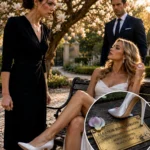
“Claire, why can’t you just let me have one thing?”
The table went quiet.
That was the moment I almost lost my composure.
Not outwardly.
Inside.
Because she truly believed it.
My sister, who had been handed my money, my protection, my family’s tenderness, my grandmother’s bracelet, my grandfather’s trust, my parents’ excuses, and now nearly my wedding day, looked at me in a private dining room and asked why I couldn’t let her have one thing.
I took a slow breath.
“Vivi,” I said softly, “name one thing I had that you didn’t try to take.”
Her face hardened.
My mother whispered, “Cruel.”
Margaret Hale’s eyes moved from Vivienne to me with new attention.
Preston finally spoke.
“Maybe we should pause.”
Vivienne turned on him. “No. She wants to humiliate me.”
I stood.
Every head lifted.
My father barked, “Sit down.”
I picked up the settlement agreement.
For one second, my mother looked relieved.
Then I tore it cleanly in half.
Not dramatically. Not into confetti.
Just once.
A neat, final sound.
“I’ll see you in court,” I said.
And I left the Bellevue Club with every old-money eye in the dining room following me.
Behind me, Vivienne’s voice rose for the first time.
“She can’t do this!”
But I already had.
Chapter 4: The Contract Opens
The courthouse was not beautiful.
That felt appropriate.
Newport County Probate Court sat in a pale stone building with fluorescent lighting, worn benches, and the kind of silence that made perfume seem too loud.
On the morning of the emergency hearing, rain struck the tall windows in nervous sheets.
My family arrived together.
My father wore charcoal gray and righteous fury.
My mother wore navy and pearls.
Vivienne wore winter white, because she had never understood subtlety.
Preston came, but he did not sit beside her at first. Margaret Hale sat in the second row with a lawyer I did not recognize, which meant the Hales were no longer watching as family.
They were watching as risk management.
I sat beside Wallace Grant and his younger partner, Maya Ellis.
Ethan sat behind me.
He did not touch my shoulder. He knew I was holding myself together with a discipline too fragile for public comfort.
But when I glanced back, he looked at me like I was not alone.
That was enough.
The hearing began with the usual formalities.
Then Wallace stood.
He was old, yes. He moved slowly. But when he spoke, the room seemed to remember he had spent five decades making powerful men regret casual lies.
“Your Honor,” he said, “we are here because Claire Whitaker, rightful forty-percent shareholder of Whitaker & Lowe Development and beneficiary of the Henry Whitaker Trust, was systematically denied knowledge of her ownership rights while her signature was forged to authorize distributions exceeding six hundred thousand dollars.”
My mother made a small choking sound.
The judge looked over her glasses.
My father’s attorney rose quickly.
“These are inflammatory allegations in a family dispute.”
Wallace nodded.
“Fortunately, we brought documents rather than adjectives.”
Maya connected a laptop.
The first exhibit appeared on the courtroom screen.
My grandfather’s will.
Henry Whitaker’s signature.
The ownership allocation.
Claire Whitaker: 40%.
Robert Whitaker: 35%.
Vivienne Whitaker Trust: 15%.
Linda Whitaker: 10%.
My father stared forward, jaw locked.
The second exhibit appeared.
The acknowledgment of receipt.
My forged signature.
Wallace placed a real signed company document beside it.
The difference was obvious.
Then came the trust withdrawals.
Line by line.
Boston apartment.
V.W. Studio.
Blackwell Academy.
Range Rover lease.
Sedona retreat.
Saks purchase.
Company debt support.
Each with documents.
Each with signatures.
Each with my name attached.
The courtroom’s silence deepened with every page.
Vivienne stopped looking bored around the third exhibit.
By the fifth, she leaned toward my mother and whispered something.
The judge noticed.
“Ms. Whitaker,” she said.
Both of us looked up.
“Vivienne Whitaker,” the judge clarified.
Vivienne flushed.
“Do you need a break?”
“No, Your Honor.”
Her voice was small now.
It did not work as well in court as it did in dining rooms.
Wallace played the Hawthorne House security footage next.
There was Vivienne in my bridal robe.
There was my mother saying, “This is supposed to be a happy day.”
There was my father claiming he was preventing a family issue.
There was Eleanor Ashford saying clearly:
Hearing it again in that courtroom felt different.
At Hawthorne House, the words had protected my wedding.
In court, they exposed the pattern.
My family had not misunderstood permission.
They had simply stopped believing mine mattered.
Then Wallace called Eleanor Ashford as a witness.
She wore the same green suit.
She testified that Robert Whitaker had contacted Hawthorne House requesting a transfer of the reservation, stating that “Claire had agreed in principle” and that any additional costs could be billed through Whitaker & Lowe.
“Did Claire Whitaker ever provide such consent?” Wallace asked.
“No,” Eleanor said.
“Did Vivienne Whitaker represent that consent had been given?”
Vivienne’s eyes filled again.
The judge did not soften.
Then came Nora.
I had not known Wallace had subpoenaed her until she walked in.
Our receptionist looked terrified, but she sat straight.
She testified that she had been asked by my father to scan signed approvals that I had never brought to her.
She testified that Vivienne had come into the office after hours multiple times.
She testified that two weeks earlier, she overheard Vivienne say to me, “You weren’t using the money.”
Vivienne’s face went white.
My mother whispered, “Nora, how could you?”
The judge snapped, “Mrs. Whitaker.”
My mother closed her mouth.
Then Maya introduced the emails.
Claire will ask questions if she receives the Grant packet directly.
Better that we manage it.
Vivi cannot know Claire’s trust paid the lease.
She’ll feel judged.
Just sign Claire’s part.
The last email sat on the screen.
Black letters.
White background.
No emotion.
Utter devastation.
The room went completely silent.
Not courtroom quiet.
Soul quiet.
The kind of silence people enter when a lie finally dies and everyone is afraid of the body.
Vivienne stared at the screen like betrayal had happened to her.
My father turned slowly toward her.
My mother covered her mouth.
Aunt Linda, sitting behind them, looked down at her hands.
Preston stood.
Vivienne grabbed his sleeve.
“Don’t,” she whispered.
He looked at her hand, then gently removed it.
That was her first public loss.
Not the money.
Not the venue.
The moment a man raised inside privilege looked at her and saw liability instead of charm.
Wallace turned to my father.
“Mr. Whitaker, did you sign as trustee on withdrawals from Claire Whitaker’s trust?”
My father’s attorney objected.
The judge allowed the question.
My father stood.
He looked smaller than I remembered.
“We used family resources to support family needs,” he said.
Wallace’s voice stayed mild.
“Did you inform Claire that these resources were legally hers?”
My father’s mouth opened.
Closed.
“Did she authorize these withdrawals?”
My father glanced at my mother.
The word landed harder than any apology could have.
My mother began to cry silently.
Wallace asked, “Did you allow your daughter Vivienne to believe she was receiving parental support when in fact the funds came from Claire’s trust?”
My father swallowed.
Vivienne exploded.
“You said it was family money!”
The judge’s eyes sharpened.
My father snapped, “Sit down.”
“No!” Vivienne’s voice cracked, high and furious. “You said Grandpa wanted me taken care of too!”
“He did,” Wallace said calmly. “Through a restricted trust that you were not allowed to access freely because he was concerned about your spending.”
Vivienne turned scarlet.
The courtroom inhaled as one.
The truth beneath the inheritance.
My grandfather had not forgotten Vivienne.
He had seen her.
That was worse.
Wallace introduced the trust clause.
Vivienne’s funds were to be released only for education, verified housing, medical necessity, or business investment approved by an independent trustee.
No luxury leases.
No jewelry.
No retreats.
No weddings.
Vivienne looked at my mother.
“You told me Grandpa was punishing Claire because she left for Chicago.”
My mother whispered, “I was trying to protect you.”
“From what?” I asked.
Everyone turned.
It was the first time I had spoken in the hearing beyond confirming my name.
My mother looked at me with wet eyes.
I stood slowly.
The judge allowed it.
My voice was quiet.
“From knowing that Grandpa trusted me?”
My mother’s face crumpled.
Not loud.
Final.
“You protected Vivi from consequences. You protected Dad from accountability. You protected yourself from admitting you stole from one daughter to comfort another.”
My father flinched.
I looked at Vivienne.
“And you protected my sister from ever learning the difference between being loved and being funded.”
Vivienne’s tears spilled.
“I didn’t know.”
That might have been partly true.
But partial innocence does not erase full participation.
“You knew enough,” I said.
She shook her head. “Claire, I didn’t know it was yours.”
I thought of her in my office chair.
You weren’t using the money.
“Yes,” I said. “You did.”
Her mouth trembled.
For once, no one rushed to hold her.
The judge ordered an immediate freeze on contested trust assets, suspended Robert Whitaker’s authority as managing officer pending full accounting, and appointed an independent forensic accountant.
She also prohibited Whitaker & Lowe from using company funds for the Hale-Whitaker wedding or any family event.
Then she addressed me.
“Ms. Whitaker, based on the ownership documents presented, your shareholder rights are recognized pending final review. You and counsel may petition for interim operational control if company assets are at risk.”
My father closed his eyes.
Maya leaned toward me and whispered, “We file today.”
Across the aisle, Vivienne whispered to Preston, “Say something.”
He looked at her for a long moment.
Then he said, “My family can’t be involved in this.”
Her face collapsed.
“But we’re getting married.”
Preston did not answer.
Margaret Hale rose, smoothed her jacket, and left with her lawyer.
The door closed softly behind her.
Vivienne watched it like someone had turned off the sun.
Outside the courtroom, the hallway filled with people pretending not to listen.
My family gathered near the elevators in a broken cluster.
My father approached first.
His anger was gone, which somehow made him harder to look at.
“Claire,” he said.
For years, I had wanted him to say my name like that.
Not as a warning.
Not as a burden.
As if I mattered.
Now it arrived too late, carrying nothing I could use.
“I made mistakes,” he said.
“Mistakes are when you forget a birthday. Not when you forge a signature for nine years.”
He looked down.
My mother stepped forward, crying openly.
“I thought you were strong enough.”
That sentence hit harder than I expected.
Because it was almost honest.
“I was a child,” I said. “Then I was a young woman. Then I was your daughter. I was never supposed to be strong enough to survive you.”
She covered her mouth.
Vivienne hovered behind them, mascara streaked, diamond bracelet still on her wrist.
For once, it looked ridiculous.
“Claire,” she whispered. “Please. My wedding—”
I laughed softly.
Not because anything was funny.
Because even ruined, she reached for the same thing.
“My wedding,” I corrected.
Her face twisted.
“You’re really going to keep it?”
I looked at her for a long time.
Then I said, “No.”
Everyone froze.
Vivienne’s eyes sparked with hope.
I took out my phone and called Eleanor Ashford.
She answered on the second ring.
“I’d like to cancel the June fourteenth wedding.”
Ethan, standing behind me, went still.
I turned and met his eyes.
He understood before anyone else did.
I put the phone on speaker.
Eleanor said, “Are you certain?”
“Yes. Please apply the cancellation terms as written.”
My mother whispered, “Claire, why?”
I did not look away from Vivienne.
“Because I don’t want to marry Ethan in a garden my family tried to turn into a crime scene.”
Vivienne’s hope drained.
Eleanor said gently, “Understood.”
“And Mrs. Ashford?”
“If Hawthorne House has availability later this year for a smaller ceremony, with only people who actually love us, please have Melanie call me.”
Then Eleanor said, “I’ll personally see to it.”
I ended the call.
Vivienne stared at me.
“But the date—”
“Gone,” I said.
My father looked stunned. “You gave it up?”
“No,” I said. “I chose peace over performance. There’s a difference.”
That was the power reversal no one expected.
They had spent weeks trying to take my venue because they believed owning it was the victory.
But the real victory was being able to release what they had contaminated.
I turned to my parents.
“Wallace will communicate with you. Not me.”
My mother sobbed. “You’re cutting us off?”