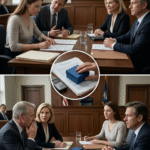
The door opened.
Mara entered with two building-security officers and Thomas Reed, the independent lead director of Langford Meridian.
Graham stopped.
Thomas looked older than he had that morning.
Disappointed men often did.
“I heard enough,” he said.
Graham’s face lost all color.
Mara held out her hand to me.
I gave her the phone.
“Graham Langford,” she said, “effective immediately, the Bennett Continuity Trust revokes your voting proxy pending investigation of material fiduciary misconduct.”
“You cannot do that.”
“She can,” Thomas said.
“I am CEO.”
“You are on administrative leave.”
“This is my company.”
“No,” I said.
The room became perfectly still.
“It never was.”
PART FOUR — THE ENGAGEMENT AT MY HOUSE
The board suspended Graham the next morning.
Langford Meridian issued a brief statement citing an internal review of executive expenditures.
No mention was made of the affair.
No mention was made of Sloane.
No mention was made of the recording in Mara’s evidence vault.
Silence did what scandal could not.
It made the press curious.
By noon, reporters had connected Sloane’s maternity concierge payments to the company account.
By evening, photographs of her engagement ring appeared beside images of the hotel roof whose repair budget had funded it.
The next morning, the New York Ledger printed a headline asking whether Langford Meridian shareholders had financed their chief executive’s second family.
Graham blamed me.
He sent twenty-three messages.
You are destroying the company.
You are humiliating our families.
You know the transactions were temporary.
Sloane is under medical stress.
This is not who you are.
The last one almost made me laugh.
He had mistaken my refusal to destroy him for an inability to do so.
Victoria called Mara, then Thomas, then my mother.
My mother listened for four minutes before saying, “Victoria, your son did not fall into a woman.”
“He climbed.”
Then she hung up.
Despite the investigation, Graham refused to cancel the engagement celebration.
The invitations had been sent.
The flowers were in transit.
The glass pavilion was already rising above Bellweather’s south lawn.
Sloane had told friends that the board suspension was temporary and politically motivated.
Graham told the press he would be fully vindicated.
They moved the event expenses from Langford Meridian to a private account funded by Victoria.
Then Graham’s attorney sent Mara a formal demand for access to Bellweather under the original event contract.
Mara responded with the deed, the trust instrument, the unsigned authorization page, and an invoice for three weeks of unauthorized construction.
He paid it.
I allowed the engagement to proceed.
Mara thought I had changed my mind.
“I have not,” I told her.
“Then why give them the house?”
“I am not giving them anything.”
“What are you planning?”
“A meeting.”
“During the engagement?”
“Before the blessing.”
Mara watched me over her glasses.
“Your grandmother would be proud.”
“My grandmother would ask why it took me this long.”
On November nineteenth, Newport woke beneath a pale sky and a hard Atlantic wind.
Bellweather stood above the cliffs like a gray stone ship, its windows reflecting the sea.
The mansion had forty-three rooms, two libraries, a ballroom, a chapel, and a private harbor built by a railroad family who had lost their fortune before finishing the gardens.
My grandmother purchased it at auction.
She said beautiful things were most useful after arrogant men underestimated their maintenance costs.
By sunset, black cars curved along the drive.
Women stepped onto the gravel in couture gowns.
Men arrived in tuxedos and private conversations.
The guest list included senators, hotel owners, hedge-fund managers, society editors, and three members of the Langford Meridian board who had not yet declared where their loyalties rested.
Sloane had chosen ivory roses and white orchids.
She had suspended ten thousand glass droplets above the ballroom so the ceiling appeared to be raining diamonds.
A string quartet performed beside the staircase where I had once descended in my wedding dress.
Every detail was exquisite.
Every invoice was preserved.
I arrived at seven twenty.
The invitation requested winter white.
I wore black.
Not mourning black.
Authority black.
My gown was silk, severe at the shoulders, with no necklace and no ornament except my grandmother’s sapphire ring.
Mara walked beside me.
Thomas Reed arrived behind us.
Conversation faded as we entered the ballroom.
Some guests looked shocked.
Others looked delighted.
In wealthy circles, morality was flexible.
Spectacle was sacred.
Sloane stood beneath the chandelier in a white beaded gown with one hand resting against the gentle curve of her stomach.
Graham stood beside her in black tie.
For a moment, he looked exactly like the man I had married.
Beautiful.
Certain.
Completely convinced the room belonged to him.
Then he saw me.
The certainty disappeared.
Sloane recovered first.
She crossed the ballroom smiling.
“I did not know you were coming.”
“You mailed me an invitation.”
A woman nearby turned away to hide her expression.
Sloane lowered her voice.
“I assumed you would have the dignity to decline.”
“You addressed it to me personally.”
“It was a mistake.”
“I brought the original in case you need help remembering.”
Her smile froze.
“You cannot ruin tonight.”
“I do not intend to.”
“Then why are you here?”
I looked around the ballroom.
Graham approached.
“You need to leave.”
“Do I?”
“This is a private event.”
“At Bellweather.”
“You authorized access.”
“I did.”
His eyes narrowed.
“Because the board needed everyone in one place.”
He glanced at Mara and Thomas.
“What board?”
“The one meeting in the library at eight.”
“This is not a corporate event.”
“Then you should not have invited six directors and charged the first deposits to the company.”
“I repaid those funds.”
“After the audit began.”
Sloane touched his arm.
“Graham, the photographer is waiting.”
The gesture was small.
Intimate.
For one second, the hospital returned to me.
The blue light.
The empty chair.
The coral lipstick inside his collar.
Pain moved through me, deep and old.
I let it pass.
That was the secret no one had taught Sloane.
A woman could feel everything and still choose her next move.
“I will see you in the library,” I said.
Graham caught my wrist.
The room noticed.
His fingers tightened around the bone.
“You will not turn my engagement into a board meeting.”
I looked down at his hand.
Then back at him.
“Remove it.”
He released me.
Slowly.
Behind us, the quartet continued playing, though two violinists had begun watching.
“Enjoy your photographs,” I said.
“They may be the last ones taken of you as chief executive.”
At eight, the Bellweather library doors closed.
Seven directors sat around the walnut table.
Graham arrived with Victoria, Sloane, and three attorneys.
Mara sat to my right.
Thomas sat to my left.
Rain had begun against the windows, darkening the ocean beyond the glass.
Graham remained standing.
“This meeting is invalid.”
Thomas opened the board book.
“Notice was properly delivered under the emergency-governance provision.”
“The trust cannot call an emergency meeting during my private event.”
“The trust holds fifty-two percent voting control,” Mara said.
“And your private event is occurring in trust-owned property.”
Victoria looked at me.
“You planned this.”
I placed Sloane’s invitation on the table.
“She did.”
Sloane’s face whitened.
Mara distributed the evidence packets.
The first section contained the engagement invitation, the envelope, the postmark, and the handwritten note.
The second contained the company expenses.
The third documented Aurora Strategic Partners.
The fourth traced the Wexler investor entities to Graham’s college roommate and two private trusts established six weeks before the proposed acquisition.
The fifth included a transcript of the recording.
By the time the directors reached Graham’s statement about making Aurora disappear, no one was looking at him.
He began talking faster.
“The language is being taken out of context.”
“What context improves it?” Thomas asked.
“I was negotiating with my wife.”
“You were describing concealment.”
“I was angry.”
“You were specific.”
Graham turned to me.
“You manipulated that conversation.”
“I asked questions.”
“You knew I was upset.”
“You were not upset when you moved the money.”
Victoria lifted the transcript.
“This recording should be inadmissible.”
“In a divorce hearing, your attorney may raise that argument,” Mara said.
“This is a corporate governance meeting.”
Graham looked toward the three directors who had remained silent.
One of them, Henry Cole, closed the evidence packet.
“I supported the Wexler deal because you represented the investor group as independent.”
“They are independent.”
“One entity shares an address with your personal attorney.”
“That is administrative.”
“Another received funds from Aurora.”
“That was a loan.”
“The third is controlled by your roommate’s wife.”
Graham said nothing.
Henry removed his glasses.
“You lied to the board.”
Outside the library, applause erupted.
The ballroom guests believed the blessing was about to begin.
Inside, the vote began.
Six directors supported termination for cause.
One abstained.
Graham was removed as chief executive at eight thirty-seven in the evening.
The board also canceled the Wexler transaction, referred the Aurora payments to federal investigators, and authorized civil action to recover misused funds.
Sloane sat perfectly still.
Her engagement ring looked enormous beneath the library lights.
Victoria stared at the tabletop.
Graham looked at me.
Not with sorrow.
With disbelief.
“You did this on our engagement night.”
I glanced at the envelope.
“You scheduled your engagement on the night of the meeting.”
His face twisted.
“You let us spend weeks planning this.”
“I told you Bellweather was mine.”
“You wanted to humiliate me.”
“I wanted witnesses.”
Sloane stood abruptly.
“I am pregnant.”
The sentence cut across the room.
Everyone turned.
She pressed one hand to her stomach.
“You cannot throw us into the street.”
“No one is throwing you anywhere,” Mara said.
“The Tribeca condominium remains available pending the asset review.”
Sloane looked at Graham.
He looked away.
That was the moment she understood he had promised the same property to more than one future.
“The apartment is ours,” she said.
Mara turned a page.
“The apartment was purchased with funds diverted from Langford Meridian.”
Sloane’s voice cracked.
“Graham told me it came from his personal account.”
“Graham also told the court he had been separated since January.”
Sloane turned toward him.
“You said March.”
The room went silent.
Graham stared at her.
She continued.
“You told me you moved out in March.”
“You were still living with her.”
“It was complicated.”
“You said the divorce was filed before you proposed.”
“I said it was being handled.”
“You said Bellweather would be ours.”
“It should have been.”
The word should exposed him more completely than any audit.
He believed love entitled him to property.
He believed desire converted ownership.
He believed a promise made by a man became binding merely because a woman wanted to hear it.
Sloane removed her hand from her stomach.
For the first time, she looked young.
Not innocent.
Only unprepared.
A knock sounded at the door.
Elena entered.
“Mrs. Langford, the chapel is ready.”
Every face turned toward me.
“Please inform the officiant that the blessing is canceled.”
Sloane inhaled sharply.
“The guests may stay for dinner,” I continued.
“The musicians and staff will be paid in full.”
Graham laughed bitterly.
“How generous.”
“The food is already prepared.”
“And I do not punish employees for executive misconduct.”
He moved toward me.
“What am I supposed to tell three hundred people?”
“The truth would be memorable.”
I left the library.
Mara and Thomas followed.
Behind us, Victoria began speaking in a low, urgent voice.
Sloane started crying.
Graham said her name once.
She told him not to touch her.
When I entered the ballroom, the guests turned toward the staircase.
The quartet stopped.
Rain streaked the tall windows.
Beyond them, the glass pavilion glowed above the dark lawn like a palace made of ice.
I stepped onto the first stair.
“Thank you for coming to Bellweather,” I said.
The room became silent.
“There has been a change to this evening’s program.”
A society reporter near the bar lifted her phone.
“The private blessing will not take place.”
Whispers moved through the crowd.
“Dinner will be served as planned, and the staff will be paid in full.”
I paused.
“Bellweather has always been a house where vows matter.”
No one moved.
“Tonight, it will remain one.”
I descended the staircase.
The first person to approach was an eighty-year-old hotel owner who had known my grandmother.
She took my hand.
“Margaret would have enjoyed that,” she whispered.
“She would have charged them rent.”
The woman laughed.
Then the room exhaled.
Dinner was served.
Half the guests stayed because they supported me.
The other half stayed because they wanted to see what happened next.
At nine fifteen, Graham and Sloane left through separate doors.
At nine forty, the fireworks contractor asked whether he should cancel the display.
I looked at the boxes arranged along the cliff.
“Can you change the colors?”
“To what?”
“Blue and gold.”
The Bennett colors.
At ten, fireworks rose above the Atlantic.