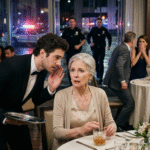
They did not celebrate an engagement.
They announced a change in ownership the Langfords should have remembered had happened decades earlier.
I stood alone on the terrace while gold light broke across the water.
For the first time since the hospital, I breathed without feeling something missing from the room.
PART FIVE — THE COURTROOM WHERE TITLES EXPIRED
The divorce lasted eleven months.
Graham fought every page.
He challenged the trust.
He challenged the recording.
He challenged the expense audit, the building logs, the insurance declaration, the marital agreement, and the authority of the board that had removed him.
He claimed I had conspired to destroy his reputation.
He gave interviews about betrayal while his attorneys argued that evidence of his betrayal should remain private.
Sloane left the Tribeca condominium six weeks after the engagement.
She moved into a hotel suite paid for by Victoria and stopped wearing the twenty-carat ring in public.
For a time, she remained loyal to Graham.
Then federal investigators subpoenaed Aurora’s records.
The possibility of prison has a clarifying effect on romance.
Sloane hired her own attorney.
She surrendered emails, invoices, voice messages, and copies of the documents Graham had asked her to sign.
Among them was a draft amendment transferring Bellweather’s management rights to Aurora after the Wexler acquisition.
Another promised Sloane a five-percent ownership interest in Langford Meridian.
Graham did not own five percent to give her.
He had built their future from assets belonging to other people.
The pregnancy continued.
I never sought medical details.
The child was innocent.
Whatever Graham and Sloane had done, I would not turn a baby into evidence unless the law required it.
The law eventually did.
Not because of me.
A man named Julian Cross filed a private paternity action.
Julian had been Langford Meridian’s outside media consultant before Sloane joined the company.
He and Sloane had maintained a relationship during the same period she began seeing Graham.
The paternity test established that Graham was not the father.
I learned the result from Mara three days before the final divorce hearing.
We were sitting in her office, reviewing the settlement chart.
She placed the report face down.
“You do not need this to win.”
“I know.”
“Graham’s misconduct is already established.”
“Do you want it excluded from our argument?”
“It may become public through the separate case.”
“That is not my decision.”
“He used the pregnancy to justify the engagement.”
“The child did not.”
Mara nodded once.
That was the end of it.
I did not celebrate when Sloane’s lie was exposed.
There are victories that make you larger.
There are others that merely reveal how small everyone involved has become.
Graham learned the truth in a private conference room.
According to his attorney, he sat alone for twenty minutes afterward.
Then he called me.
I answered because the case was almost over and because some doors should be closed while both people are awake.
“Did you know?” he asked.
“Not until this week.”
“You must be pleased.”
“Do not pretend to be above this.”
“I am not above it.”
I looked at the files covering my desk.
“I am beyond it.”
His breathing sounded uneven.
“She lied to me.”
“She let me believe that child was mine.”
“I destroyed my marriage for her.”
The words came softly.
“You destroyed our marriage for yourself.”
“You did not betray me because she was honest.”
“You betrayed me because you believed your wanting her made dishonesty acceptable.”
“I loved her.”
“You do not believe me.”
“I believe you loved how she looked at you.”
“How is that different?”
“You never had to become better to deserve it.”
The silence stretched.
When he spoke again, his voice was smaller.
“Was there ever a chance for us?”
I closed my eyes.
The question returned me to the hospital room.
To the empty chair.
To the hope I had defended long after it stopped defending me.
“There were hundreds,” I said.
“You used all of them.”
He began to say my name.
I ended the call.
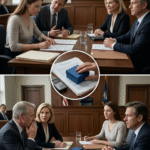
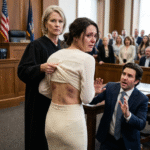
The final hearing took place on a gray September morning in Manhattan Supreme Court.
Reporters waited behind barricades outside.
Inside, the courtroom smelled of polished wood, paper, and rain drying on wool coats.
Graham sat at the opposite table.
Eleven months without the company had altered him.
The tailoring remained perfect.
The certainty did not.
Victoria sat behind him.
She wore black and held her handbag with both hands.
Sloane was not present.
By then, she had given birth to a healthy son and moved to California.
Her cooperation agreement protected her from certain civil claims in exchange for testimony concerning Aurora.
She sent a written apology through her attorney.
I did not answer it.
The judge reviewed the evidence without drama.
That was what I liked about courtrooms.
Luxury could distract.
Charm could redirect.
A beautiful lie could survive for years at dinner tables.
In court, dates remained dates.
Signatures remained signatures.
Money left trails.
The postmarked invitation established that Graham and Sloane had publicly represented an engagement before either spouse filed for divorce.
The building records disproved Graham’s claim of a January separation.
The corporate audit established misuse of company funds.
The recording established intent to hide assets and dilute the controlling trust.
The marital agreement established the consequences.
Graham forfeited all claims to appreciation in trust-owned property during the marriage.
He surrendered his unvested executive shares.
He repaid the misappropriated funds through the sale of his personal holdings, including the yacht interest he had hidden through Aurora.
He retained a townhouse inherited from his grandfather, his personal investment accounts, and a diminished minority stake in Langford Meridian.
The court granted my petition.
No alimony was awarded to either party.
The Park Avenue duplex, Bellweather Estate, the Connecticut house, the Paris apartment, and the underlying hotel properties remained with the Bennett Continuity Trust, exactly where they had always been.
After the ruling, Graham approached me in the courthouse corridor.
Mara remained several feet away.
So did the security officers.
Graham looked toward the windows.
Rain moved across the city in fine silver lines, the same way it had on the afternoon the invitation arrived.
“You won,” he said.
“This was not a game.”
“It felt like one.”
“That may have been the problem.”
He looked older than forty.
Not because of wrinkles.
Because the future no longer arranged itself around him.
“Do you hate me?” he asked.
The answer surprised him.
It surprised me less.
Hatred required an intimacy I no longer possessed.
“I thought you would always protect me,” he said.
“Until you didn’t.”
“Until protecting you required betraying myself.”
He looked at my bare left hand.
“I never understood how much you controlled.”
“You let me believe it was mine.”
“I let you believe we were building it together.”
His mouth tightened.
“Is that supposed to make me feel better?”
Behind him, Victoria emerged from the courtroom.
She stopped when she saw us.
For a moment, she looked as though she wanted to say something.
An apology, perhaps.
Or another explanation shaped like one.
Instead, she gave me a small nod.
I returned it.
We had both lost a version of Graham.
The difference was that she would spend the rest of her life pretending hers still existed.
Graham placed his hands in his coat pockets.
“What will you do with Bellweather?”
“Live there sometimes.”
“And the company?”
“Repair it.”
“You think you can run it without me?”
“I already was.”
He flinched.
I had not meant it cruelly.
Truth often sounded cruel when spoken after years of courtesy.
A reporter called my name from the far end of the corridor.
Graham looked toward the sound.
“Are you going to tell them everything?”
“Why not?”
“Because not every humiliation needs an audience.”
His eyes lowered.
For the first time in twelve years, he appeared ashamed.
Not because he had been caught.
Because I had offered him more dignity in defeat than he had offered me in marriage.
“I am sorry about our daughter,” he said.
My breath caught.
He had not spoken of her in months.
Perhaps years, if silence could be measured honestly.
“Her name was Eleanor Margaret,” I said.
He closed his eyes.
I looked at him.
“You know now.”
Then I walked away.
A WARM CONCLUSION — THE HOUSE THAT REMEMBERED MY NAME
One year after the engagement that never happened, Bellweather reopened.
Not as a private monument to my victory.
Not as a museum of betrayal.
I had spent enough of my life inside rooms arranged around Graham’s choices.
The west wing became a residency for women rebuilding careers after financial abuse, public scandal, or family crisis.
The program provided legal counsel, temporary housing, financial planning, and something wealth could not always purchase.
Time without fear.
The ballroom hosted its first event in October.
No diamonds hung from the ceiling.
No society photographers waited at the staircase.
We filled the room with candles, autumn branches, long tables, and bowls of white roses from my mother’s garden.
The women in the inaugural residency attended with their children.
Some wore gowns.
Others wore borrowed dresses, office suits, or shoes purchased that afternoon.
No one cared.
Rose gave the first toast.
She stood beneath the chandelier holding a glass of champagne and looked at me with the same fierce expression she had worn beside my hospital bed.
“To my sister,” she said.
“The only woman I know who can turn an eviction notice into a foundation.”
Laughter rose around the room.
I laughed too.
It came easily.
That surprised me.
After dinner, a little girl named Sophie wandered into the library.
Her mother had left a marriage with two suitcases and fourteen dollars.
Sophie stood beneath my grandmother’s portrait and studied it.
“Was she a queen?” she asked.
“Did she own this castle?”
“Then she was almost a queen.”
I knelt beside her.
“She was better than a queen.”
“Because she knew the castle was only useful if people felt safe inside it.”
Sophie considered this.
Then she pointed toward the display case beneath the portrait.
Inside rested the cream invitation, the original envelope, and the handwritten note.
My wedding ring was no longer there.
I had removed it before the trial and melted it into two small gold keys.
One opened the legal office in Bellweather’s west wing.
The other hung on a chain around my neck.
“What is that?” Sophie asked.
“An old invitation.”
“Did you go?”
“Was it fun?”
I looked through the library doors.
Children were running through the ballroom while their mothers danced beneath the chandeliers.
Mara stood near the fireplace speaking with Rose.
My mother was correcting the placement of a flower arrangement no one else believed needed correcting.
Outside, the Atlantic reflected the last light of evening.
“Yes,” I said.
“In the end, it was.”
Later that night, after the guests had gone, I walked alone to the chapel.
We had restored the damaged roof and opened the doors to the sea.
The altar remained simple.
The same wooden pews stood in neat rows.
For years, I had believed the chapel belonged to the memory of my wedding.
Now it felt like what it had always been.
A room.
Stone, wood, glass, and light.
Places did not betray us.
People did.
And sometimes, after enough time, places allowed us to write something kinder over the pain.
I lit a candle for Eleanor Margaret.
I did not ask the universe why she had been taken.
I did not ask whether Graham remembered her birthday.
I did not ask whether the life we had planned might have saved our marriage.
Some questions were only cages with beautiful doors.
I stood until the flame became steady.
Then I walked back toward the house.
Mara was waiting in the library with two glasses of wine.
“You disappeared,” she said.
“I was saying good night.”
She handed me a glass.
Her gaze moved toward the invitation beneath the glass.
“Do you ever wish Sloane had not sent it?”
I considered the question.
Without the envelope, I might have remained silent longer.
I might have accepted another lie, another late night, another explanation that required me to doubt what I had seen.
Graham might have completed the Wexler transaction.
Aurora might have vanished.
Bellweather might have become the stage for a wedding paid for with money taken from the company my family had saved.
The invitation had been intended as proof that I had been replaced.
Instead, it became proof that they had acted too early.
Sloane had believed the word former could erase me.
Graham had believed filing papers could rewrite a date.
Neither understood that ink worked both ways.
It could insult.
It could also testify.
I touched the old postmark beneath the glass.
Then I smiled.
I said, “Former is a dangerous word before court.”