The woman sleeping with my husband sat beneath a brass plaque engraved **WIFE** and smiled into three cameras as if she had won something.
My husband looked at her instead of the empty chair beside him and called our twelve-year marriage the longest mistake of his life.
The podcast host laughed awkwardly and reminded Camille Rhodes that the chair was meant for the legal spouse.
Camille crossed one silk-covered leg over the other and rested her manicured hand on the armrest.
“Future wife is close enough,” she said.
Graham smiled.
Not nervously.
Not apologetically.
Proudly.
The man whose last name I had polished into a luxury empire leaned toward the microphone and said, “Camille is the healing chapter after a very long mistake.”
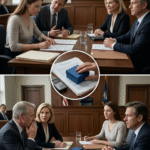
I listened from the forty-second floor of Bennett, Shaw & Pierce, where my divorce attorney had already placed three documents in front of me.
A petition for dissolution.
An emergency motion to freeze marital assets.
And a sealed envelope Graham had spent twelve years believing did not exist.
Naomi Bennett watched the podcast on the wall-mounted screen without blinking.
She was fifty-three, silver-haired, and famous for making wealthy men regret underestimating quiet women.
“Do you want me to stop the broadcast?” she asked.
I looked at the woman sitting in my chair.
Then I looked at my husband, who believed humiliation was leverage.
“No,” I said.
“Let them finish.”
# PART ONE
## THE CHAIR WITH MY NAME ON IT
The podcast was called *Uncoupled*, a glossy Manhattan production where actors, athletes, politicians, and disgraced billionaires discussed the end of their marriages beneath flattering amber lights.
The set was designed to look intimate and expensive.
Two cream velvet chairs faced each other across a smoked-glass table.
One chair had a brass plaque reading **HUSBAND**.
The other read **WIFE**.
Behind them, the skyline of Lower Manhattan shimmered through floor-to-ceiling windows.
Graham sat in the husband’s chair wearing the charcoal Tom Ford suit I had bought him for our tenth anniversary.
Camille sat in mine wearing winter-white silk and the emerald earrings he had once told me were “too extravagant” for anyone under sixty.
I recognized them immediately.
They had been purchased three weeks earlier through a corporate card assigned to Vale House Hospitality.
May you like
The charge had been entered as “European design consultation.”
That was Graham’s problem.
He had never learned that the difference between extravagance and evidence was an itemized receipt.
The host, Julian Price, adjusted his notes.
Julian had built his career by smiling sympathetically while famous people ruined themselves on camera.
He glanced toward someone behind the monitors, probably a producer wondering whether allowing a mistress to occupy the wife’s chair created legal exposure.
“Just for clarity,” Julian said, “Vivienne Vale is still legally your wife.”
“For the moment,” Graham replied.
Camille tilted her head.
The movement was practiced and photogenic.
“Legality and truth aren’t always the same thing,” she said.
Naomi paused the screen.
“Interesting,” she murmured.
“What?”
“She has been media-trained.”
“She runs brand strategy for my husband’s company.”
“Your company,” Naomi corrected.
“Not yet.”
Naomi looked toward the sealed envelope.
“It has always been your company.”
I did not answer.
On the screen, Julian asked when Graham’s relationship with Camille had begun.
Graham folded his hands.
He had a particular pose for lies.
His fingers interlocked.
His chin lowered.
His voice softened just enough to sound burdened rather than dishonest.
“Our emotional connection began after my marriage was already over in every way that mattered.”
It was the sentence married men used when they wanted adultery to sound like a scheduling problem.
Julian pressed him for a date.
Graham hesitated.
Camille did not.
“Aspen,” she said.
Graham’s eyes flicked toward her.
It lasted less than a second.
It was still long enough.
“Aspen was eighteen months ago,” Julian said.
“Yes,” Camille replied.
“And you were both attending the Vale House winter investment summit?”
“Yes.”
“Vivienne attended that summit as well.”
Camille smiled.
“Vivienne attended everything.”
The way she said my name caused the producer behind camera two to look down.
“She was very committed to appearances,” Camille continued.
Naomi resumed the video.
I watched my husband’s mistress explain my marriage to an audience of nearly four million subscribers.
She described me as polished, distant, strategic, and controlling.
She said Graham had lived in a “museum of expectations.”
She said our Fifth Avenue home was beautiful but emotionally empty.
She said I cared more about perfect flowers than imperfect people.
I remembered arranging white garden roses at two in the morning because Graham’s mother had decided the flowers ordered for our anniversary dinner looked common.
I remembered Graham kissing my forehead afterward and whispering, “You always save me.”
Apparently, salvation had an expiration date.
“Did you love her?” Julian asked him.
Graham took a breath.
“I loved who I thought she was.”
Naomi turned the sound down.
“You can leave,” she said.
“I can handle the rest.”
“I’m staying.”
“You do not need to hear every cruelty to prove you can survive it.”
“I’m not proving anything.”
I reached for the legal pad beside me.
“I’m documenting inconsistencies.”
Naomi studied me.
Then she pushed a black fountain pen across the table.
“That,” she said, “is why I like you.”
The podcast continued.
Graham spoke about the loneliness of being married to a woman from an old family.
He said the Ashfords had always made him feel like an employee.
He failed to mention that he had been an employee when I met him.
He was thirty-two, brilliant, hungry, and standing outside a failed hotel development in Charleston with rain soaking through his only good suit.
His investors had withdrawn.
His lenders had stopped answering calls.
His company had nine days before insolvency.
I brought the proposal to my father.
My father brought the money.
Graham brought charm.
Together, we turned one half-renovated hotel into thirty-seven Vale House properties across four countries.
Magazine profiles called Graham a visionary.
They called me private.
No one wrote that the first investors’ dinner had taken place in my family’s dining room.
No one wrote that the architectural concept came from sketches I had made while studying restoration at Columbia.
No one wrote that the signature Vale House scent had been adapted from my grandmother’s garden in Savannah.
I preferred it that way.
Power was easier to preserve when men mistook it for decoration.
On the podcast, Camille reached for Graham’s hand.
“We met at a time when he had forgotten what happiness felt like,” she said.
Graham looked at her with theatrical gratitude.
“She reminded me that love shouldn’t feel like a board meeting.”
I wrote the exact sentence down.
Naomi glanced at my notes.
“You know we have a certified transcript being produced.”
“I know.”
“Then why are you writing?”
“Because I want to remember how calm I was.”
For the first time that evening, Naomi smiled.
Julian shifted the conversation toward the divorce.
“Has anything been filed?”
“Not yet,” Graham said.
“Why not?”
“My attorneys have been trying to reach a respectful private resolution.”
That was a lie.
His attorneys had sent me a proposed separation agreement at 11:40 the previous night.
It offered me the Fifth Avenue apartment, six million dollars, and a nondisclosure agreement broad enough to erase twelve years of my life.
In exchange, Graham would retain all his company shares, the Hamptons estate, the private aircraft membership, and exclusive control of the Vale House name.
He had given me forty-eight hours to respond.
He believed public humiliation would make me sign faster.
He did not know Naomi and I had been preparing for six weeks.
Julian looked toward Camille.
“Are you expecting to marry?”
Camille glanced down, allowing silence to create anticipation.
“There are some promises that don’t need paperwork,” she said.
The camera tightened on the diamond ring hanging from a thin chain around her neck.
It was not an engagement ring.
It was my mother’s yellow diamond.
The room around me seemed to sharpen.
The glass table.
The leather folder.
The red recording light beneath the television.
My mother had worn that diamond every Christmas from the time I was a child until the year cancer reduced her hands to paper and bone.
She had left it to me with a note written in blue ink.
*Never wear anything that makes you feel owned.*
I had kept the ring in a safe at our Fifth Avenue residence.
Graham knew the code.
Naomi saw my face change.
“What is it?”
“The necklace.”
“Yours?”
“My mother’s.”
Naomi picked up her phone.
“Do not call the police yet,” I said.
Her thumb stopped above the screen.
“He removed a piece of inherited property from a secured safe and gave it to his mistress.”
“That is not a marital misunderstanding.”
“Then why not call?”
“Because I want him to deny it under oath first.”
Naomi slowly lowered the phone.
There was no pity in her expression.
Only respect.
On the screen, Camille touched the diamond.
“Graham gave me this as a symbol of the future,” she said.
My husband looked directly into the center camera.
“I spent too many years honoring the past.”
Something inside me broke.
It did not shatter loudly.
It separated with the clean precision of a surgeon’s blade.
For twelve years, I had protected his pride.
I had corrected financial projections before board meetings and allowed him to present them as his own.
I had soothed lenders, charmed investors, and sat beside his mother at every charity luncheon where Eleanor Vale spoke about me as if I were an expensive inconvenience.
I had smiled through questions about children.
I had endured magazine profiles that credited Graham’s discipline for the company’s growth and blamed my reserve for the rumors about our marriage.
I had even protected him two years earlier, when I lost our son in a private hospital suite overlooking the East River.
Graham had arrived seven hours after the surgery.
He wore yesterday’s shirt.
His collar smelled faintly of bergamot and woodsmoke.
Camille’s perfume.
At the time, he told me a board dinner had run late.
I wanted to believe him badly enough that I did.
Three weeks ago, my investigator recovered the hotel’s archived garage logs.
Graham’s car had entered Camille’s building at 9:18 that night.
It had left at 4:06 the next morning.
He had been in her bed while I signed papers authorizing the hospital to release the body of our son.
I had not cried when I read the report.
Grief had already taken everything soft from that memory.
What remained was structure.
Date.
Time.
Location.
Proof.
Julian asked Graham what he hoped I would understand after watching the episode.
Graham considered the question.
“I hope she understands that dignity sometimes means letting go.”
I placed the pen on the table.
Naomi muted the screen again.
“Say the word,” she said.
“You have enough.”
“I want all of it.”
The interview ended eleven minutes later.
Julian thanked them for their honesty.
Camille remained in the wife’s chair as the closing music played.
The cameras appeared to stop.
The lights dimmed.
But the internal production feed continued.
Graham unclipped his microphone.
Camille lifted my mother’s diamond from her chest and examined it beneath the studio lights.
“Do you think she watched?” she asked.
“She watches everything,” Graham replied.
“Will she sign?”
“She won’t have a choice.”
Julian’s voice came from off camera.
“You two understand this will explode.”
“That is the point,” Graham said.
A producer warned them that the room microphones were still active.