Graham laughed.
“So edit it out.”
Camille turned toward him.
“What happens if Vivienne fights?”
“She can’t afford to fight forever.”
Naomi’s eyebrows rose.
Graham continued.
“The Ashford money is tied up in old trusts, and she has no operational authority at Vale House.”
Camille’s smile returned.
“And the apartment?”
“Mine through the marriage.”
“The Hamptons house?”
“Mine.”
“The company?”
“The podcast network?” Julian asked jokingly.
Graham laughed again.
“Apparently mine tonight.”
I reached forward and paused the recording.
The frame froze on Camille sitting beneath the word **WIFE**, wearing my mother’s diamond and smiling at a future purchased with stolen money.
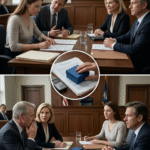
Naomi opened the sealed envelope.
Inside was a thirty-eight-page trust instrument executed eleven years earlier, six months after my wedding.
A blue tab marked Section Nine.
A red tab marked Schedule C.
And one page bearing Graham’s signature, notarized beneath a paragraph he had never bothered to read.
Naomi turned the document toward me.
“Are you ready?” she asked.
I looked at my husband’s frozen smile.
“Then let’s introduce him to his wife.”
# PART TWO
## THE MARRIAGE HE MISTOOK FOR OWNERSHIP
My father distrusted beautiful promises.
He trusted signatures, leverage, and people who read before signing.
When he agreed to fund Graham’s first hotel, he required the creation of Ashford Hospitality Holdings.
The public documents showed Graham as founder and chief executive of Vale House Group.
The private documents showed something else.
Ashford Hospitality Holdings owned fifty-two percent of Vale House Group’s Class B voting shares.
The Ashford Family Trust owned Ashford Hospitality Holdings.
I became trust protector after my father’s death.
That meant Graham controlled the company’s daily operations.
It meant I controlled who was allowed to control Graham.
He knew the trust had invested in the company.
He did not know its shares carried six votes each.
My father had disclosed it.
Graham had signed the acknowledgment.
He had simply been too impatient to read the schedules.
That was the first secret.
The second was buried in his executive employment agreement.
Any intentional diversion of company funds, material dishonesty, reputational misconduct, or breach of fiduciary duty allowed the board to terminate him for cause.
Termination for cause activated a bad-leaver provision.
The provision gave Ashford Hospitality Holdings the right to purchase most of Graham’s remaining shares at the lower of fair market value or his original acquisition price.
The third secret was in our postnuptial agreement.
Three years after our wedding, Graham requested access to additional Ashford capital for an expansion into Europe.
My father agreed under one condition.
Graham and I had to sign an agreement protecting inherited property, company assets, and family-controlled intellectual property from divorce claims.
Graham’s attorneys negotiated aggressively.
They demanded language protecting his position if I embarrassed him publicly or interfered with the company.
My father gave them the clause.
Then he made it mutual.
Adultery alone would not strip either spouse of property.
But adultery combined with financial misconduct, theft of inherited assets, public defamation, or use of a family-controlled media platform to coerce a settlement would trigger indemnification, fee-shifting, and forfeiture provisions.
Graham signed every page.
He received forty million dollars in expansion capital the following morning.
Over the years, he forgot why the money had arrived.
Entitled men often mistook access for ownership.
Six weeks before the podcast, I received a cream envelope at the Fifth Avenue apartment.
There was no return address.
Inside was a hotel folio from Vale House Napa.
The presidential suite had been reserved for four nights under the name C. Rhodes.
Champagne, spa treatments, private dining, and jewelry insurance had been charged to Graham’s executive account.
At the bottom of the folio, someone had written a room number in black ink.
Beneath it were five words.
*Ask where he was Wednesday.*
Wednesday was the anniversary of our son’s death.
Graham had told me he was in London negotiating a property acquisition.
He had sent white lilies to the apartment.
I hated lilies.
He knew that.
I gave the folio to Naomi.
Within seventy-two hours, her investigator had photographs, travel records, security logs, and eighteen months of financial transfers.
Graham had not merely slept with Camille.
He had financed her.
Vale House paid for the apartment where they met.
Vale House paid for her clothes.
Vale House paid for the public relations firm preparing her launch as the company’s new chief creative officer.
Eight million four hundred thousand dollars had moved through consulting agreements, marketing retainers, and a Delaware company called CMR Strategic.
CMR had no employees.
Its registered address was a mailbox.
Its sole member was Camille Rhodes.
Three approvals bore my electronic signature.
I had authorized none of them.
Naomi recommended immediate action.
I asked for time.
Not because I hoped Graham would return.
Not because I feared being alone.
I wanted to know the entire architecture of the betrayal before I demolished it.
So I continued attending dinners.
I sat across from Graham at Le Bernardin while he claimed his phone kept lighting up because of an investor in Singapore.
I watched him send messages beneath the table.
I kissed his mother’s cheek at a hospital fundraiser while Eleanor Vale complained that I had denied her grandchildren.
I attended a Sunday service at St. Bartholomew’s and listened as Graham thanked God for the sanctity of family.
I did not confront him.
Silence made him careless.
Carelessness made him generous with evidence.
He began moving money.
He transferred two million dollars from a joint investment account into a new entity controlled by his personal attorney.
He instructed the caretaker at our Hamptons estate to prepare the east wing for “an extended guest.”
He contacted the rector at Eleanor’s family chapel in Connecticut and asked about available dates the following spring.
He ordered a custom wedding band from a jeweler on Madison Avenue.
He also asked his legal team to draft the separation proposal.
The proposal described our marriage as “irretrievably broken due to mutual emotional estrangement.”
There was nothing mutual about the way he had emptied my mother’s safe.
There was nothing emotional about forged signatures.
Two days before the podcast, Graham finally told me he wanted a divorce.
We were standing in the library of our apartment.
Snow moved beyond the tall windows, softening Central Park into a charcoal drawing.
Graham poured himself twelve-year-old Scotch from my father’s crystal decanter.
He did not offer me a glass.
“I think we both know this has been over for a long time,” he said.
I stood beside the fireplace in a black cashmere dress.
“How long?”
“Years.”
“That is a large answer.”
“It’s the honest one.”
“Is there someone else?”
He looked offended.
The performance was almost admirable.
“This is not about another person.”
“No?”
“This is about me refusing to spend the rest of my life inside your family’s expectations.”
I studied the man I had married.
He was still handsome.
Silver touched his temples now, making him look distinguished rather than older.
His cuff links bore the Vale House crest I had designed.
His shoes rested on a Persian rug my mother had inherited from her grandmother.
Even his rebellion was furnished by my family.
“What do you want?” I asked.
“A civilized ending.”
“And what does that look like?”
“You keep the apartment.”
The apartment was held in my trust.
“Generous.”
“You receive six million dollars.”
The joint account he had offered to divide held less than nine million after his secret transfer.
“You retain the jewelry I gave you.”
Most of my jewelry had been inherited.
“You agree not to interfere with Vale House.”
There it was.
Not sadness.
Not guilt.
Control.
“And you?” I asked.
“I retain the company, the Hamptons property, and my personal investments.”
“The Hamptons property was purchased with Ashford funds.”
“It was purchased during our marriage.”
“Anything else?”
He looked toward the fire.
“I would appreciate discretion.”
“From me?”
“From both of us.”
I almost admired the audacity.
He had already recorded the podcast.
It had been filmed that afternoon and scheduled for release two days later.
He was asking for discretion while preparing my public execution.
I knew because Linden Media’s automated rights-management system had sent a content alert to the Ashford Family Office.
Graham did not know the trust owned sixty-eight percent of Linden Media.
He did not know every flagship episode was archived on Ashford servers.
He did not know the chair marked **WIFE** sat inside a building whose deed ultimately belonged to me.
I lowered my eyes as though considering his offer.
“When do you need an answer?”
“Forty-eight hours.”
“So soon?”
“I think a clean break is best.”
“For whom?”
“For everyone.”
I nodded.
“Then you should have your answer soon.”
Relief softened his face.
He believed my composure meant surrender.
He stepped toward me and touched my shoulder.
“I never wanted to hurt you.”
I looked at his hand until he removed it.
“That may be the cruelest thing you’ve said tonight.”
He frowned.
“Why?”
“Because it means this was you being careless.”
I left him in the library.
The following night, I moved my mother’s remaining jewelry to a private vault.
The yellow diamond was already gone.
By the time Graham walked into the podcast studio with Camille, Naomi had assembled four binders.
The first contained evidence of adultery.
The second contained evidence of financial diversion.
The third contained corporate governance documents.
The fourth contained the postnuptial agreement.
The sealed envelope contained the trust instrument Graham had signed and forgotten.
When the podcast ended, Naomi’s associates entered the conference room.
A corporate litigator.
A forensic accountant.
A criminal defense attorney retained only to advise the company.
And Lydia Chen, general counsel for the Ashford Family Office.
No one raised a voice.
No one used the word revenge.
At 9:14 p.m., we sent a litigation hold to Graham, Camille, Julian, Linden Media, Vale House Group, and six outside vendors.
At 9:22 p.m., the company’s audit committee received an emergency report.
At 9:31 p.m., Naomi filed my divorce petition in New York County Supreme Court.
At 9:43 p.m., we requested a temporary freeze on disputed transfers.
At 10:07 p.m., Linden Media’s legal department learned that the woman publicly mocked during its flagship podcast controlled the trust holding most of its voting stock.
At 10:18 p.m., the network’s chief executive called me personally.
He apologized for the chair.
I told him the chair was not the problem.
The lies told from it were.
At 10:41 p.m., Graham texted me.
*I hope someday you understand.*
I read the message once.
Then I forwarded it to Naomi.
At 11:03 p.m., Camille posted a black-and-white photograph from the studio.
She sat beneath the brass plaque, smiling toward Graham.
Her caption read:
*Sometimes you have to stop apologizing for taking the place meant for you.*
The photograph received seventy thousand likes in forty minutes.
At 11:52 p.m., Naomi sent Graham’s attorneys a single-page response to his settlement proposal.
It contained three sentences.
*Mrs. Vale declines.*
*Preserve all evidence.*
*Further communication should be directed to counsel.*
At 12:16 a.m., the podcast episode was temporarily removed.
At 1:04 a.m., Graham called me seven times.
At 2:30 a.m., the episode returned.
Nothing had been edited.
Camille was still in my chair.
Graham still called our marriage a mistake.
My mother’s diamond still rested against Camille’s throat.
But a legal notice now appeared before the opening music.
*This episode contains contested statements relevant to pending matrimonial and corporate proceedings.*