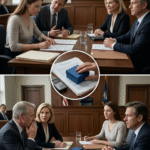
*Certain individuals and entities mentioned herein dispute the accuracy of the claims presented.*
*The original recording has been preserved pursuant to legal notice.*
By morning, the episode had a legal disclaimer.
By breakfast, it had become evidence.
# PART THREE
## THE NIGHT THE TRANSCRIPT BECAME A WEAPON
Graham arrived at the Ashford Family Office at nine fifteen the next morning.
The building stood on Park Avenue behind a limestone façade without a logo.
My grandfather believed the most powerful rooms did not need signs.
Graham entered through the revolving doors with two attorneys and the expression of a man inconvenienced by other people’s overreaction.
He found me in the twelfth-floor boardroom.
A winter storm had polished Manhattan into shades of silver and white.
Twelve leather chairs surrounded the walnut table.
My father’s portrait hung above the fireplace.
Graham stopped when he saw the directors seated around me.
He recognized the chair of the audit committee.
He recognized the company’s outside counsel.
He recognized the two independent directors he had personally recruited.
He did not recognize me.
Not in that room.
Not at the head of the table.
“What is this?” he asked.
“An emergency board meeting,” Lydia said.
“I was not notified.”
“You received notice at seven this morning.”
“I was asleep.”
“That does not invalidate delivery.”
Graham’s lead attorney leaned toward him.
He whispered something.
Graham ignored it.
His eyes remained on me.
“You did this.”
“Because of a podcast?”
“Because of eight million four hundred thousand dollars.”
Color left his face.
Only slightly.
Only for a moment.
“I have no idea what you’re talking about.”
Lydia distributed copies of the audit report.
Graham did not touch his.
Camille’s company name appeared on the first page.
CMR Strategic.
Payments.
Approvals.
Dates.
Bank accounts.
Forged signatures.
“This is a misunderstanding,” he said.
“The forensic report disagrees,” Lydia replied.
“Vivienne approved those contracts.”
“I did not.”
“You delegated authority.”
“I did not delegate my signature.”
His attorney placed a hand on his sleeve.
“Graham, do not answer substantive questions without reviewing the documents.”
Graham jerked his arm away.
“This is my company.”
The room became very still.
I opened the trust instrument.
“It is the company you were hired to lead.”
He laughed.
The sound was sharp and disbelieving.
“You own minority shares.”
“The Ashford Trust owns fifty-two percent of the Class B voting stock.”
“That is impossible.”
“You signed the acknowledgment.”
“I signed financing documents.”
“This would have been disclosed.”
“It was.”
I slid the signature page across the table.
He stared at it.
His name appeared in blue ink.
The date was eleven years old.
The notary stamp had faded slightly.
His initials marked the paragraph stating that Class B shares carried six votes each.
“You should have read Schedule C,” I said.
For the first time since I had known him, Graham had no immediate reply.
His attorney read the page.
Then he sat down.
Lydia continued the meeting.
The audit committee had found sufficient preliminary evidence of unauthorized related-party transactions and material misrepresentation.
The board would vote on whether to suspend Graham pending a complete investigation.
Graham looked around the table.
“These accusations are coming from my wife during a hostile divorce.”
“Your wife did not generate the banking records,” the audit chair said.
“She controls the trust.”
“She is the trust protector,” Lydia corrected.
“This is retaliation.”
I folded my hands.
“You went on a podcast and called me a mistake.”
His jaw tightened.
“Is that what this is about?”
I looked toward the audit report.
“This is about the theft.”
“I did not steal anything.”
“Then explain the shell company.”
“Camille performed legitimate consulting work.”
“Eight million dollars’ worth?”
“She repositioned the brand.”
“She repositioned my mother’s diamond too.”
His expression changed.
Only the directors nearest him saw it.
I saw everything.
“That necklace was in our home,” he said.
“It was in a locked safe.”
“You gave me access.”
“I gave my husband access.”
The word landed differently now.
His attorney spoke quickly.
“Personal property allegations are outside the scope of this meeting.”
“The allegation is relevant to the executive integrity provisions,” Lydia replied.
Graham looked at me.
“I was going to return it.”
“To whom?”
He said nothing.
“The board will proceed,” Lydia said.
The vote took less than four minutes.
Nine directors supported immediate suspension.
One abstained.
Graham was ordered to surrender access credentials, company devices, and authorization over corporate accounts.
Security waited outside the doors.
He stood slowly.
“You cannot humiliate me in my own company.”
I looked at him across the table.
“You chose humiliation as a negotiating strategy.”
“This will destroy the brand.”
“The brand survived before you.”
“It does not exist without me.”
“It existed before the first property opened.”
He stared at me.
Then he finally understood.
The linen texture in the guest rooms.
The carved magnolia emblem.
The scent of cedar, gardenia, and rain.
The dark green libraries in every hotel.
The handwritten welcome cards.
All of it had come from the Ashford estate where I grew up.
He had been the face.
I had been the memory.
“You planned this,” he said.
I stood.
“You planned it.”
I collected the trust documents.
“I simply stopped protecting you from your own decisions.”
Security escorted him from the boardroom.
He did not look back.
Camille called me eighteen minutes later.
I let the call go to voicemail.
Her message arrived immediately.
“Vivienne, I think there has been a misunderstanding, and I would prefer to discuss this woman to woman.”
I saved the recording.
She called again.
Then she sent a text.
*Graham told me everything was legally settled.*
I forwarded that to Naomi too.
At noon, Vale House issued a statement announcing Graham’s temporary leave pending an independent financial review.
By twelve fifteen, financial reporters had linked the announcement to the podcast disclaimer.
By one, Camille had deleted her photograph.
The internet had already saved it.
Her caption appeared beneath thousands of reposts.
*The place meant for you.*
Commenters added new versions.
*The subpoena meant for you.*
*The deposition meant for you.*
*The unemployment line meant for you.*
I did not participate.
Public cruelty was still cruelty, even when aimed in a satisfying direction.
I had no interest in becoming the woman Graham claimed I was.
At three, Eleanor Vale arrived at my apartment without calling.
She wore a camel coat, pearls, and the same expression she had worn at my wedding when the florist informed her peonies were unavailable.
The doorman called upstairs.
I allowed her in.
She entered the drawing room and refused tea.
“What have you done?” she demanded.
“I filed for divorce.”
“You had him removed from his company.”
“The board suspended him.”
“Do not play with language.”
“Language matters.”
“Graham built Vale House.”
“He helped build it.”
“You are punishing him because he fell in love.”
“He diverted company funds.”
“He made mistakes.”
“He forged my signature.”
“You don’t know that.”
“I do.”
Eleanor removed her gloves one finger at a time.
“You have always resented his success.”
I looked at the woman who had spent twelve years treating my restraint as weakness.
“His success was never separate from mine.”
“You could have handled this privately.”
“He chose a podcast.”
“He was desperate.”
“He was strategic.”
“He felt trapped.”
“So he gave my mother’s diamond to his mistress?”
Eleanor’s mouth tightened.
“He told me it was a family piece.”
“Then perhaps he believed it belonged to the marital estate.”
“He watched my mother place it in my hand four days before she died.”
Silence entered the room.
Eleanor looked away first.
“He has been unhappy,” she said.
“So have I.”
“He deserves a family.”
The old blade.
Polished by repetition.
I felt it touch the scar beneath my ribs where surgeons had taken my son from me.
Two years earlier, Eleanor had stood beside my hospital bed and told me stress could be dangerous during pregnancy.
She had said it gently.
As though the loss were a lapse in etiquette.
Now she used the empty nursery to defend her son’s affair.
I walked toward the windows.
Snow lay over Central Park in long white sheets.
“Did Graham tell you where he was that night?” I asked.
“What night?”
“The night I lost the baby.”
Eleanor said nothing.
I turned.
Her face told me before her mouth did.
She knew.
Perhaps not then.
Perhaps later.
But she knew.
“He was in a difficult position,” she whispered.
I had expected rage.
Instead, I felt something colder.
Finality.
“I was.”
Eleanor’s eyes filled.
“You cannot destroy him.”
“I am not destroying him.”
“Then what do you call this?”
“An audit.”
“Vivienne.”
“Your son made choices believing I would be too ashamed to expose them.”
I walked to the table and picked up a folder.
“He counted on my silence.”
I handed it to her.
Inside was a copy of the deed to the Connecticut estate where Eleanor lived.
The estate had belonged to Graham’s father until debt forced its sale fifteen years earlier.
My father purchased it through an Ashford trust and allowed Eleanor to remain for life.
She had always believed Graham bought it back.
Her hands began to tremble.
“What is this?”
“The truth.”
She read the ownership page.
“You own my home?”
“The trust does.”
“Are you evicting me?”
She looked up.
“Because your cruelty does not require me to imitate it.”
Eleanor closed the folder.
For once, she had nothing elegant to say.
I walked her to the door.
Before she left, she turned.
“Did you ever love him?”
The question should have offended me.
It did not.
“Yes,” I said.
“That is why the evidence hurts.”
That evening, Graham’s attorneys requested mediation.
Naomi declined.
The following morning, they requested another forty-eight hours.
Naomi declined again.
By Friday, a judge had frozen the disputed accounts and prohibited the sale or transfer of major marital assets.
Graham moved into a suite at the Vale House flagship hotel.
At six that evening, the hotel’s general manager informed him his executive privileges had been suspended.
He paid the public rate with his personal credit card.
The card was declined.
Camille paid for the room.
Three days earlier, she had called herself his healing chapter.
Now she was covering incidentals.
# PART FOUR
## THE ROOM BENEATH THE BALLROOM
The Vale House Winter Benefactors’ Gala was scheduled for the following Saturday.
It was the company’s largest annual event.
Eight hundred guests had been invited to the Metropolitan Museum of Art.
The guest list included senators, actors, international investors, museum trustees, and enough old money to make new money lower its voice.
Graham had planned to attend with Camille.
His public relations team intended to position their appearance as an act of courage.
He would speak about personal authenticity.
Camille would wear ivory.
By the end of the evening, their relationship would be public, sympathetic, and impossible to separate from the Vale House brand.
That had been the strategy before the podcast.
After his suspension, the board removed him from the program.
He announced he would attend anyway.
Eleanor called three directors.
Camille called two fashion editors.
Graham’s publicist leaked that I was using inherited wealth to punish a self-made man for leaving an unhappy marriage.
The story appeared online Friday afternoon.
By Friday evening, strangers were debating whether I had driven Graham into Camille’s arms by being too cold.
No one had seen me cry.
Therefore, I could not have been wounded.
No one had heard me beg.
Therefore, I must have been controlling.
No one knew how many times I had covered Graham’s mistakes.