Grant had never known about the safe.
Men search for secrets in phones, not behind antique perfume trays.
Mara arrived at eight with black coffee, a navy suit, and the expression of a woman who considered vengeance acceptable when properly notarized.
She placed her briefcase on the marble table.
“Before we begin, I need to know how much destruction you want.”
I watched rain blur the city below.
“Enough that he can still understand it.”
Mara smiled slightly.
“My favorite measurement.”
I opened the blue silk folder.
Inside were documents Grant had signed without reading because he believed love made contracts symbolic.
The prenuptial agreement.
The Whitaker Foundation trust deed.
The St. Augustine’s Memorial Garden easement.
The Harlow Consolidated voting proxy.
The embryo consent form.
The last one hurt to touch.
My fingers stopped on the white paper.
Mara noticed.
“We don’t have to address that today.”
“Yes,” I said. “We do.”
Before Eleanor, Grant and I had done IVF.
Not because we needed to at first.
Because Harlow men liked heirs scheduled like quarterly reports.
After two miscarriages, the doctors recommended genetic testing.
After Eleanor died, I asked the clinic to preserve the remaining embryos until I could think again.
Grant signed the paperwork in front of me.
We agreed no decisions without mutual consent.
At least, that was what he told me.
Mara removed another file from her briefcase.
“I had the clinic send certified copies after you called last night.”
My stomach tightened.
She opened it.
“There was a request three months ago to transfer the remaining embryos to a private storage facility in Atlanta.”
The room tilted.
I placed one palm flat on the table.
“Who signed it?”
Mara’s eyes softened.
“Your signature was forged.”
I did not move.
For a long moment, the only sound was rain against glass.
People think betrayal is loud.
It is not.
The worst betrayal is quiet enough to hear your own pulse trying to leave your body.
Grant had taken my marriage.
He had taken my home.
He had offered my own cottage as charity.
And three months ago, he had tried to take the last frozen possibility of my children.
“Why?” I asked.
Mara handed me another page.
“Because Brynn Calloway had a consult at the same fertility clinic two days later.”
I stared at the line.
Patient intake.
Brynn Elise Calloway.
Reproductive options.
Donor embryo discussion.
For a moment, I felt the old grief rise like black water.
Then the ice returned.
Clean.
Merciful.
Mara spoke carefully.
“We do not yet know if an embryo was transferred. The clinic says the transfer was halted due to incomplete documentation, but someone attempted to move them.”
“Grant.”
“Yes.”
“Brynn knew?”
Mara slid over a printed email.
From Brynn to Grant.
Subject line: Our future.
I read enough.
Not all.
Enough to see the sentence.
If Olivia won’t give you an heir, maybe she already did.
My hand closed around the paper.
Not trembling.
Compressing.
Mara said nothing.
That was why she was worth every obscene dollar.
I placed the email back on the table.
“There will be no quiet separation.”
“There will be no non-disparagement.”
“There will be no Harlow access to the embryos.”
“Absolutely not.”
I looked at the rest of the folder.
“Tell me about the company.”
Mara’s smile returned.
Ah.
Her favorite battlefield.
“Harlow Consolidated Holdings is more vulnerable than Grant realizes.”
“My grandfather’s loan?”
“More than a loan.”
Years before I married Grant, Harlow Consolidated had nearly collapsed under a hotel development in Nashville.
Grant called it a temporary liquidity problem.
My grandfather called it a rich boy drowning in cufflinks.
The Whitaker Trust provided a rescue loan in exchange for preferred shares and a dormant voting proxy triggered by fraud, felony indictment, or breach of fiduciary duty.
Grant had told his family the debt was paid.
It was not.
He had refinanced around it, hidden it under subsidiaries, and used my signature on two consent forms after Eleanor’s funeral.
Forms I never signed.
Mara tapped the documents.
“With the forged clinic paperwork, the trust documents, and what appears to be misuse of foundation funds, we have a pattern.”
Foundation funds.
I looked up.
“What foundation funds?”
Mara’s eyes sharpened.
She opened a spreadsheet.
Rows of transactions filled the screen.
Vendor payments.
Event invoices.
Consulting fees.
Calloway Creative.
Brynn’s company.
My charity had paid Grant’s mistress.
Not once.
Not twice.
For eleven months.
Under the category of grief outreach.
I laughed then.
One short sound.
It startled both of us.
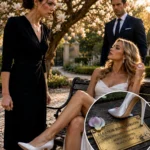
Brynn had sat on my daughter’s bench after being paid from my daughter’s memorial foundation.
For grief outreach.
The elegance of the cruelty almost deserved applause.
Almost.
Mara leaned forward.
“We can file for divorce today. We can request a temporary restraining order on the embryos. We can notify the foundation board. We can trigger the voting proxy if we establish fraud.”
“And the garden?”
“Private property owned by the Whitaker Foundation, leased for public access under conditional terms. Commercial photography requires written consent.”
“Did they have it?”
Mara studied me.
“What are you thinking?”
I looked at my reflection in the rain-dark window.
Black dress.
Pearl earrings.
Bare left hand.
A woman emptied and sharpened.
“There’s a gala Friday.”
“The Harlow Children’s Hospital Gala?”
Grant chaired it.
Evelyn hosted it.
Brynn had probably already selected another white dress.
The ballroom would be full of donors, board members, surgeons, judges, bankers, and women who collected secrets like jewelry.
Mara waited.
I closed the blue silk folder.
“They wanted a public humiliation,” I said. “We’ll give them one.”
Part 4 — The Gala Under the Chandeliers
By Friday night, every woman in Charleston with an internet connection had seen the rumor.
Not the truth.
Just the rumor Grant wanted.
Poor Olivia had never recovered after the baby.
Poor Grant had tried so hard.
Poor Brynn was unexpected, but maybe a blessing.
The city loves a betrayal best when it can be rearranged into a healing journey for the man.
I arrived at the Harlow Children’s Hospital Gala at nine fifteen.
Late enough to be seen.
Not late enough to look wounded.
The ballroom glittered beneath seven chandeliers and three hundred years of Southern hypocrisy.
White orchids climbed the columns.
Champagne moved on silver trays.
A string quartet played something expensive and forgettable.
At the far end of the room, the Harlow family stood beneath a banner that read HEALING BEGINS WITH HOPE.
Grant stood beside Brynn.
She wore pale blue this time.
Maternal blue.
Soft blue.
Look-at-me-I-am-not-the-villain blue.
The Beaumont diamond flashed on her hand like a dare.
Evelyn saw me first.
Her smile locked into place.
Then Grant turned.
I watched the blood leave his face with the calm pleasure of a woman seeing a storm arrive exactly on schedule.
I wore a black velvet gown with long sleeves and a neckline sharp enough to be considered a legal argument.
My hair was pinned low.
My earrings were diamonds from my mother, not my husband.
No wedding ring.
No tears.
No visible wound.
That is what frightened them most.
Pain they understood.
Control disturbed them.
Mara walked beside me in midnight satin with an evidence drive in her clutch.
Behind us came Arthur Bell, chairman of the Whitaker Foundation board, and Judge Rosalind Hayes, retired but still feared by every man who had ever lied under oath in the Lowcountry.
Grant excused himself from a donor and crossed the marble floor.
“Olivia,” he said through a smile.
People watched without watching.
That was the specialty of rooms like this.
“Grant,” I said.
His eyes flicked to Mara.
“You shouldn’t be here.”
“My name is on the invitation.”
“This is my event.”
I looked up at the banner.
“No. It isn’t.”
His smile faltered.
Brynn appeared beside him, one hand resting on her stomach.
The gesture had become less subtle in three days.
“Olivia,” she said. “I really hope we can all be kind tonight.”
I looked at her hand.
Then at the diamond.
“Kindness would have been choosing a different bench.”
Her cheeks tightened.
Grant gripped his champagne flute.
“Not here.”
“That is what you said in the hospital too.”
He went rigid.
Some memories deserve to become weapons.
The hospital’s chief development officer stepped onto the stage and welcomed the guests.
Applause rose.
Grant straightened.
This was his moment.
His speech.
His image.
His annual performance as grieving father turned philanthropic leader.
He had built an entire public identity from Eleanor’s death while privately trying to erase her mother.
He walked to the podium beneath the lights.
The ballroom quieted.
“My friends,” Grant began, warm and polished. “Tonight we gather for the children who need us most.”
He was good.
I will give him that.
Liars often are.
He spoke of resilience.
Of family.
Of hope after loss.
Then he looked directly at me.
A mistake.
He said, “As many of you know, my family endured a tragedy that changed us forever. It taught me that life is fragile, and that love sometimes asks us to begin again.”
A soft murmur moved through the room.
Brynn lowered her eyes.
A masterpiece.
He had turned adultery into rebirth in under thirty seconds.
Then the large screen behind him changed.
Not with music.
Just a clean black slide with white text.
WHITAKER FOUNDATION AUDIT.