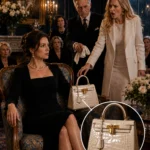
Not loudly. Newport rooms do not gasp. They inhale.
She wore winter white again, because villains love symbolism when they think they are heroines. Her coat was belted above her pregnancy like a ribbon on a stolen gift. At her ears were my mother’s pearls.
My pearls.
Cole had one hand at her lower back.
That was the first public wound.
The second was his expression: calm, controlled, almost bored. He expected outrage. He had prepared for tears. He wanted me wild because wild women are easy to dismiss.
Madison looked at me as if we were two guests at the same brunch.
“Vivienne,” she said. “Thank you for including me.”
“I didn’t.”
Aunt Patricia made a sound into her handkerchief.
Cole’s eyes flashed.
“Madison is here because the contents of the will may affect my family.”
“My mother’s will affects my mother’s family.”
Madison placed one protective hand over her stomach.
“That’s a cruel thing to say.”
I looked at her hand.
“No. It was precise.”
Cole stepped closer. His voice lowered.
“Enough.”
“No,” Uncle Graham said.
He had not moved from the mantel, but somehow he was now the center of the room.
Cole turned.
“Graham, this is a private matter.”
“This is Eleanor’s house,” Graham said. “You are a guest.”
Madison gave a tiny laugh, the kind meant to make an older man look unreasonable.
“Well,” she said, glancing around. “Eleanor and I never met, but I’m sure she would have wanted everyone to feel welcome.”
Mr. Alden looked down at his documents.
I saw it then.
Not amusement.
Satisfaction.
Cole guided Madison toward the front row. There were two chairs side by side: one for me, one for him. My name was written on a small ivory card on the left chair.
Vivienne Hart Harrington.
Madison noticed it.
She noticed everything.
Then, with a softness that felt rehearsed, she lifted the place card, set it on the table, and placed her purse on my seat.
“I should be near family,” she said.
The moment.
The one that would later replay in my mind not as humiliation, but as mercy.
Because there is no lawyer, no detective, no private investigator as useful as an arrogant enemy in front of witnesses.
The room held itself still.
Cole did not move the purse.
That was what I remember most.
Not Madison’s audacity. Not the pearls. Not the insult. Cole’s stillness.
His choice.
He let her do it.
He wanted me to see the life he had already built around my absence.
My uncle removed the purse without touching her.
The gesture was elegant enough to be legal and insulting enough to be art.
He placed it on the floor near the doorway.
“Mrs. Harrington’s seat,” he said.
Madison’s cheeks flushed.
Cole stood.
“This is ridiculous.”
“Yes,” Graham replied. “It is.”
I sat.
My hands were cold, but steady.
Mr. Alden opened the leather portfolio.
“Before we begin,” he said, “I will remind everyone present that this reading is being recorded pursuant to Mrs. Hart’s instructions.”
Cole’s head turned.
“Recorded?”
Mr. Alden pointed to two small brass fixtures near the bookshelves.
“My client requested an official record.”
Madison looked at the fixtures. For the first time, uncertainty touched her face.
I did not know about the cameras.
But my mother had.
Of course my mother had.
Mr. Alden continued.
“Eleanor Whitmore Hart executed her final will and testament on January seventeenth of this year, with full mental capacity and in the presence of two witnesses, myself, and a medical examiner retained independently at her request.”
Cole’s fingers flexed.
A medical examiner.
That detail mattered. I did not know why yet, but Cole did.
Mr. Alden read the opening clauses. Donations to Trinity Church. A seven-figure endowment to the Newport Preservation Society. Scholarships for first-generation women at Brown. Lifetime pensions for the household staff, including health insurance and housing stipends.
My mother had thought of everyone.
Then came family.
To my sister-in-law Patricia, she left a sapphire brooch and a line that made Aunt Patricia weep silently into both hands.
To Graham, she left my father’s pocket watch and “my enduring gratitude for being the only man in our family who understood restraint.”
Graham smiled at the floor.
To several cousins, she left cash bequests and art.
Then Mr. Alden paused.
The fire shifted.
Cole sat straighter.
Madison’s hand moved again to her stomach.
“To my beloved daughter, Vivienne Eleanor Hart Harrington,” Mr. Alden read, “I leave the entirety of my residuary estate, including but not limited to all real property, investment accounts, ownership interests, personal effects, trust distributions within my power of appointment, intellectual property, foundation control rights, and beneficial interest in the Whitmore Family Holdings structure, subject to the terms of the attached private memorandum.”
My ears rang.
Everything.
My mother had left me everything.
I had expected a generous inheritance. I had expected responsibility. I had not expected the world.
Cole did not speak, but the blood drained from his face in a slow, satisfying retreat.
Madison stared at Mr. Alden.
“Can she do that?” she whispered.
Aunt Patricia turned her head very slowly.
Mr. Alden continued as if Madison had not spoken.
“And regarding Cole Harrington, husband of my daughter, I leave the following statement.”
He looked up.
For the first time, his gaze moved directly to Cole.
Then he read my mother’s sentence.
“A man who humiliates my daughter inherits nothing from me.”
The room froze.
Not with shock.
With recognition.
Every person there understood exactly what they had just witnessed.
My mother had not merely excluded Cole.
She had named him.
She had judged him.
And she had done it in ink that would outlive him.
Cole stood so fast his chair struck the rug.
“This is absurd.”
Mr. Alden closed one hand over the paper.
“Sit down, Mr. Harrington.”
“I will not sit while a dead woman insults me.”
Uncle Graham’s voice came from the mantel.
“You may prefer the alternative.”
Cole looked at him.
“What alternative?”
“Leaving.”
Madison rose beside Cole, trembling now. Her performance had shifted from queen to victim.
“I don’t understand why I’m being attacked.”
I turned to her.
“No one attacked you.”
“You all looked at me.”
“You entered my mother’s house wearing her pearls and placed your purse on my chair.”
A flush rose from her throat to her cheeks.
“They were a gift.”
“From my husband,” I said. “Who did not own them.”
Cole snapped, “Vivienne.”
There was a warning in his voice. A familiar one. The tone he used in restaurants when I asked why a woman had texted him at midnight. The tone he used in hotel lobbies when I noticed the lipstick on his collar. The tone that used to make me shrink.
It did not work in my mother’s house.
Mr. Alden lifted the second envelope.
“There is more.”
Cole went still.
“This portion concerns documents Mrs. Hart requested be delivered to Mrs. Harrington following the public reading. However, given certain conduct in this room, and pursuant to the discretion granted to me as executor, I will summarize the relevant protective provisions now.”
Protective provisions.
The phrase slid through the room like a knife beneath silk.
Mr. Alden removed several pages.
“Mrs. Hart established a litigation reserve of twenty million dollars for the protection of her daughter’s marital, financial, and reputational interests.”
Madison sat down.
Cole did not.
“She also authorized independent forensic review of any business entity in which Mr. Harrington sought to claim marital interest connected to Hart or Whitmore assets.”
Cole laughed once.
“This is harassment.”
“No,” Mr. Alden said. “This is estate planning.”
Uncle Graham’s eyes gleamed.
Mr. Alden read on.
“Mrs. Hart further preserved correspondence, financial records, security footage, medical opinions, and sworn statements relating to attempts by any party to pressure, manipulate, defame, medically undermine, financially exploit, or publicly humiliate her daughter during the twelve months preceding her death.”
The air vanished.
Cole’s face changed.
Not anger now.
Fear.
Tiny. Controlled. Almost hidden.
But I had been married to him for nine years. I knew every expression he owned.
That one was new.
Madison whispered, “Cole?”
He ignored her.
“What exactly are you implying?” he asked.
Mr. Alden slid a sealed envelope across the table toward me.
“I am implying nothing. Mrs. Hart was quite explicit.”
I picked up the envelope.
Inside was a letter, several digital access keys, and a small black card embossed with a phone number and the name of a private security firm.
The letter was written in my mother’s hand.
By the time you read this, they will have underestimated you in public.
Good.
Arrogance is useful. It makes people theatrical. Theater creates witnesses.
Do not confront them. Do not explain. Do not beg for love from a person who has learned to profit from your pain.
Call the number on the black card. Ask for Naomi Pierce. Tell her you are ready for the orchard.
I know you will not understand that sentence yet.
You will.
Forgive me for not telling you sooner. A mother wants to protect her child from monsters. I learned too late that sometimes the only protection that lasts is teaching her where the monsters keep their records.
With all my love,
Mother
My throat closed.
The orchard.
I folded the letter slowly.
Madison was crying now, but no tears had fallen.
“This is horrible,” she said. “A baby is involved.”
Mr. Alden looked at her stomach for one polite, devastating second.
“Yes,” he said. “That has been noted.”
Cole moved as if to grab the envelope from my hand.
Graham stepped between us.
He did not touch Cole.
He did not need to.
“Careful,” he said.
Cole’s eyes never left mine.
“This is not over.”
For the first time that day, I smiled.
“No,” I said. “I believe it just started.”
Chapter 3: The Orchard Was Not a Place
Naomi Pierce did not sound like what I expected.
Private security, in my imagination, meant men with earpieces and black SUVs. Naomi sounded like a woman who drank black coffee, kept three passports, and had never lost a game of chess.
“Mrs. Harrington,” she said when I called. “I’m sorry for your loss.”
“Did you know my mother?”
“I worked for her.”
“For how long?”
“Long enough.”
Outside the window of my Newport bedroom, fog moved across the lawn. Cole had not returned to the house after the will reading. Madison had left with him, clutching her purse like a wounded animal.
By midnight, Page Six had a blind item about a “pregnant blonde companion” at an “icy Newport estate proceeding.”
By morning, my phone was a graveyard of missed calls.
Cole. Cole’s attorney. Cole’s mother. Two board members from Harrington Development. My college roommate from Palm Beach who never called unless someone rich had been embarrassed.
I ignored all of them.
“What is the orchard?” I asked Naomi.
A pause.
“A digital archive your mother commissioned eight months ago.”
“Archive of what?”
A coldness moved through me.
“What does everything mean?”
“It means your mother suspected Mr. Harrington was attempting to position you as unstable, financially incompetent, and emotionally dependent ahead of her death.”
I sat down on the bed.
The canopy above me blurred.
“No.”
“I’m afraid yes.”
I heard myself breathing.
Naomi continued, calm as winter.
“Your mother became concerned after receiving a copy of a proposed psychiatric conservatorship evaluation sent by mistake to one of her attorneys.”
“A what?”
“The document argued that following Mrs. Hart’s death, you would likely experience severe depressive decline requiring temporary financial oversight by your spouse.”
The room tilted.
Cole had told me I was forgetful.
Cole had told me I was fragile.
Cole had told me grief had changed me before my mother had even died.
He had moved my jewelry, then suggested I misplaced it. Canceled meetings, then told people I forgot them. Sent texts from my phone when I was asleep. Replaced my vitamins with pills that made me foggy for weeks, until my mother noticed at lunch and quietly took the bottle from my purse.
I thought I was losing myself.
He had been building a case.
“Why didn’t she tell me?” I whispered.
“Your mother believed confronting him early would make him destroy evidence. She wanted a complete record.”
Complete.
There are words that sound clean until they enter your life.
“What evidence?”
“Financial transfers. Emails. Audio recordings from common areas of Whitmore House. Building security logs from your Manhattan apartment. Copies of prescriptions. Communications between Mr. Harrington, Ms. Vale, and a physician named Dr. Lawrence Keene.”
I closed my eyes.
Dr. Keene.
Cole’s friend from Yale. The elegant psychiatrist who had smiled too warmly when Cole suggested I see someone for “stress management.” The man who asked if I ever felt detached from reality while writing notes on a yellow pad.
I had seen him three times.
After the third appointment, he had recommended a “short rest facility” in Connecticut.
My mother had called it what it was.
A gilded trap.
She moved me to Newport the next morning.
At the time, I thought she was being controlling.
Now I realized she had been running interference in pearls.
“What do I do?” I asked.
“You do nothing visible,” Naomi said. “Not yet.”
“Everyone thinks I’m humiliated.”
“Excellent.”
I almost laughed.
Naomi went on.
“Humiliated people are underestimated. Angry people are watched. Quiet people are ignored.”
My mother could have said that.
“Is my husband dangerous?” I asked.
Another pause.
“Financially, yes. Reputationally, yes. Physically, I have no direct evidence. But desperation makes amateurs unpredictable.”
My bedroom door opened without a knock.
Cole stepped in.
My body reacted before my mind did. The phone went silent against my palm.
He looked tired, but expensive tired. The kind achieved with hotel lighting and too much Scotch.
I ended the call without speaking.
Cole glanced at the phone.
“Who was that?”
“Florist.”
His eyes narrowed.
“At midnight?”
“For thank-you arrangements.”
He shut the door behind him.
The old me would have asked where he had been. The old me would have cried. The old me would have demanded the truth from a man who had made lying his native language.
The new me sat still.
Cole hated that.
“Today got out of hand,” he said.
I did not answer.
“Madison should not have moved your card.”
Still nothing.
His jaw worked.
“She’s emotional. The pregnancy has been difficult.”
There it was, offered like a weapon and a shield at once.