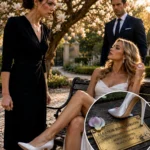
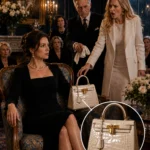
Celeste sat frozen in my chair with broken glass glittering near her ankle.
My book had slipped from her lap and lay face-down on the carpet.
It looked like a fallen verdict.
I did not look away from Graham.
He had once told me I was forgettable in a room full of accomplished people.
Now a room full of accomplished people waited for me to speak.
The moderator adjusted the microphone.
“Evelyn,” she said gently, “or should I say Aurelia?”
I leaned toward the microphone.
The light was hot on my cheeks.
My bracelet clicked again.
“Tonight,” I said, “Evelyn will do.”
A laugh moved through the room, soft at first, then fuller.
It gave me three seconds to breathe.
Three seconds to stand inside my own body.
The moderator asked the first question, the one we had prepared.
“Why did you choose anonymity?”
I could have given the polished answer.
Privacy.
Art over celebrity.
The freedom to write without expectation.
Instead, I saw Graham’s fingers tightening behind Celeste’s chair.
I saw Celeste’s red nails digging into my book’s dust jacket.
I saw a photographer crouch to capture the exact geometry of disaster.
So I told a cleaner truth.
“Because some women can only tell the truth safely when the world does not know their name yet.”
The room went quiet.
Not uncomfortable.
Listening.
That was different.
I spoke about writing at night.
I spoke about mothers and daughters.
I spoke about how a house can hold both memory and captivity.
I spoke about women who had been taught to apologize for taking up a chair.
My voice did not shake until the moderator asked about the title.
“What is the glass orchard?”
I looked at the crystal glasses on the table.
Each one caught the stage light and fractured it.
“It is a beautiful place built by someone else’s rules,” I said.
“It shines from a distance, but every branch cuts your hand when you reach for fruit.”
In the front row, Celeste lowered her eyes.
Graham did not.
He was recovering.
I could see it happen.
Graham Alder had never met a public crisis he could not polish.
By the time the applause began, he was standing straighter.
By the time the moderator invited audience questions, his face had softened into concerned pride.
By the time an editor from Boston asked how long I had been writing, Graham was already nodding like a husband who had guarded a delicate secret.
He raised his hand during the reception that followed.
The moderator, not knowing his plan, allowed him the microphone.
Graham stood.
His smile was rueful.
It was almost beautiful.
“I suppose I should congratulate my wife publicly,” he said.
A few people laughed.
“I have watched Evelyn wrestle with this story for years, and while I may not have known every detail of her publishing arrangements, I always believed she had something extraordinary inside her.”
The pivot.
Not denial.
Inclusion.
He was trying to attach himself to the moment he had tried to ruin.
He glanced toward me with moist eyes.
“I only wish she had trusted me enough to share tonight with me before now.”
A murmur passed through the room.
It was a good line.
On the surface, it sounded wounded.
Underneath, it placed a hook in my ribs.
I stepped back to the microphone.
“You took my chair,” I said.
Then I smiled.
“I kept my name.”
The room changed.
It was not loud.
It was worse.
It was the kind of silence that chooses a side.
Graham’s smile held, but the skin around his eyes tightened.
The moderator ended the panel soon after.
Applause followed me offstage in waves.
People stood.
Some because they admired the book.
Some because they loved a public unmasking.
Some because they had known, in their bones, what it meant to be told not to make a scene.
Backstage, the air was cooler.
My agent Margot Voss came toward me in a black velvet suit, tears shining beneath her glasses.
“You were magnificent,” she said.
Her voice cracked on the last word.
I almost laughed.
I almost sobbed.
Instead, I pressed my fingers to my lips until the moment passed.
Mara Whitcomb stood behind Margot with a leather folder under her arm.
Mara was sixty-three, silver-haired, narrow-eyed, and the only attorney I had ever met who could make silence feel like a locked door.
“You held,” she said.
It was the highest praise Mara gave.
Graham appeared three minutes later.
Celeste followed him, holding my book against her chest.
The dust jacket was bent at one corner.
A wet stain from champagne darkened the lower edge.
I stared at it.
Celeste noticed.
For the first time that night, she looked less victorious.
“Evelyn,” Graham said.
His voice had the careful patience of a man speaking near witnesses.
“This has clearly become more complicated than either of us anticipated, and I think we should step into a private room before something gets said in public that cannot be unsaid.”
Mara closed one hand over the leather folder.
“Mr. Alder, any private conversation with Mrs. Pierce will include counsel.”
Graham blinked.
He had always hated women who did not hurry to soften their edges.
“Counsel,” he repeated.
Then he gave a short laugh.
“Evelyn, surely you are not turning a marital misunderstanding into a legal circus because of an awkward seating mix-up.”
Celeste shifted beside him.
Her perfume reached me first.
White flowers.
Expensive soap.
Fear beginning to sour beneath both.
“I didn’t know,” Celeste said.
Her tone was light, but her fingers had gone rigid around the book.
“Graham told me you hated literary functions.”
Graham turned to her.
“Not now, Celeste.”
That was the first time he sounded careless.
Not cruel.
Not polished.
Careless.
Celeste heard it too.
A small red mark appeared at her throat, just above the collarbone.
I reached for the book.
She hesitated.
Then she handed it to me.
The damp cover was cold under my fingertips.
I wiped a bead of champagne from my own title.
“You may keep the seat,” I said.
Celeste’s eyes lifted.
I held the book against my heart.
“But not the story.”
Graham’s face hardened.
“There is no need to posture,” he said.
“I have protected you from the worst parts of this industry for years, Evelyn, and if you now choose to pretend that protection was oppression because it makes better theater, then you are allowing strangers to applaud the collapse of your own marriage.”
It sounded reasonable.
It always did.
A man like Graham never said, I wanted your money.
He said, I protected your interests.
He never said, I wanted your silence.
He said, I kept things simple for you.
Mara opened the folder.
“Mr. Alder, you have been served.”
She handed him a packet.
Graham did not take it.
The papers struck his tuxedo shirt and slid to the floor.
For one second, no one moved.
Then Celeste bent automatically to pick them up.
She read the top line.
Emergency Petition For Injunctive Relief.
Her lips parted.
Graham snatched the papers from her hand.
“This is absurd,” he said.
Mara’s voice remained even.
“The court order freezes any further transactions involving the Pierce Orchard Trust, Orchard House, the Aurelia Wren contracts, and all entities associated with C.V. Cultural Holdings pending investigation.”
At the sound of her initials, Celeste went still.
“What does my company have to do with this?”
Graham turned on her with a flash of irritation.
“Celeste, I said not now.”
Her face changed again.
Not guilt.
Not innocence.
Calculation.
A door had opened in the room, and she was trying to see whether it led to a trap.
Before she could speak, my phone vibrated in my evening bag.
I ignored it.
It vibrated again.
Mara glanced at me.
“You should check that.”
I pulled it out.
The screen showed a name I had not seen in four months.
Anna.
My daughter.
My thumb hovered.
Graham saw the screen.
His eyes sharpened.
“Do not drag Anna into this,” he said.
The old command nearly worked.
A muscle in my wrist jumped.
Anna had stopped answering my calls after her divorce.
Graham said she needed space.
He said she felt judged.
He said daughters blame mothers because mothers are safer to hate.
I had believed enough of it to leave messages instead of driving to her house.
The phone vibrated once more.
I answered.
For a moment, all I heard was breathing.
Then Anna’s voice came through, thin and shaken.
“Mom,” she said.
“I watched the livestream.”
My hand went numb around the phone.
In the background, a child laughed.
My granddaughter.
I pressed the phone harder to my ear.
“Did you write it?” Anna whispered.
“Yes,” I said.
A sound broke out of her.
It was not quite a sob.
It was the sound of a door unsealing.
“Then Graham lied about everything,” she said.
I closed my eyes.
Graham moved toward me.
Mara stepped between us.
Anna kept speaking.
“He told me you were embarrassed by me.”
My ribs tightened.
“He told me you said my divorce made the family look unstable.”
The floor seemed to tilt beneath my heels.
I opened my eyes and looked at my husband.
His face was composed again.
Too composed.
“Anna,” I said.
My voice scraped.
“I never said that.”
There was another pause.
Then Anna said, “I found the emails.”
Behind me, Mara’s head turned.
“What emails?” I asked.
Anna swallowed audibly.
“The ones from your account.”
My skin went cold.
“They don’t sound like you.”
Graham’s hand curled around the packet of legal papers.
Mara reached for my phone and put it on speaker.
Anna’s voice filled the backstage corridor.
“I’m sending them to you now.”
A chime sounded.
Then another.
My screen filled with forwarded messages.
Each one carried my name.
Each one had been sent from an old address I had not used in years.
Each one cut my daughter out of my life with language Graham would have called firm and I would have called unforgivable.
Mara’s own phone buzzed.
She glanced down.
Her face lost every trace of softness.
“What is it?” I asked.
She opened an attachment.
A scanned deed filled her screen.
The page was dense with legal print, but one line burned clear.
Grantor: Evelyn Pierce Alder.
Grantee: C.V. Cultural Holdings, LLC.
The property description beneath it was Orchard House.
My mother’s house.
The home Graham had promised was safe.
Mara turned the phone toward me.
At the bottom of the page was my forged signature.
Beside it, in blue ink, was Celeste Vale’s name as managing member.
PART 3
C.V. Cultural Holdings was not a harmless arts venture.
It was a lockbox built to steal my childhood.
Mara spread the deed across the desk in Margot’s hotel suite while sirens wailed faintly sixteen floors below.
The ballroom celebration had become a press storm by midnight.
Clips of my reveal were already online.
In one of them, Celeste sat in my seat with my book in her lap.
In another, Graham told the room he wished I had trusted him.
In the worst one, the camera caught my face when Anna’s call came through backstage.
I watched it once.
Then I turned the phone over.
Some kinds of pain should not be replayed by strangers.
Mara tapped the deed with the end of her pen.
“This transfer was recorded nine days ago,” she said.