The woman sleeping with my husband wore my father’s funeral scarf to the Metropolitan Opera and called it dramatic.
It was black silk with a narrow silver edge, the kind of scarf that looked severe until light touched it.
I had worn it once.
On a wet November morning, I had stood beside my father’s grave in Sleepy Hollow while rain slid beneath my collar and cemetery lilies collapsed under the storm.
Afterward, I folded the scarf into tissue paper and placed it in the cedar drawer of my dressing room.
I kept it because, even years later, it still smelled faintly of rain, lilies, and the last day I had been someone’s daughter.
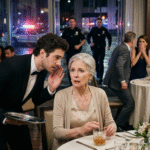
That night at the opera, Celeste Marlowe wrapped it around her glossy blond hair.
She tilted her head beneath the crystal chandeliers and smiled at me as if we shared a private joke.
“Grief makes beautiful accessories,” she said.
My husband, Grant Vale, stood beside her in a midnight-blue tuxedo I had chosen for him.
He did not look ashamed.
He looked irritated that I had noticed.
“Eleanor,” he murmured, touching my elbow with the careful pressure men use when they are pretending not to threaten their wives in public.
“Don’t ruin the night.”
Around us, Manhattan’s richest families floated through the marble lobby beneath gold ceilings and white orchids.
Board members, senators, heirs, donors, and women wearing diamonds large enough to finance small hospitals watched without appearing to watch.
I looked at Celeste.
Then I looked at Grant.
I did not raise my voice.
I did not slap her.
I did not cry.
I said, “The night was ruined when you dressed her in my dead.”
Then I walked away before either of them understood that the opera was not the performance they should have been afraid of.
PART ONE — THE WOMAN WHO NEVER MADE A SCENE
For eleven years, Grant had told people that I was his secret advantage.
He said it at investor dinners, charity luncheons, and magazine interviews conducted in the glass library of our townhouse on East Seventy-Third Street.
“My wife sees the entire chessboard,” he would say, smiling as he rested one hand against the back of my chair.
It sounded like praise.
It was actually a warning.
Grant never liked that I saw the board.
He liked that I moved the pieces quietly enough for him to take credit.
May you like
When we married, Vale Meridian was a respectable regional real estate firm with three aging office buildings and more debt than imagination.
My father, Jonathan Ashford, had been chairman of Ashford Capital, a private investment company old enough to have funded railways, hospitals, and political careers.
He invested in Grant because I asked him to.
Not because Grant impressed him.
My father had watched Grant deliver a forty-minute presentation in our family library, then waited until the staff had cleared the coffee.
“He wants applause more than he wants success,” my father told me afterward.
“He wants both,” I said.
“Men who need both eventually sell one to purchase the other.”
I should have listened.
Instead, I spent ten years building Vale Meridian beside my husband.
I redesigned its acquisition strategy, recruited the legal team, restructured its debt, and convinced three pension funds to back our expansion into hospitals and luxury senior residences.
Grant became the public face.
I became the private architecture.
By the time my father died, Vale Meridian controlled properties in nine states and had a valuation of four billion dollars.
Business magazines called Grant a visionary.
At home, he called me difficult whenever I asked why certain numbers no longer matched.
The affair began, according to the evidence, fourteen months before the opera.
According to my instincts, it began much earlier.
A marriage rarely breaks on the day betrayal becomes visible.
The fracture starts in small absences.
A phone turned facedown.
A shower taken immediately after coming home.
A laugh offered too generously to a woman at dinner, followed by coldness toward the wife who noticed.
Celeste Marlowe entered our lives as Vale Meridian’s new vice president of brand development.
She was thirty-two, clever in the polished way of women who had learned that beauty opens doors faster when it carries a spreadsheet.
She came from nowhere Grant respected.
Her father repaired air conditioners in Ohio.
Her mother taught elementary school.
Celeste had remade herself at Wharton, erased her Midwestern vowels, and learned to wear winter white without looking afraid of red wine.
I admired her at first.
Ambition does not offend me.
Entitlement does.
Six months after Celeste joined the company, she began attending meetings she did not need to attend.
Three months later, Grant started repeating her opinions as though they had formed naturally in his own mind.
Then came the Hamptons conference.
Grant told me he had to stay an extra night because a storm had grounded the helicopter.
The helicopter company’s flight log showed clear skies and an eleven-minute return to Manhattan.
I did not confront him.
I downloaded the log.
The following week, his credit card statement listed a dinner for two at Le Bernardin on a night he claimed to be in Boston.
I photographed the receipt.
Then our driver, Luis, quietly asked whether I wanted him to continue taking Ms. Marlowe to the Mercer Hotel after late meetings.
I looked at him across the kitchen island.
Luis had driven my father for nineteen years before coming to work for me.
He had the kind of loyalty rich families praise publicly and rely upon privately.
“How long?” I asked.
He lowered his eyes.
“Since last winter, Mrs. Vale.”
I thanked him and finished my coffee.
That evening, Grant came home carrying peonies.
He kissed my cheek and said he had missed me.
I placed the flowers in a silver vase.
Then I called Naomi Brooks.
Naomi had been my roommate at Columbia and was now one of New York’s most feared matrimonial attorneys.
She answered on the second ring.
“Did he hit you?” she asked.
“No.”
“Did he move money?”
“I think so.”
Her voice changed.
Physical cruelty shocked people.
Financial cruelty interested lawyers.
“How much?”
“I don’t know yet.”
“Then don’t accuse him of anything,” she said.
“Smile, sleep, and collect.”
So I did.
For four months, I smiled.
I sat beside Grant at dinners while Celeste sat two chairs away.
I listened to him praise her instincts.
I watched her touch the stem of her wineglass whenever he spoke, as though his voice vibrated through crystal.
I let them believe silence meant ignorance.
In wealthy marriages, rage is expected to arrive in diamonds, broken windows, or a public scene at a charity auction.
No one prepares for a wife who keeps the seating chart.
My father had taught me that.
Jonathan Ashford never shouted in negotiations.
He would allow louder men to fill the room with confidence.
Then he would slide one document across the table and take their company before dessert.
He died in a private room at NewYork-Presbyterian after a six-month battle with pancreatic cancer.
Grant was in London when the doctors said there were only hours left.
He claimed the company jet could not get clearance.
I later learned he had diverted it to Paris so Celeste could attend a fashion show.
My father died holding my hand.
His final coherent words were not about money, the company, or my marriage.
He whispered, “You were never the quiet one, Ellie.”
I bent close.
He smiled, barely.
“You were the patient one.”
At the funeral, rain fell hard enough to blur the line between mourners and stone angels.
My mother had died when I was twenty-four, so I stood alone at the grave’s edge.
Grant arrived seventeen minutes late.
He wore the wrong black tie.
He checked his phone during the prayer.
When the casket was lowered, I covered my hair with the black silk scarf my father had given me in Paris years earlier.
He had bought it from a small shop near the Palais Royal after I had been caught in a spring storm.
“Every woman needs one beautiful thing that asks nothing from her,” he had said.
After the funeral, the scarf still held the smell of wet earth and lilies.
I could not wash it.
Some grief feels like a wound.
Mine felt like evidence.
That was why seeing it on Celeste’s head did not merely expose the affair.
It told me Grant had entered my private dressing room, opened the cedar drawer, unfolded the one object I had never allowed anyone to touch, and handed it to his mistress.
Infidelity was common.
Desecration was personal.
After I left the opera lobby, I did not go home.
I crossed Lincoln Center Plaza beneath the white glow of the fountain and entered a black sedan waiting at the curb.
Naomi sat in the back seat wearing a red evening gown beneath her wool coat.
She had purchased an opera ticket under another name and spent the evening three rows behind Grant.
“Well?” she asked.
I placed my clutch on my lap.
“She wore the scarf.”
Naomi’s jaw tightened.
“Did he speak?”
“Enough.”
“Were you recording?”
I touched the diamond brooch pinned inside my neckline.
A small blue light blinked once.
“Every word.”
Naomi exhaled slowly.
“Then tonight may have saved us six months.”
The car moved south through Manhattan.
People hurried along Broadway beneath theater lights, unaware that my marriage had just ended between the fountain and Sixty-Fifth Street.
Naomi opened a leather folder.
Inside were copies of wire transfers, hotel invoices, board emails, and the preliminary report from a forensic accountant.
Grant had not merely been sleeping with Celeste.
He had been building a future for her using assets he believed belonged to him.
A penthouse in Tribeca had been purchased through a Delaware shell company.
A two-million-dollar art collection had been invoiced as “executive environment consulting.”
A private fertility clinic had received six payments from a Vale Meridian subsidiary.
And forty-eight million dollars had been moved into an acquisition fund controlled by Grant and Celeste.
Naomi tapped the last page.
“This is no longer just divorce.”
I stared at the number.
“What is it?”
“Embezzlement, securities fraud, breach of fiduciary duty, and possibly conspiracy.”
I looked out the window as we passed the Plaza Hotel.
Grant and I had spent our wedding night there.
He had stood at the window in his tuxedo shirt and promised he would spend the rest of his life proving he deserved me.
The memory did not hurt.
Not anymore.
It embarrassed me.
“Can he take the company down with him?” I asked.
“Not if we move first.”
I closed the folder.
“Then we move tonight.”
PART TWO — THE HOUSE HE THOUGHT WAS HIS
Our townhouse looked particularly beautiful when I returned at midnight.
Six limestone floors rose above a quiet block lined with bare trees and discreet security cameras.
The brass lamps beside the front door glowed against polished stone.
Grant often called it his house.
He had never read the deed.
The property had belonged to my mother’s trust.
After her death, it passed to me alone.
Grant’s name appeared nowhere except the household insurance policy and several magazine features he had framed in his office.
I entered through the front door and handed my coat to Mrs. Alvarez, our house manager.
She had been with my family since I was sixteen.
Her gaze moved to my uncovered hair.
“Did you lose the scarf?” she asked.
She understood immediately.
Mrs. Alvarez was sixty-three and Catholic, with a memory for betrayal that bordered on biblical.
“Mr. Vale has not returned,” she said.
“I know.”
“Will he be returning?”
“Not tonight.”
She looked toward the marble staircase.
“The staff?”
“Please gather everyone in the breakfast room at eight.”
Her expression remained professional.
Only her eyes softened.
“Yes, Mrs. Vale.”
I went upstairs to Grant’s dressing room.
His life was arranged by color and occasion.
Charcoal suits for investor meetings.
Navy for television.
Black for funerals and apologies.
I opened the cedar wardrobe and removed twelve garment bags.
Then I packed his watches, cuff links, shoes, medication, passports, and personal files.
I left the clothes Celeste had selected for him.
She could keep the costume.
At two in the morning, Grant called.
I watched his name glow on the screen.