I let it ring six times before answering.
“Where are you?” he demanded.
“At home.”
“You left without saying anything.”
“I said enough.”
He lowered his voice.
“You embarrassed me in front of half the board.”
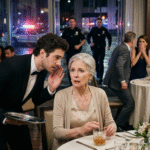
“You brought your mistress to the opera in my father’s funeral scarf.”
“Celeste borrowed a scarf.”
“From a locked drawer in my dressing room?”
Silence stretched between us.
Then Grant sighed as if I were exhausting him.
“This is exactly why I didn’t tell you.”
The cruelty was so clean it almost impressed me.
“Tell me what?”
“That I’ve been unhappy.”
I sat on the bench at the foot of our bed.
The bed had been carved in Italy.
Grant had once joked that it cost more than his childhood home in Connecticut.
“How long have you been unhappy?” I asked.
“For years.”
“And yet you stayed.”
“We have a life, Eleanor.”
I looked around the room.
“We have assets.”
His breath sharpened.
“Don’t start talking like a lawyer.”
“I have been speaking to one.”
That silenced him.
When Grant spoke again, the irritation had left his voice.
“Naomi?”
“Yes.”
“Come on, Ellie.”
He used the childhood name my father had used.
Men like Grant believed tenderness was a password they could enter after committing a crime.
“Come back to the opera,” he said.
“We can discuss this privately tomorrow.”
“You are discussing it privately.”
“Don’t be dramatic.”
I glanced at the empty cedar drawer.
“Where is the scarf now?”
He hesitated.
“Celeste has it.”
“Get it back.”
“It’s just fabric.”
“No, Grant.”
I spoke softly.
“It is the last thing of mine you will ever give away.”
He laughed once, without humor.
“You’re not going to blow up eleven years over a scarf.”
I looked at the legal folder on the bed.
“I’m going to end eleven years over what the scarf proved.”
He began speaking quickly.
He said Celeste meant nothing.
Then he said she understood him.
He said the affair had only happened once.
Then he said marriages evolve.
He said powerful men often made unconventional choices.
He said I had become cold after my father died.
He said I cared more about the company than about him.
Each sentence contradicted the last.
I let him build the record.
The diamond brooch remained pinned to my dress.
At last, he asked, “What do you want?”
There it was.
Not forgiveness.
Not love.
Terms.
“I want you to come home,” I said.
He sounded surprised.
“Tonight?”
“At nine tomorrow morning.”
“Why?”
“We should speak face-to-face.”
He relaxed.
He thought I had folded.
Grant often mistook composure for surrender.
“Fine,” he said.
“And bring Celeste.”
The silence returned.
“What?”
“She is part of the conversation.”
“Eleanor, that’s not appropriate.”
I smiled for the first time that night.
“Neither was my father’s scarf.”
I ended the call.
At eight the next morning, the household staff gathered in the breakfast room.
Sunlight moved across the long oak table.
Coffee steamed in porcelain cups no one touched.
There were fourteen employees, some of whom had worked for my family longer than Grant had known me.
I stood at the head of the table.
“As of this morning, Mr. Vale no longer resides in this house.”
No one gasped.
Good staff do not gasp.
“His personal belongings have been packed and moved to the service vestibule.”
Mrs. Alvarez nodded once.
“His security access has been revoked.”
Our head of security made a note.
“Any instruction issued by Mr. Vale regarding this property, its staff, vehicles, or accounts is no longer valid unless I approve it in writing.”
Luis looked toward me.
“Will you still require the car at nine?”
“Where are you going?”
“Nowhere.”
I looked around the table.
“He is coming here.”
At eight forty-five, Naomi arrived with two associates and a court reporter.
At eight fifty, Vale Meridian’s general counsel entered through the garden door.
At eight fifty-five, my father’s longtime trustee, Samuel Price, arrived carrying a locked document case.
At nine, Grant rang the bell.
He used to have a key.
Celeste stood beside him.
She wore cream wool, oversized sunglasses, and the confidence of a woman who believed she had survived the scandal because the wife had not screamed.
The scarf was tied around the handle of her Hermès bag.
That hurt more than seeing it on her head.
She had reduced my grief to decoration twice.
Mrs. Alvarez opened the door but did not invite them in.
Grant frowned.
“What is this?”
“I’ll ask Mrs. Vale.”
“You don’t need to ask my wife whether I can enter my own house.”
Mrs. Alvarez looked at him with perfect calm.
“It is not your house, sir.”
I watched from the top of the staircase.
Grant looked up.
For the first time since I had known him, he appeared uncertain beneath our roof.
“Eleanor,” he said.
“Come in.”
Celeste stepped forward.
“Not with the scarf on your bag.”
She glanced down and gave a small, dismissive laugh.
“For God’s sake.”
I said nothing.
The silence grew heavy enough to embarrass her.
Finally, she untied the scarf and held it out.
Mrs. Alvarez crossed the foyer, accepted it without touching Celeste’s hand, and carried it upstairs.
Only then did I descend.
Grant’s eyes traveled over my pale gray dress, the pearls at my throat, and the diamond brooch on my lapel.
He had seen me dressed that way in boardrooms and courtrooms.
He should have recognized the uniform.
“You invited lawyers?” he asked.
“I invited witnesses.”
We entered the library.
Grant stopped when he saw Samuel Price.
He knew Samuel as my father’s closest adviser and the executor of the Ashford estate.
Celeste removed her sunglasses.
Naomi gestured toward two chairs on the opposite side of the table.
“Please sit.”
Grant remained standing.
“I am not being ambushed in my own home.”
Samuel opened the locked document case.
“As Mrs. Alvarez informed you, this property is held solely by Eleanor Ashford Vale.”
Grant looked at me.
“We’re married.”
“Not for much longer,” I said.
Celeste sat first.
That told me everything.
She wanted the meeting over quickly because she still believed the outcome had already been negotiated elsewhere.
Grant sat beside her.
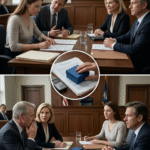
Naomi placed a recorder in the center of the table.
“This meeting concerns the dissolution of the Vale marriage, misuse of corporate assets, breach of fiduciary duty, and emergency governance measures at Vale Meridian Holdings.”
Celeste’s face changed slightly.
Grant leaned back.
“What emergency governance measures?”
Samuel removed a thick binder.
My father had created the Ashford Continuity Trust six years earlier, when Vale Meridian began acquiring healthcare properties.
The trust provided two hundred and eighty million dollars in financing.
In exchange, it received preferred shares with enhanced voting rights.
Grant knew about the financing.
He had signed the agreement.
What he had not understood was the conversion clause.
If Vale Meridian’s chief executive committed fraud, concealed material transactions, misused company assets, or exposed the corporation to reputational harm, the preferred shares converted automatically.
Upon conversion, the trust held fifty-two percent of the voting power.
The trust’s sole beneficiary was me.
Its acting trustee, upon my father’s death, was also me.
Samuel slid the binder toward Grant.
He did not touch it.
“This is absurd,” Grant said.
“It was drafted by Sullivan & Cromwell,” Samuel replied.
“You signed it on March fourteenth, six years ago.”
“I signed a credit facility.”
“You signed every page.”
“You never told me you controlled the trust.”
“You never asked who owned the money.”
Celeste shifted in her chair.
Her cream coat suddenly looked less like armor and more like a stain waiting to happen.
Naomi opened another folder.
“Last night, the trust received sufficient evidence to trigger conversion.”
“What evidence?” Grant asked.
I touched the diamond brooch.
His gaze fixed on it.
“The conversation in the opera lobby,” I said.
“That proves an affair, not fraud.”
“No,” Naomi replied.
“The affair is merely relevant to your marital agreement.”
Grant looked at her sharply.
“Our prenup has no infidelity clause.”
“It does not.”
Naomi turned a page.
“It has a dissipation clause.”
I watched him remember.
Our prenuptial agreement did not punish adultery.
My father thought morality clauses were theatrical and difficult to enforce.
Instead, the agreement protected separate property and imposed severe consequences for using marital or corporate assets to support an undisclosed romantic partner.
Grant had mocked the clause before our wedding.
He said only idiots bought apartments for their mistresses.
He bought Celeste a penthouse through a shell company and billed it to Vale Meridian.
Naomi listed the transactions.
The Tribeca penthouse.
The art.
The Paris trip.
The jewelry charged to a property development account.
The fertility clinic.
At that, Celeste went still.
Grant looked at her.
It was the first unscripted moment between them.
I noticed.
So did Naomi.
Grant’s voice hardened.
“The clinic was private.”
“You used company funds,” I said.
“I was going to repay them.”
“With what?”
“My distributions.”
“Those distributions were suspended at six this morning.”
He stared at me.
“You can’t do that.”
“I already did.”
Celeste’s hand moved to her stomach.
It was a small gesture.
Barely visible.
But I had spent eleven years noticing what people tried to hide.
I looked at Grant.
“Is she pregnant?”
Neither answered.
Naomi did not move, but I felt her attention sharpen beside me.
Celeste lifted her chin.
“I am.”
The room became very quiet.
Some women might have broken then.
A pregnancy made betrayal tangible.
It gave the affair a heartbeat, a due date, and a nursery imagined in rooms purchased with stolen money.
I felt pain.
It was deep and clean.
But pain is not the same as collapse.
“How far along?” I asked.
“Sixteen weeks.”
I calculated backward.
The conception date fell three days before the anniversary of my father’s death.
Grant had sent me white roses that morning.
That evening, he had claimed he needed to attend a zoning dinner in Washington.
I looked at him.
“Congratulations.”
Celeste blinked.
She had prepared herself for rage.
My courtesy unsettled her more.
Grant leaned forward.
“This changes things.”
“It does,” I said.
“We need discretion,” he continued.
“For the baby.”
“For the company.”
There was the man I had married.
Not a husband.
Not a father.
A brand manager wearing human skin.
“I’m willing to be reasonable,” he said.
Naomi almost smiled.
Grant continued, speaking as though he were still chairing a meeting.
“I’ll step away from certain accounts until the misunderstanding is resolved.”
“It is not a misunderstanding,” Samuel said.
“You will step away from the company.”
Grant turned toward him.
“You don’t have that authority.”
“I don’t,” Samuel replied.
“Eleanor does.”
I placed a document on the table.
At seven thirty that morning, the converted trust shares had been certified.
At eight, a special board meeting had been called under the emergency provisions.
At eight twenty-two, five directors voted to suspend Grant as chief executive pending a full investigation.
At eight twenty-eight, they appointed me interim chairwoman.
The meeting in my library was not a negotiation.
It was a notification.
Grant stared at the signatures.
Two belonged to directors he had invited to the opera.
One belonged to his godfather.
“No,” he said.
It was the first honest word he had spoken.
Celeste looked at him.
“You said she had no operational authority.”
Grant did not answer.
“You said the shares were symbolic.”
Still nothing.
I watched the romance between them develop its first crack.
Affairs flourish in rooms protected from fact.
Daylight is rarely kind.
Naomi slid two envelopes across the table.
One contained Grant’s separation agreement.
The other contained notice that Celeste had been placed on administrative leave pending investigation.
Celeste did not open hers.
She looked at me with sudden fury.
“You planned all of this.”
“I documented what you did.”
“You were spying on us.”
“I was auditing my company.”
“It was his company.”
I met her eyes.
“It was the stage he stood on.”
Grant stood so quickly his chair struck the floor.
“You think you can humiliate me?”
I looked around the library where he had proposed, pitched investors, and accepted praise paid for by my family.
“I think you mistook my silence for permission.”
He pointed toward me.
“You will destroy everything your father built.”
That was almost funny.