“You prosecuted men with armies of lawyers.”
“I thought if I told you, you would march into my house and confront Grant.”
“I probably would have.”
“He knew that.”
Claire looked down at her good hand.
“He said that if I involved you, he would destroy Dad’s name.”
I felt a coldness settle beneath my ribs.
“How?”
“He said there were records proving Dad had bribed officials when he rescued Mercer Dynamics.”
“That he had covered up deaths at the Riverton plant.”
“That the Hale Trust was built with blood money.”
“Did you believe him?”
“No.”
She closed her eyes.
“Then I started looking.”
Claire had inherited her father’s patience and my suspicion.
Before marrying Grant, she had worked as a forensic accountant in Washington.
She could follow money through shell companies, charitable foundations, and offshore accounts with the quiet persistence of water finding a crack in stone.
Grant had persuaded her to leave her firm after their wedding.
He said the travel was damaging their marriage.
He said they should start a family.
He said there was no reason for his wife to spend her life examining other people’s crimes.
The family they discussed never came.
The career she surrendered did not return.
Grant gradually took control of their accounts.
He criticized the clothes she bought, the calls she made, and the time she spent with me.
Then he began calling her unstable.
“He made my world smaller one decision at a time,” Claire said.
“I didn’t notice the cage because he built it around me slowly.”
Three months earlier, she had received an envelope without a return address.
Inside was a photocopy of an invoice from a company called Northlight Technical Consulting.
Mercer Dynamics had paid Northlight more than eleven million dollars over five years.
The invoice listed safety-testing services at the Riverton manufacturing facility.
Northlight had no employees, no laboratories, and no physical address beyond a rented mailbox in Delaware.
Claire traced its ownership through two other corporations.
The final beneficiary was a private holding company controlled by Daniel Ross.
I felt my heartbeat change.
“Daniel?”
“He didn’t act alone.”
She had found payments authorized by Grant.
Some were disguised as consulting fees.
Others had been labeled emergency remediation expenses.
All of them followed internal test failures involving the Atlas relay, a component used in industrial power-control systems.
The relay was supposed to shut down equipment when heat or pressure reached dangerous levels.
According to the official reports, Atlas passed every major safety review.
According to the hidden data Claire found, **the relay failed under sustained heat nearly forty percent of the time.**
“How did you get the hidden data?” I asked.
“Grant brought home a company laptop.”
“He was drunk.”
“He left it open.”
Claire’s mouth tightened.
“I know how that sounds.”
“It sounds like a woman saw evidence that people might be in danger.”
“I copied the files.”
She found photographs of burned machinery and emails discussing an incident at Riverton.
A message from Grant instructed the plant manager to classify the event as an electrical malfunction unrelated to Atlas.
Another message from Daniel recommended confidential settlements with the families of three contract workers.
There were no public reports of deaths.
There were no names.
Only payment codes.
“Grant caught me copying the last folder,” Claire said.
“He asked what I had seen.”
“I lied.”
“He struck me for the first time that night.”
I looked at the bruises on her arm.
“The first time?”
“Everything before that had been grabbing, shoving, blocking doors, taking my phone.”
“I told myself there were categories.”
“I told myself a slap was different from a fist.”
“I told myself a shove was different from a beating.”
She looked at me.
**“Fear teaches you to measure cruelty in fractions.”**
The hospital door opened.
Commissioner Morales entered with Samuel Price.
Samuel had served as counsel to the Hale Trust since my husband’s death.
He was seventy-two, careful with words, and nearly impossible to surprise.
That night, he looked shaken.
“The board has placed Grant on immediate administrative suspension,” he said.
“Daniel proposed the motion himself.”
Claire and I exchanged a glance.
“Of course he did,” she murmured.
Samuel closed the door.
“The police secured Grant’s laptop and telephone.”
“His attorneys are already arguing that Claire obtained company records illegally.”
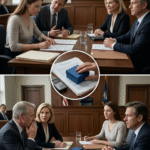
“Did they find the blue drive?” I asked.
Claire looked toward me.
“I hid it before dinner.”
“Where?”
She hesitated.
“I was afraid to tell anyone.”
“You can tell us now,” Lena said.
Claire shook her head.
“Not until I know who sent the invoice.”
Samuel pulled a chair closer.
“There is something else.”
He removed a folder from his briefcase and handed it to me.
Inside was a copy of an email written by Daniel Ross six months earlier.
It concerned the upcoming appointment of a chief operating officer.
The independent search committee had considered five candidates.
Grant’s name had been removed after concerns arose regarding undisclosed vendor relationships.
I read the paragraph twice.
“He knew he wasn’t being promoted,” I said.
Samuel shook his head.
“Daniel told Grant that the appointment was guaranteed.”
“Why?”
“We do not know.”
Claire did.
“He needed a scapegoat.”
We all looked at her.
She sat straighter despite the pain.
“If federal regulators discovered the Atlas failures after Grant became chief operating officer, the responsibility would land on him.”
“Daniel would claim Grant concealed the reports to protect his promotion.”
Samuel’s expression darkened.
“Grant authorized the payments.”
“Yes,” Claire said.
“He is guilty.”
“But Daniel built the system.”
“He gave Grant enough power to commit the crime and enough ambition to believe he would survive it.”
I thought of Grant carving roast beef at the head of the table.
I thought of Evelyn laughing about correcting Claire.
Men like Grant often imagined themselves to be kings.
**The cleverer men merely taught them where to sit.**
Lena’s telephone rang.
She stepped into the hallway to answer it.
Samuel lowered his voice.
“Margaret, why did Grant mention Thomas?”
“I was hoping you could tell me.”
Samuel looked toward Claire.
“What exactly did he say when he caught you?”
Claire’s fingers moved restlessly over the blanket.
“He said my father had tried to play hero too.”
The air seemed to leave the room.
“What else?” I asked.
“Grant was drunk.”
“He kept saying Daniel had cleaned up my father’s mess.”
“That Dad should have understood the company was bigger than one man’s conscience.”
Samuel removed his glasses.
My husband, Thomas Hale, had died twenty-one years earlier when his car left a mountain road during heavy rain.
The police found no mechanical defect.
There were no skid marks, but investigators believed the road had been too wet for them to remain.
Thomas had been returning from the Riverton facility.
He had called me that afternoon and said he had found something disturbing.
I had been preparing for trial.
I told him we would discuss it after dinner.
There was no dinner.
For twenty-one years, I had blamed the weather, the road, and the hurried final telephone call I could never take back.
Now I remembered his exact words.
**“Margaret, if I am right, the company was never in financial trouble by accident.”**
At the time, I thought he meant mismanagement.
I had never asked whether he meant a crime.
Commissioner Morales returned.
Her face had changed.
“Grant’s attorney says he is willing to provide information about the Riverton deaths in exchange for consideration.”
“That was fast,” Samuel said.
“He is frightened,” I replied.
“No,” Lena said.
“He is more than frightened.”
She looked directly at me.
“Grant claims Daniel Ross ordered the destruction of evidence related to Thomas Hale’s death.”
Claire’s eyes widened.
Samuel stood.
“On what basis?”
“Grant says Evelyn kept copies of letters exchanged between Daniel and her late husband.”
I thought of the dining room.
Evelyn had defended Grant with confidence until Claire mentioned Riverton.
Then she had reached for the diamonds at her throat.
Not her glass.
Not her son.
Her necklace.
I saw the motion again in my mind.
The diamonds were old, set in a heavy silver frame.
Evelyn wore them to every major company event.
Thomas once told me they had belonged to the Mercer founder’s wife.
I turned to Lena.
“Did the officers search Evelyn?”
“Send someone back to the house.”
“For what?”
Samuel stared at me.
“You think she hides evidence in jewelry?”
“I think people keep important things close to the body.”
Claire looked at her sling.
Then she gave a faint, almost disbelieving smile.
“Mom.”
“What?”
“The drive is in my sling.”
For several seconds, none of us spoke.
She reached beneath the padded strap near her wrist and pulled loose a small section of Velcro.
Hidden inside the lining was a blue flash drive.
Grant had sat across from her throughout dinner.
He had watched her struggle.
He had mocked her injury.
**The evidence he wanted had been resting against the arm he broke.**
Samuel took the drive carefully.
“I will make protected copies.”
“Not yet,” Claire said.
She looked toward Commissioner Morales.
“First, we find out who else knows it is blue.”
## PART THREE — THE BLUE DRIVE
The emergency board meeting began at nine the next morning.
Claire remained in the hospital under observation.
I attended by secure video from a private conference room down the hall.
Samuel sat beside me.
Commissioner Morales stood near the window, listening without appearing on camera.
On the screen, Daniel Ross occupied the central chair in the Mercer Dynamics boardroom.
He wore a charcoal suit and a dark blue tie.
His voice carried the measured sadness of a man performing grief for an audience.
“What happened to Claire is indefensible,” he began.
“Grant Mercer has disgraced his family, his position, and this company.”
Three directors nodded.
Naomi Chen, head of the audit committee, did not.
“An allegation is not a conclusion,” she said.
“No,” Daniel replied.
“But the medical findings appear clear.”
He looked toward the camera.
“Margaret, you have my deepest apology.”
“You did not break Claire’s arm.”
“No, but I placed too much faith in Grant.”
Daniel lowered his eyes.
“I informed him that he was likely to become chief operating officer.”
“It seems that confidence encouraged his worst instincts.”
The phrasing was elegant.
It also placed the entire scandal exactly where Claire had predicted.
On Grant’s ambition.
Not Daniel’s money.
Not the false testing company.
Not the dead workers.
Samuel slid a legal pad toward me.
He had written one sentence.
**HE IS BUILDING THE SCAPEGOAT IN REAL TIME.**
I looked back at the screen.
“Daniel, when did you learn about the Atlas reports?”
He paused.
“What reports?”
“The reports Claire discovered.”
“I have not seen them.”
“Did Grant tell you about them?”
“Did Evelyn?”
“Certainly not.”
Daniel spread his hands.
“My understanding is that Claire found some material on a blue drive, but we do not yet know whether it is authentic.”
No one spoke.
Samuel slowly turned his head toward me.
Commissioner Morales stepped away from the window.
On the screen, Naomi Chen leaned forward.
“How do you know the drive is blue?”
Daniel’s expression did not change immediately.
That was what made the moment so revealing.
An innocent man would have shown confusion.
Daniel showed calculation.
“I assumed Samuel had mentioned it.”
Samuel moved into view.
“I did not.”
“Perhaps Grant’s attorney—”
“The attorney did not describe the drive,” Lena said from outside the camera’s frame.
Daniel’s eyes shifted.
“Commissioner?”
She stepped forward.
“This is Commissioner Morales.”
“I would like an answer.”
Daniel removed his glasses and cleaned them with a folded handkerchief.