“It is possible Claire mentioned the color when we spoke last week.”
“I have not spoken to Daniel in four months,” Claire said.
Her voice came from the conference-room doorway.
I turned.
She stood there wearing hospital clothes beneath a long coat, her injured arm secured in a proper medical brace.
Dr. Patel was beside her and clearly unhappy.
“You should be resting,” I said.
“I have rested enough.”
She sat next to me.
On the boardroom screen, Daniel appeared genuinely disturbed for the first time.
“Claire, I did not know you were joining us.”
“That seems to be a problem for you.”
He recovered quickly.
“You have endured a terrible ordeal.”
“Yes.”
She looked into the camera.
“But not the one you planned.”
Daniel’s mouth hardened.
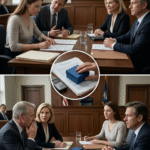
Claire placed a sealed evidence bag on the table.
The blue drive was inside.
“I found payments from Mercer Dynamics to Northlight Technical Consulting.”
Naomi Chen interrupted.
“Northlight passed three separate audit reviews.”
“Because the audit documents were falsified.”
Daniel leaned back.
“That is a serious accusation.”
“It is not an accusation.”
Claire nodded toward Samuel.
“It is arithmetic.”
Samuel displayed a diagram of the Northlight ownership structure.
The line ended with Ross Capital Holdings.
One director swore under his breath.
Another removed his glasses.
Daniel remained still.
“Ross Capital owns hundreds of investments,” he said.
“I do not personally oversee every subsidiary.”
“Northlight had no employees,” Claire replied.
“No equipment.”
“No testing facility.”
“Yet Mercer Dynamics paid it eleven million dollars for safety certification.”
Daniel looked toward Naomi.
“I assume the audit committee will review these claims.”
“We are reviewing them now,” Naomi said.
Her tone had lost all warmth.
“The payments began three weeks after Atlas failed its first sustained-heat test.”
“They increased after the Riverton incident.”
Daniel’s jaw tightened.
“There was no fatal incident at Riverton.”
“Then why did Northlight transfer six hundred thousand dollars to three families?”
The screen filled with documents.
Names appeared beside dates and amounts.
James Vickers.
Leonard Shaw.
Miguel Alvarez.
Three contractors officially listed as having resigned on the same day.
All three had died within forty-eight hours of the Riverton fire.
Their families signed confidential settlements through an outside law firm.
The company’s public report described the event as minor equipment damage.
Naomi covered her mouth.
Peter Lang, another director, whispered, “Dear God.”
Daniel turned toward me.
“Margaret, surely you understand the risk of presenting stolen and unverified records.”
“I understand the risk of ignoring them.”
“You built your career on proper procedure.”
“I built my career on evidence.”
“And evidence can be manipulated.”
Claire reached into her coat with her good hand.
She removed three original death certificates.
“These came from the county archives.”
She placed them beside the drive.
“The causes of death were thermal injuries, smoke inhalation, and structural trauma.”
“The place of injury was the Riverton plant.”
Daniel’s face became rigid.
“You have no proof that I knew.”
“You knew the drive was blue,” Claire said.
The meeting erupted.
Directors spoke over one another.
Naomi demanded Daniel’s resignation.
Peter called for federal investigators.
Samuel moved to suspend Daniel’s authority.
Then Daniel did something unexpected.
He laughed.
It was not loud.
It was the weary laugh of someone watching children celebrate before a game had ended.
“You believe this is about safety reports?”
He looked directly at Claire.
“You have no idea what you found.”
Claire’s expression remained calm.
“Explain it.”
“Ask your mother.”
His eyes shifted toward me.
“Ask her why the Hale Trust acquired thirty-eight percent of Mercer Dynamics for less than half its market value.”
“I know why,” I said.
“The company was days from bankruptcy.”
“Because Thomas made sure the banks withdrew their credit.”
Samuel stiffened.
“That is false.”
“Is it?”
Daniel leaned toward the camera.
“Thomas learned about the Riverton deaths before the official rescue.”
“He used them to force the Mercer family into selling control.”
Claire turned toward me.
My voice felt distant.
“I knew nothing about the deaths.”
Daniel smiled.
“Perhaps Thomas protected you.”
“Or perhaps you protected yourself.”
Commissioner Morales moved closer to the screen.
“You should be cautious, Mr. Ross.”
“I am being cautious.”
He replaced his glasses.
“That is why I kept copies.”
“Copies of what?” Claire asked.
“Correspondence between Thomas Hale and Charles Mercer.”
“Your father threatened to expose the deaths unless Charles surrendered the voting shares.”
My daughter looked at me as if the floor had shifted beneath her.
I wanted to tell her Daniel was lying.
I wanted certainty.
Instead, an old memory returned.
Thomas standing in our kitchen twenty-two years earlier, holding a glass of water he never drank.
He had just returned from a meeting with Charles Mercer.
I asked whether the company would accept our offer.
Thomas said, **“They will accept because they have no honorable alternative.”**
I had believed he was speaking about bankruptcy.
Daniel watched understanding enter my face.
“You remember something,” he said.
I did not answer.
Daniel’s confidence grew.
“The Hale fortune was not used to rescue Mercer Dynamics.”
“It was used to seize it.”
“Your husband was no savior.”
“He was an extortionist.”
Claire closed her eyes.
For most of her life, Thomas Hale had been the fixed point by which she measured decency.
He was the father who attended every school performance, cooked pancakes on Saturdays, and carried injured birds to a wildlife clinic in an old cardboard box.
He had taught her that character was what remained when no one was watching.
Now a man on a screen was telling her that character had been a costume.
Daniel looked toward the other directors.
“I propose we adjourn until independent counsel reviews every allegation.”
Naomi shook her head.
“You are not in a position to propose anything.”
“I am chairman.”
“Not for much longer.”
Daniel’s smile returned.
“You cannot remove me without the Hale Trust’s vote.”
He knew I was shaken.
He believed doubt had made me weak.
He had mistaken pain for paralysis.
It was a common error.
“Samuel,” I said, “prepare the motion.”
Daniel’s smile faded.
“Margaret, do not act emotionally.”
“Motion to suspend Daniel Ross from all executive and board authority pending investigation.”
Samuel read it aloud.
Naomi seconded it.
The vote passed with the Hale Trust’s support.
Daniel stared at me.
“You will regret that.”
“I have regretted many things.”
I thought of Thomas’s final call.
“I no longer intend to regret silence.”
Daniel disconnected.
For several seconds, we watched his empty chair.
Then Claire spoke.
“Do you think Dad did it?”
I could have comforted her with certainty I did not possess.
That would have been another form of dishonesty.
“I think your father kept something from me.”
Her eyes filled.
“That isn’t what I asked.”
I took her good hand.
“I do not believe he used dead men to steal a company.”
“But belief is not proof.”
She looked down.
“What do we do?”
“What I taught juries to do.”
I squeezed her hand.
“We follow the evidence even when it leads toward someone we love.”
Commissioner Morales’s phone vibrated.
She read the message and swore softly.
“What happened?” Samuel asked.
“Officers searched Evelyn’s necklace.”
Lena looked at me.
“The silver backing contained a memory card.”
Claire inhaled sharply.
“What is on it?”
“Scanned letters.”
“Financial records.”
“And an audio file recorded the night before Thomas died.”
My heart seemed to stop.
Lena continued.
“The voices belong to Daniel Ross, Charles Mercer, and your husband.”
## PART FOUR — THE LANTERN TRAP
The recording began with the clink of ice in a glass.
Thomas spoke first.
“The families deserve the truth.”
Charles Mercer answered with a voice weakened by age and alcohol.
“The truth will close every factory we have.”
“Then close them.”
“Four thousand people will lose their jobs.”
“Three men lost their lives.”
Daniel’s younger voice entered.
“They were contractors who ignored a restricted area.”
“That is a lie,” Thomas said.
“They were ordered inside because production was behind schedule.”
Silence followed.
Then Charles said, “What do you want?”
“The Atlas program suspended.”
“Independent testing.”
“Full compensation for the families.”
“And a voting trust that prevents anyone in this room from burying another safety report.”
Daniel laughed.
“You expect us to surrender control?”
“I expect you to choose between surrendering control and facing criminal prosecution.”
Claire pressed her hand to her mouth.
Daniel had told part of the truth.
Thomas had threatened them.
But he had not threatened them for personal gain.
He had forced the sale because the Mercer leadership could not be trusted with human lives.
The recording continued.
Charles sounded defeated.
“I will sign the shares over.”
Daniel said, “You cannot.”
“I built this company.”
“And I watched you destroy it.”
Thomas’s voice softened.
“Charles, this is the last decent decision available to you.”
A chair moved.
Then Daniel spoke again.
“What happens to us?”
“You leave management.”
“The board is restructured.”
“A portion of annual profits goes into a permanent fund for injured workers and their families.”
“You planned all of this,” Daniel said.
“I planned for the possibility that you would refuse.”
“You self-righteous bastard.”
Thomas did not respond.
The recording ended with a door slamming.
For a long time, the hospital conference room remained silent.
Claire began crying.
Not with relief.
With grief renewed after twenty-one years.
“He was trying to save them,” she whispered.
I closed my eyes.
Thomas had not told me because I was prosecuting a corruption case involving a state agency that regulated Mercer Dynamics.
Any knowledge on my part could have compromised the case.
He had protected my work.
He had also walked alone into a fight that killed him.
Samuel examined the scanned letters from Evelyn’s memory card.
One document described a provision known as the Lantern Covenant.
Thomas chose the name because a lantern did not extinguish darkness by argument.
It simply made concealment impossible.
Under the covenant, the Hale Trust would control thirty-eight percent of the company.
An employee-benefit trust controlled another fourteen percent.
Normally, the two blocks voted separately.
But if a senior officer retaliated against a safety whistleblower through threats, violence, dismissal, or fraudulent prosecution, the voting rights would combine temporarily.
**For ninety days, the designated protector of the covenant would control fifty-two percent of Mercer Dynamics.**
“Who is the designated protector?” Claire asked.
Samuel scrolled to the final page.
His expression changed.
“The original protector was Thomas.”
“And after his death?” I asked.
“You became trustee of the Hale shares.”
“That is not the same thing.”
Samuel looked from me to Claire.
“The successor protector was to be selected by a confidential vote of the employee-benefit trustees.”
“When?” Claire asked.
“Every ten years.”
“And who did they select?”
Samuel was silent.
“Samuel?”
“The most recent vote occurred six months ago.”
A strange sensation moved through me.
Six months earlier, Samuel had called and asked whether Claire might be willing to review irregular vendor payments.
I told him she had left forensic accounting and was struggling in her marriage.
He said no more.
That was the last time we spoke.
“You knew,” I said.
“I knew the employees had chosen someone.”
He looked at Claire.
“I did not know whether she had accepted.”
Claire lowered her eyes.
I understood before she spoke.
“You accepted.”
The word hurt more than it should have.
“You were investigating the company for six months, and you did not tell me.”
“I could not.”
“Because the covenant required independence from the Hale trustee.”
“I am your mother.”
“And Grant was my husband.”
Her voice cracked.
“I wanted to believe I could manage both without forcing you to choose between me and Dad’s legacy.”