He had expected me to come diminished.
A sad wife in beige.
A symbol of his generosity.
Instead, I walked down the side aisle wearing my own sapphires.
His eyes moved to my throat.
For one second, the mask slipped.
Fear.
Small, bright, delicious.
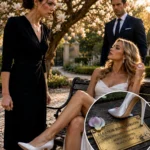
Sloane stood at the front of the room in a custom ivory gown with a cathedral veil and my fake necklace glittering at her throat. She looked beautiful. I will give her that. Beauty is not morality. It visits all kinds of houses.
Her smile faltered when she saw the sapphires.
I gave her a little nod.
The kind one gives to a child who has mistaken plastic for diamonds.
I took my seat in the front row.
Not hidden.
Not ashamed.
Front row.
Bride’s side.
The ceremony began.
A string quartet played something romantic enough to be incriminating.
Sloane walked down the aisle alone, because her father had declined to attend and her mother had sold an interview to a lifestyle blog that morning. She carried white roses. Her hands trembled.
Grant watched her approach with the expression he used at investor meetings: pleased with acquisition.
The officiant spoke about love, courage, second chances.
I watched Grant’s profile and felt nothing.
That surprised me.
For months, I had imagined pain.
A wave. A knife. A collapse.
But pain had a limit.
Disgust did not.
When the officiant asked whether anyone wished to offer a blessing, Sloane turned to me.
The room inhaled again.
She had planned this.
Of course she had.
A microphone appeared in the aisle, carried by a nervous planner in black.
Sloane smiled, bright and vicious beneath the veil.
“Vivienne,” she said. “You’ve been such an important part of making today beautiful. Would you say something?”
Grant’s mouth tightened.
He had not planned this part.
Interesting.
For a moment, I considered refusing.
Then I stood.
Every phone rose.
The planner handed me the microphone.
It was warm from someone else’s hand.
I looked at Sloane.
Then at Grant.
Then at the room.
“I was asked to help choose wedding gifts,” I said.
A ripple of laughter moved through the guests, uncertain and delighted.
“Because apparently, I have good taste.”
More laughter.
Grant’s face went gray.
Sloane’s smile fixed itself in place.
“I took that responsibility seriously. A gift should suit the recipient. It should be thoughtful. It should reveal not only what is given, but what is deserved.”
Naomi stood near the back wall, still as a blade.
Julian stood beside her.
I had not seen him enter.
His eyes were on me.
I continued.
“Sloane sent a beautiful list. Crystal. Linen. Art. A piano. A home. My jewelry.”
The laughter died.
Sloane’s hand flew to her necklace.
“And one final item,” I said. “Grant, obviously.”
Silence.
Perfect.
Alive.
I turned toward the groom.
“So I chose that.”
The ballroom screens, which had been showing a tasteful monogram of G and S, went black.
Then white text appeared.
A WEDDING GIFT FROM VIVIENNE HART WHITAKER
No music.
No drama.
Just documents.
Page one: certified forensic analysis of my forged signature.
Page two: transfer records from the Whitaker Foundation to Lark & Pine Consulting.
Page three: Lark & Pine payments to Mercer House LLC.
Page four: Mercer House ownership documents signed by Sloane Mercer.
Page five: security stills of Sloane entering my private vault.
Page six: appraisal and proof of ownership for the sapphire necklace.
Page seven: Grant’s email to his crisis consultant.
A sound moved through the ballroom.
Not a gasp.
Something lower.
The sound of a room realizing it had been invited to the wrong performance.
Grant stepped forward. “Turn that off.”
Daniel did not move.
The screens continued.
Page eight: financing proposal offering The Aurelia as collateral.
Page nine: ownership correction notice.
Page ten: activation of the Evelyn Trust.
Page eleven: emergency board consent removing Grant Whitaker as CEO pending investigation.
Page twelve: revocation of corporate event privileges and reassignment of all wedding expenses to private parties Grant Whitaker and Sloane Mercer.
Sloane whispered, “Grant?”
Grant did not look at her.
He looked at me.
“You don’t know what you’re doing,” he said.
The microphone caught it.
Every phone caught it.
I smiled.
“That has been your favorite mistake.”
Two legal couriers entered the ballroom.
Not police. Not handcuffs. Nothing so vulgar.
Just two quiet professionals in dark suits carrying envelopes thick enough to ruin bloodlines.
One went to Grant.
One went to Sloane.
Naomi stepped forward.
“Mr. Whitaker, Ms. Mercer,” she said clearly, “you are being served with civil complaints, preservation notices, and immediate injunctions concerning assets identified in these filings. Counsel for the Whitaker Foundation has also received referrals regarding suspected misappropriation. You are advised not to destroy records, transfer assets, or contact witnesses except through counsel.”
Sloane stared at the envelope as if it were alive.
“What is this?” she whispered.
I answered her.
“Your gift receipt.”
The room erupted.
Not loudly at first.
Whispers. Chairs shifting. A dropped glass. Someone saying, “Oh my God,” with the reverence usually reserved for natural disasters.
Grant tore open his envelope.
I watched him read.
Watched the blood leave his face line by line.
Sloane turned on him.
“Tell me this isn’t real.”
He snapped, “Be quiet.”
The groom.
The prize.
The man she had written at the bottom of her list with a heart.
Grant stepped toward me. “Vivienne. We can discuss this privately.”
One syllable.
It stopped him.
He lowered his voice, forgetting the microphone still loved him. “You’ll destroy us both.”
I looked around the ballroom.
At the chandeliers.
At the flowers.
At the guests who had come to watch me disappear and were now recording my resurrection.
“No, Grant,” I said. “I’m only returning what you gave me.”
Sloane’s voice cracked. “You said she couldn’t touch The Aurelia.”
Grant turned. “I said be quiet.”
The bride flinched.
And in that flinch, the fantasy died.
Not all at once.
But enough.
The screens changed again.
A final document appeared.
It was the agreement Grant had made Sloane sign six weeks earlier.
Domestic Asset Management and Private Benefit Agreement.
Grant had called it protection. A way to keep gifts and properties “clean” during the divorce.
Sloane had signed as managing member of the LLCs.
She had accepted responsibility for records, transfers, and beneficial assets.
She had signed statements that she understood the assets were held outside Grant’s personal accounts.
In other words, Grant had not only bought her a life with stolen money.
He had put her name on the hiding place.
Her face changed as she read.
The anger drained first.
Then the glamour.
Then the girl appeared.
Young. Greedy. Terrified.
“Grant,” she said, “what did you make me sign?”
He looked at her as though she were suddenly inconvenient.
“Not now.”
Sloane laughed once.
A broken little sound.
“You said it made me safe.”
Grant did not answer.
That was answer enough.
I almost pitied her.
Almost.
Then I remembered her wearing my grandmother’s sapphires.
Pity passed.
The officiant had retreated behind a floral column.
Guests were standing now. Recording openly. Whispering names of law firms. Calculating distance.
Julian moved closer to the front, but he did not interfere.
This was mine.
Grant took another step toward me.
Security took one toward him.
Daniel’s voice cut through the room.
“Mr. Whitaker, please remain where you are.”
Grant looked at Daniel with pure outrage. “I own this hotel.”
“No, sir,” Daniel said. “You operated it.”
That sentence was so elegant I nearly applauded.
Naomi handed me another envelope.
I opened it.
Inside was my divorce decree, signed by a judge that morning after emergency filings and Grant’s prior settlement signatures became enforceable.
Legal dissolution.
Irretrievable breakdown.
Asset preservation.
Spousal misconduct provisions triggered.
I took off my wedding ring.
The room quieted again, hungry for the next line.
I placed the ring into a small black velvet box.
Then I walked to Sloane.
She recoiled as if I might strike her.
I did not.
Women like me do not need to raise a hand when paper can do the cutting.
I held out the box.
Her eyes dropped to it.
“What is that?” she asked.
“The only gift I selected from your list.”
She did not take it.
So I placed it on the altar between her bouquet and Grant’s shaking hands.
“The man,” I said. “Returned permanently.”
Someone in the back whispered, “Jesus.”
Grant looked at the ring.
Then at me.
For the first time in twelve years, he looked as if he understood that I had loved him.
Not because love saved him.
Because losing it cost more than he had imagined.
“Vivienne,” he said.
There was something almost human in his voice.
Too late is the saddest language.
I leaned closer, speaking softly enough that only he and Sloane could hear.
“You asked for my taste. I gave you absence.”
Then I turned and walked out.
Behind me, Sloane was crying.
Grant was calling my name.
The guests were uploading.
By the time I reached the lobby, the first clip had already hit Instagram.
By the time I stepped into the cold afternoon, the caption had become:
WIFE SERVES HUSBAND AND MISTRESS AT THEIR OWN WEDDING.
By midnight, America had chosen sides.
By morning, so had the board.
CHAPTER 5: THE MAN WHO CAME WITH DEBT
The internet is not justice.
It is weather.
It arrives wild, loud, hungry, and gone by next week unless someone finds another fire to feed it.
For three days, my face was everywhere.
On Facebook, women over fifty called me “classy” and “cold as champagne.”
On TikTok, girls stitched my speech over videos of themselves applying red lipstick.
On Instagram, Sloane’s followers turned into archaeologists, digging through every old post for evidence of borrowed luxury.
Someone made a slowed-down edit of me removing my wedding ring while dramatic cello music played.
Someone else zoomed in on Grant’s face when the trust documents appeared and added the caption:
When the audacity expires.
I did not post.
Not once.
Silence had served me too well to abandon it for applause.
Naomi handled statements.
Mrs. Hart Whitaker will not comment on pending litigation. She asks for privacy and respect for all legal processes.
Respect for all legal processes sounded boring.
That was why it worked.
Grant tried to spin the story.
His crisis consultant released a statement about “a private family matter weaponized in public.”
Unfortunately for him, the internet had already seen page seven.
Make sure she looks complicit.
That sentence did more damage than my gown, the sapphires, or the ring.
Men underestimate women’s anger.
But they misunderstand women’s memory.
Every woman who had ever been called unstable by a man with something to hide recognized the handwriting of the lie.
The board removed Grant as CEO on Monday.
By Tuesday, Whitaker Hospitality appointed an interim chief executive and announced an independent audit.
By Wednesday, the Whitaker Foundation froze all discretionary accounts.
By Friday, the district attorney’s office confirmed it had opened an inquiry.
No handcuffs.
Not yet.
Just doors closing.
One after another.
Grant moved out of the penthouse under the supervision of counsel. He took three suits, two watches, and a bronze sculpture I had always hated. The penthouse itself was placed under temporary exclusive use in my favor pending asset review.
The Charleston house remained mine.
The Santa Fe property remained mine.
My mother’s paintings came off the walls before Grant could call them marital atmosphere.
The sapphire necklace returned to a bank vault under my maiden name.
Sloane disappeared for nine days.
Then she came to see me.
Not at the penthouse.
I had moved my personal office to The Aurelia.
Evelyn’s mezzanine suite had been repainted a deep mineral blue. The desk faced the park. On the shelves were my mother’s art books, my father’s old adding machine, and a framed note from Evelyn:
Daniel announced Sloane at 11:12 on a Thursday.
“She does not have an appointment,” he said.
“Of course not.”
“Would you like security?”
I considered it.
“No. But leave the door open.”
Sloane entered without the glow.
That was the first thing I noticed.
No ring light confidence. No bridal shine. No champagne silk.
She wore jeans, a camel coat, and sunglasses too large for her face. Her hair was pulled back. Without the performance of glamour, she looked younger and far more tired.
She stopped in the doorway.
For once, she seemed uncertain whether she was allowed in a room.
“Vivienne,” she said.
“Ms. Mercer.”
She flinched at the formality.
“Can we talk?”
“We are.”
She stepped inside.
Her eyes moved around the office. Evelyn’s office. My office. The office she had planned to erase me from.
“I didn’t know,” she said.
I said nothing.
She swallowed. “Not all of it.”
That, I believed.
It did not absolve her.
But I believed it.
“Grant said you were cruel,” she said. “He said you controlled everything. He said you didn’t love him. He said you only cared about the company and the houses and what people thought.”
I looked at her.
“Did he mention my jewelry before or after he gave it to you?”
Her face colored.
“I’m sorry about that.”
“No,” I said. “You’re sorry it was evidence.”
She looked down.
Her hands were trembling.
“He ruined me,” she whispered.
I almost laughed, but the sound would have been too bitter.
“No. He exposed you. There’s a difference.”
Her head snapped up. “You think I deserve this?”