I wore a charcoal coat, low heels, and no wedding ring.
The absence felt strange at first. My finger looked younger. Lighter. Like a room after heavy curtains had been taken down.
Grant was already inside the courtroom with his attorneys.
He stood when I entered.
Some habits survive longer than love.
He looked tired. Not destroyed. Men like Grant are rarely destroyed. They are inconvenienced by consequences and call it devastation. But there was something hollow in him now, something stripped of performance.
Sloane arrived ten minutes later.
That surprised everyone.
She had no reason to attend the custody and temporary financial orders hearing except ego, panic, or both. She wore a white coat and oversized sunglasses until the bailiff told her to remove them. Her hair was darker now, her makeup softer, as though she had rebranded from mistress to misunderstood woman.
She sat behind Grant.
Not beside him.
Behind.
I noticed.
So did he.
The judge, Honorable Marjorie Feld, entered at 10:05. She was known for disliking theatrics and reading every exhibit before anyone attempted to spin it. I liked her immediately.
The hearing began with temporary custody.
Grant’s attorney argued that he loved Ava, had been an involved father, and deserved equal parenting time.
Nathan stood.
He did not raise his voice.
He did not insult Grant.
He simply submitted the appointment records, hospital logs, missed visitation history since the separation, and the text message Sloane had sent Ava from Grant’s phone.
Judge Feld read it.
The room went quiet.
Not ballroom quiet.
Courtroom quiet.
The kind with consequences.
She looked at Grant over her glasses. “Mr. Caldwell, did Ms. Mercer have access to your phone?”
Grant’s attorney started to answer.
Judge Feld lifted one hand. “I asked Mr. Caldwell.”
Grant swallowed. “Yes, Your Honor.”
“Did you authorize Ms. Mercer to contact your minor child?”
Sloane shifted behind him.
Judge Feld looked toward her briefly, then back to Grant. “Did you take steps afterward to ensure she could not?”
Grant hesitated.
That hesitation said everything.
Judge Feld made notes.
Temporary primary physical custody remained with me. Grant received supervised therapeutic visitation until Ava’s counselor recommended expansion. Joint legal custody was deferred pending evaluation, with medical decision-making temporarily assigned to me.
I did not celebrate.
Custody is not a trophy. It is a child’s nervous system written into orders.
Then came finances.
Nathan submitted the prenuptial agreement, the trust documents, the forged equine transfer request, and the forensic accounting summary. Grant’s attorney argued that public embarrassment had already punished him, that freezing access to Whitaker-backed funds would destabilize Caldwell Development and harm employees.
Judge Feld listened.
Then she asked one question.
“Mr. Caldwell, did you sign certifications stating no trust-backed funds would be diverted to personal expenses or undisclosed compensation?”
Grant’s attorney tried again. “Your Honor, the characterization of these transfers—”
Judge Feld looked at him. “Counsel.”
The attorney stopped.
Grant said, “Yes.”
“Were funds transferred to Ms. Mercer or entities connected to her after those certifications?”
He looked at the table.
Sloane whispered, “Grant.”
Judge Feld’s eyes moved to her. “Ms. Mercer, you are not a party to this matter. Do not speak again unless called.”
Sloane flushed.
Public correction suited her poorly.
The judge granted temporary financial restraints. Grant was barred from accessing Whitaker family accounts, Ava’s education trust, the Belle Haven property, and all assets under review. He was ordered to preserve records, surrender foundation-related devices, and cooperate with the audit.
Then Nathan stood again.
“Your Honor,” he said, “there is one additional matter regarding equine property held in trust.”
Judge Feld looked almost amused. “The horse.”
“Yes, Your Honor.”
Grant’s attorney sighed.
Nathan submitted the club report, the forged transfer request, and photographs of the restored plate.
Judge Feld read silently.
Then she looked at Grant.
“Mr. Caldwell, why was another woman’s name placed on trust property connected to your wife’s deceased father?”
Grant did not answer immediately.
The entire courtroom waited.
Sloane stared at him.
His attorney whispered something.
Grant shook his head faintly.
Then, for once, he told the truth.
“Because I wanted Claire to accept that Sloane was part of my life,” he said.
Judge Feld’s face did not change. “By removing her deceased father’s name from his final gift?”
Grant’s lips trembled. “Yes.”
That was the moment.
Not the gala. Not the necklace. Not the screenshots.
That sentence.
Plain. Ugly. Unadorned.
Sloane’s face twisted. “You told me it was yours to change.”
Judge Feld’s gaze snapped to her.
Sloane looked down.
Grant turned around then, toward Sloane.
Something passed between them. Not love. Not even hatred. Recognition. He had ruined his marriage for a woman who now disgusted him because she reflected him too clearly. She had risked her future for a man who had lied so often he could not remember which version he had sold.
He looked back at me.
His eyes were wet.
“Claire,” he whispered.
Judge Feld said, “Mr. Caldwell, address the court.”
He faced forward.
For seventeen years, everything had been addressed through me. His moods. His mother. His company debts. His social obligations. His emotional weather. At last, someone else required him to stand alone inside his choices.
By the end of the hearing, the temporary orders were clear.
I kept the house.
I kept custody.
I kept control of Whitaker assets.
Magnolia remained under trust protection, with explicit prohibition against Grant or any third party attempting access, transfer, sale, or riding rights.
Sloane left before the judge finished speaking.
In the hallway, reporters waited.
Nathan suggested we exit through chambers.
I declined.
I had spent too many years leaving quietly so Grant could enter comfortably.
When we stepped into the corridor, cameras lifted.
Questions flew.
“Mrs. Caldwell, do you have a comment?”
“Is the foundation audit expanding?”
“Will you pursue criminal charges?”
“Is it true this started with a horse?”
I stopped.
Nathan glanced at me, ready to intervene.
But I wanted to answer one question.
I turned toward the cameras.
“This did not start with a horse,” I said. “It ended with one.”
The hallway fell still.
“My father taught me that love without respect becomes ownership, and ownership without truth becomes theft. Magnolia was his last gift to me. When my husband allowed another woman to put her name on that gift, he showed me exactly what he believed my silence was worth.”
Grant emerged from the courtroom behind me.
I felt him stop.
I did not turn.
“I am not here to punish anyone for leaving a marriage,” I continued. “People leave marriages. People fall out of love. What they do not get to do is erase a wife, use a child, forge documents, misuse funds, and call the consequences cruelty.”
A reporter asked, “Are you hoping for reconciliation?”
This time, I did turn.
Grant was looking at me like a man waiting for a door to open.
I gave him the truth.
“No,” I said. “I’m hoping for peace.”
His face crumpled.
Not dramatically.
But finally.
I walked away before his tears could become another thing I was expected to hold.
Outside, snow had begun to fall over Manhattan. Soft, thin, almost invisible until it touched the dark wool of my coat.
Nathan opened the car door.
As I got in, my phone buzzed.
A message from Maria at Sterling Ridge.
Photo attached.
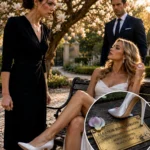
Magnolia stood in her stall, ears forward, calm and bright-eyed. The brass plate was restored.
Then came Maria’s text:
She was waiting for you this morning.
I touched the screen with my thumb.
For the first time in months, I smiled without effort.
Conclusion: Before Noon
Spring came slowly that year.
It arrived first in patches of thawed earth around the paddock fences, then in the smell of wet grass, then in Ava’s cheeks when her medication finally began to work and she laughed without saving energy for pain.
The divorce finalized in late May.
Grant signed what Nathan called “the least poetic surrender of a man who once believed himself charming.” He repaid a negotiated portion of the diverted funds, transferred his remaining interest in the Belle Haven residence, resigned permanently from the Caldwell Foundation, and agreed to a custody plan centered around Ava’s therapist’s recommendations rather than his pride.
He wrote me one letter.
Not an email. Not a text. A letter.
Claire,
I confused your grace with permission. I confused your silence with ignorance. I confused your loyalty with something I could spend.
I am sorry for Sloane. I am sorrier for Ava. But I am most ashamed that I knew what Magnolia meant to you and changed the plate anyway.
You deserved a husband who protected your father’s name.
I was not that man.
Grant
I read it once.
Then I put it in a folder marked Divorce Final.
Not because it meant nothing.
Because it meant what it could mean, and no more.
Ava continued therapy. Grant attended every supervised visit for two months, then every unsupervised afternoon, then alternating weekends when Ava was ready. He learned, slowly and imperfectly, that fatherhood was not a speech at a gala. It was showing up with soup when she was tired, reading medication labels, listening without defending himself, and leaving on time when she needed rest.
I did not interfere.
I did not rescue him either.
Sloane disappeared from our circles, then resurfaced briefly in Miami with a podcast announcement about “surviving public shame.” It lasted three episodes. In the final one, she said, “Sometimes the villain is just a woman who believed the wrong man.”
Maybe.
But she had also believed she could write her name over a dead man’s gift.
Some lessons are expensive because cheap ones are ignored.
On the first warm Saturday in June, Ava came with me to Sterling Ridge.
She had not wanted to ride since the hospital year. Her body had felt too unpredictable. Her trust in strength had become cautious. But that morning, she wore tan breeches, a navy sweater, and the serious expression she always had when trying not to show hope too quickly.
Magnolia was in the outdoor ring, groomed until her coat shone like dark honey.
Maria stood beside her.
“You don’t have to ride,” I told Ava.
“I know,” she said.
She looked at the mare. Then at me.
“Did Grandpa really say she had your eyes?”
I smiled. “He did.”
Ava touched Magnolia’s neck. The mare lowered her head, breathing softly against Ava’s sleeve.
For a while, no one spoke.
The old world had been loud with chandeliers, accusations, lawyers, whispers, and names placed where they did not belong.
This new world was quieter.
Hooves in sand.
Wind through trees.
My daughter laughing when Magnolia nudged her pocket for treats.
Maria helped Ava mount. I stood at the rail, one hand resting on the painted wood, watching my daughter sit tall in the saddle with sunlight on her hair.
She looked nervous.
Then she looked free.
Maria led Magnolia in a slow circle. Ava’s shoulders relaxed. By the second circle, she was smiling. By the third, she called out, “Mom, look!”
“I’m looking,” I said.
And I was.
I was looking at everything I had almost lost while trying to preserve a marriage that had already abandoned me.
My peace.
My child.
My father’s name.
My own.
Later, after Ava dismounted and hugged Magnolia around the neck, Maria handed me a small velvet pouch.
“What’s this?” I asked.
“The old screws from the plate,” she said. “I thought you might want them.”
Inside were four tiny brass screws. Ordinary. Scratched. Nearly weightless.
I closed my fingers around them.
For months, I had imagined the removal of Sloane’s name as the ending.
It wasn’t.
The ending was not her humiliation. It was not Grant’s regret. It was not the court order or the restored trust or the headlines fading into other people’s scandals.
The ending was this:
My daughter safe.
My father remembered.
My life quiet.
My name still mine.
Before we left, I walked down the stable aisle alone.
The brass plate shone in the afternoon light.
I touched my father’s name.
For the first time since the day he died, the grief did not feel like a room I was trapped inside. It felt like a door he had held open.
“You were right,” I whispered. “Soft until someone tries to break her.”
Magnolia stepped forward and pressed her muzzle into my shoulder.
Outside, Ava called, “Mom, are we getting lunch?”
I laughed. “Yes, sweetheart.”
As I turned to leave, sunlight caught the plate one last time.
Her name was gone.
Mine remained.
And for once, no one in the world had the power to remove it.
Comments 1
I enjoy the story thank you