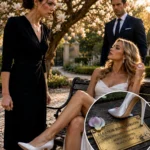
By noon, the story had traveled farther than I expected. Not in newspapers, not yet, but through the invisible bloodstream of money. Atherton Bank delayed Hayes Capital’s fund closing. Two investors requested clarification on Whitmore participation. A third withdrew. The foundation’s finance committee called an emergency meeting.
Nathaniel called Martin.
Martin did not pick up.
Vivienne called me from an unknown number at two thirty.
I answered because I wanted to hear what panic sounded like dressed as arrogance.
“Olivia,” she said, her voice cold.
“Miss Markham.”
“You’re enjoying this.”
“You expect me to believe that?”
“I don’t think about what you believe.”
She laughed once. “You know, Nathaniel warned me you could be cruel. He said you punish people with silence.”
I looked through the window of Celeste’s conference room at the East River glinting under a white sky.
“I used to think silence was kindness,” I said. “I didn’t realize how much dishonest people depend on it.”
“You don’t scare me.”
“That’s unfortunate.”
She was quiet for half a beat.
Then came the real reason she had called.
“What exactly do you have?”
I smiled without joy.
“Enough.”
She inhaled sharply. “You don’t know the whole story.”
“I know you used my name in correspondence.”
“I never signed anything.”
“Good. Then you may only be humiliated, not indicted.”
Her breath caught.
“You think Nathaniel will choose you after this?” she hissed. “He doesn’t love you. He told me sleeping beside you felt like lying next to a locked door.”
The words struck somewhere old and tender.
For a second, I saw our bedroom after my mother died. I saw myself lying awake while Nathaniel pretended to sleep. I had been grieving, yes. Distant, maybe. But I had still been there. Still raising our daughter. Still keeping the house warm. Still asking him to come to therapy. Still believing exhaustion was not abandonment.
A locked door.
Maybe I had been.
But he had not knocked.
He had gone looking for a window.
“Vivienne,” I said quietly, “you are not the first woman to be told a wife is cold so a husband can feel innocent being warm somewhere else.”
She said nothing.
I ended the call.
At three, Celeste reviewed the custody filing with me. Not to punish him. Not to erase him. To establish boundaries: no overnight guests during parenting time, no romantic partners introduced without written agreement, no school communication through third parties, no use of Lily’s image or schedule in social settings, and a financial conduct clause due to the instability of Hayes Capital.
“Reasonable,” Celeste said. “Strong, but reasonable.”
“Will he fight it?”
“Will he win?”
“Not if he keeps acting like this.”
At four thirty, Martin arrived with the final piece.
He placed a tablet on the table.
“What is it?” I asked.
“Security footage from the family office lobby yesterday.”
I already knew about the receptionist, the folder, Vivienne’s hand. I had lived it.
But watching it from above was different.
The camera had captured everything with brutal clarity: Vivienne entering on Nathaniel’s arm; Tessa greeting her as Mrs. Hayes; Nathaniel standing silent; Vivienne reaching for the folder; my arrival; the exact second Tessa realized.
Martin paused the video.
“There is audio from the lobby desk,” he said.
“Play it.”
The sound crackled.
Tessa’s voice: “Mr. Hayes, welcome. And Mrs. Hayes, we have the Whitmore packet ready.”
Vivienne’s laugh: “Perfect. Nathaniel said we should get this started before Olivia arrives.”
Then Nathaniel’s voice, low but clear:
“Just keep it simple. Once the paperwork is in motion, she’ll have to be practical.”
I felt something inside me go very still.
Not break.
Settle.
Grief is wild in the beginning, but eventually it becomes architecture. A wall here. A door there. A room you never enter again.
Martin stopped the video.
“I’m sorry,” he said.
Celeste watched me carefully.
I looked at the frozen image of Nathaniel in the lobby, his body turned slightly toward Vivienne, his face calm, his plan already moving.
“He didn’t stumble into this,” I said.
“He planned to corner me.”
I looked up.
“Then we won’t let him call it a mistake.”
The public reveal came two nights later.
Not because I wanted spectacle.
Because Nathaniel forced it.
He petitioned for an emergency board session of the Hawthorne Foundation, claiming my speech had created “reputational instability” and that my actions were “emotionally reactive during a period of grief and marital distress.” He requested a temporary pause on my authority as foundation chair pending evaluation.
In plain English, he tried to have me sidelined from my mother’s foundation by calling me unstable.
He made the mistake of doing it in writing.
The board meeting took place in the private dining room of the Langford Hotel, the same hotel where Vivienne had worn red like a victory flag.
Twenty-two people attended: trustees, legal counsel, foundation officers, Martin, Celeste, Nathaniel, and, astonishingly, Vivienne.
This time she wore ivory.
I wondered if she owned any color that did not declare war.
She sat beside Nathaniel with a folder in front of her, though she had no board seat, no foundation role, and no legal reason to be there.
When I entered, the room shifted.
I wore navy. My mother’s watch. No jewelry except my wedding ring, still on my finger for reasons that had nothing to do with love and everything to do with timing.
Nathaniel stood.
I took my seat at the head of the table.
“Please sit.”
He did.
Vivienne smiled at me from his side.
The chairman emeritus, Paul Whitaker, cleared his throat.
“We are here to address concerns raised by Mr. Hayes regarding governance stability and recent public comments affecting the foundation’s relationships.”
I folded my hands.
Nathaniel leaned forward, earnest now. He had chosen sincerity as today’s costume.
“I want to start by saying I never wanted this to become adversarial. Olivia is Lily’s mother. She is grieving. She has carried tremendous emotional weight since Margaret’s death.”
A few people nodded sympathetically.
I let them.
He continued, “But grief can distort judgment. Her speech at the gala implied misconduct without context. It damaged Hayes Capital, which has been a longtime partner in managing family philanthropic relationships.”
“Not managing assets,” Martin said.
Nathaniel’s eyes flicked to him.
“No,” he said. “Relationships.”
Vivienne placed a gentle hand on his sleeve, visible to everyone.
The audacity was almost artistic.
Nathaniel lowered his voice.
“I am concerned Olivia is making decisions from pain rather than strategy. Freezing communications, making custody threats, removing partners abruptly—these are not stable actions.”
The wounded husband.
The reasonable man.
The woman too emotional to hold power.
My mother had faced this language for forty years. It always wore a suit.
Vivienne spoke next, though no one had invited her.
“I know I’m not a board member,” she said softly, “but I’ve seen Nathaniel try again and again to protect Olivia from embarrassment. He didn’t want anyone to know how difficult things had become at home.”
A trustee named Helen Cho looked at her over the rim of her glasses.
“And you are here in what capacity?”
Vivienne blinked.
“As someone close to the situation.”
Helen’s expression cooled.
“How unfortunate for the situation.”
A cough moved around the room.
Vivienne flushed.
Nathaniel jumped in.
“What matters is whether Olivia’s judgment has compromised the foundation. I’m asking this board to consider a temporary review.”
Paul Whitaker turned to me.
“Olivia, would you like to respond?”
I looked down at my hands.
My wedding ring caught the light.
For years, that ring had meant vows. Then endurance. Then appearance. Now it was simply evidence of the legal fact Vivienne kept trying to borrow.
I removed it slowly.
No one breathed.
I placed it on the table in front of me.
Nathaniel stared at it.
His face changed.
Perhaps he thought I was being dramatic. Perhaps he remembered placing it on my finger in a church full of hydrangeas while my mother cried quietly in the front pew. Perhaps he understood, finally, that a woman does not remove a ring that calmly unless she has already mourned the marriage.
“My response,” I said, “has three parts.”
Celeste opened her folder.
Martin connected the tablet to the room’s screen.
Vivienne’s eyes narrowed.
“First,” I said, “Mr. Hayes has suggested that my judgment is impaired by grief. So I want the minutes to reflect that on October third of last year, six weeks before my mother’s death, Nathaniel Hayes began negotiations with Atherton Bank for a fund facility relying on anticipated participation from Whitmore-controlled assets.”
A document appeared on the screen.
Emails. Dates. Names.
Nathaniel’s face tightened.
“Second,” I continued, “on December seventh, after my mother’s funeral, Hayes Capital circulated investor materials implying Whitmore anchor participation.”
Another slide.
The words were highlighted.
Whitmore family capital expected as cornerstone commitment.
Murmurs around the table.
Nathaniel leaned forward. “That language was preliminary.”
“It was false,” Martin said.
I continued.
“Third, two days ago, Mr. Hayes brought Miss Markham to the Whitmore Family Office, where she was introduced as Mrs. Hayes and attempted to receive a private folder containing trust materials related to my mother’s assets.”
Vivienne laughed, brittle and loud.
“That is an absurd exaggeration.”
I looked at Martin.
He pressed play.
The screen filled with the lobby.
Tessa’s voice came through clearly.
“Mr. Hayes, welcome. And Mrs. Hayes, we have the Whitmore packet ready.”
The room went silent.
Not quiet.
Silent.
The kind of silence that has weight.
On the screen, Vivienne smiled.
Then her recorded voice said, “Perfect. Nathaniel said we should get this started before Olivia arrives.”
In the room, Vivienne went white.
Then his own voice filled the dining room.
No one moved.
Even the hotel staff near the doors stood frozen.
The video continued for three more seconds: Vivienne reaching for the folder, my arrival, Tessa’s face collapsing into horror.
Martin stopped the recording.
The silence after was worse.
It was complete.
Vivienne stood so abruptly her chair scraped the floor.
“That was private,” she said.
Judge Caroline Mercer, attending as governance counsel, looked at her with open disbelief.
“No, Miss Markham. That was a lobby.”
Vivienne’s composure cracked.
“I didn’t do anything wrong. Nathaniel told me this was already arranged. He said Olivia was holding everything hostage. He said she barely functioned after her mother died. He said—”
“Vivienne,” Nathaniel said sharply.
She turned on him.
“No. Don’t you dare. You told me I was helping you save the fund.”
The room absorbed that.
Save the fund.
Nathaniel stood halfway.
“You’re upset.”
“I’m exposed,” she snapped. “Because you lied to me too.”
For the first time, I saw her clearly.
Not as the glamorous enemy.
Not as the woman who had smiled over my pain.
As someone vain, cruel, ambitious, and foolish enough to believe proximity to betrayal made her powerful.
But her fall was still earned.
She had not been innocent. She had enjoyed my humiliation. She had touched my child’s life. She had used my name.
Nathaniel turned to the board, desperate now.
“This is being taken out of context. The fund was under pressure, yes, but my intent was to create a structure that would ultimately benefit the family. I never intended fraud.”
Celeste stood.
“Intent will be for the appropriate parties to evaluate. For today, the foundation has received enough documentation to establish that Mr. Hayes misrepresented potential Whitmore participation, involved an unauthorized third party in private financial matters, and then petitioned this board to restrict Olivia Hayes’s authority by characterizing her response as emotional instability.”
Helen Cho leaned back.
“That is a remarkable sequence.”
“It is,” I said.
Nathaniel looked at me.
And there, finally, came regret.
Not polished. Not strategic. Not useful.
Real regret.
It moved across his face like damage. His eyes reddened. His mouth trembled once before he controlled it. He looked at the ring on the table, at the screen, at Vivienne standing beside him with fury in her face and no rescue left to offer.
“Olivia,” he said.
My name sounded different in his mouth now.
Too late.
The room watched me.
A younger version of me might have wanted those words so badly I would have mistaken them for repair.
But apology after exposure is not the same as remorse before consequence.
“So am I.”
His eyes filled.
“I never meant for it to go this far.”
I believed him.
That was the ugliest part.
He had not meant to get caught. He had not meant to lose control. He had not meant for rooms full of people to know the truth.
But he had meant to deceive me.
He had meant to humiliate me.
He had meant to use my grief, my mother’s legacy, my daughter’s confusion, and my silence.
I turned to Paul Whitaker.
“As chair, I move to terminate all foundation relationships with Hayes Capital effective immediately, refer the matter to independent counsel, and bar any non-authorized third party from foundation or family office communications going forward.”
Helen seconded.
The vote passed unanimously.
Nathaniel sat down as if his bones had been cut.
Vivienne looked around the room for sympathy and found none.
Then she grabbed her purse.
“This entire family is sick,” she said, voice shaking. “You people act like money makes you moral.”
“No,” I said calmly. “But paperwork makes you accountable.”
Her face twisted.