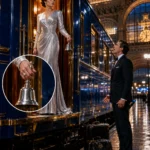
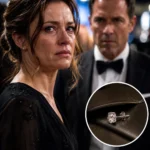
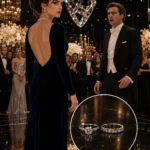
He seated his mistress in my family box at the championship polo match.
She wore my mother’s hat and waved as if old money had adopted her.
From the edge of the members’ terrace, I watched Sloane Mercer lift one white-gloved hand to the photographers below. The brim of the ivory Philip Treacy tilted at precisely the angle my mother had taught me when I was seventeen.
Not too low, Evelyn. A woman should never hide when the room belongs to her.
Sloane smiled beneath it.
My husband sat beside her with one ankle crossed over his knee, champagne in hand, looking every inch the American prince the society pages had spent ten years pretending he was.
Julian Carrington had my grandfather’s box.
My mother’s hat.
My family’s champagne.
And another woman’s hand resting on his thigh.
My phone vibrated.
A message from Julian appeared on the screen.
**The box is full. You can watch from the public lawn. Don’t make this difficult.**
I read it twice.
Not because I was shocked.
Because evidence should always be read carefully.
Around us, the Atlantic Championship was unfolding beneath a flawless Florida sky. Eight thoroughbreds thundered across the emerald field. Silver mallets flashed. White tents billowed at the edges of Blackthorn Polo & Hunt Club, where hedge-fund managers, senators, movie stars, and women wearing diamonds before noon pretended not to stare at me.
They had already seen Sloane.
Now they were waiting to see what I would do.
Cry.
Scream.
Throw champagne.
Beg my husband to remember that I had stood beside him when his first company failed, when his father died, when creditors called our apartment so often that we unplugged the phone.
Society forgives cruelty.
It never forgives a woman for making cruelty look expensive.
I slipped my phone into my clutch and walked toward Malcolm Reed, the club steward.
Malcolm had worked at Blackthorn for thirty-two years. He had served my grandfather bourbon before championship finals, carried umbrellas for my mother during summer storms, and once removed a European duke for striking a groom.
His silver brows rose as I approached.
“Mrs. Carrington.”
“Malcolm.”
His eyes moved briefly toward the family box, where Sloane was laughing at something Julian had whispered into her ear.
“I believe there may be some confusion regarding Box One.”
“There usually isn’t.”
“No,” I said. “There usually isn’t.”
I handed him my phone.
He read Julian’s message.
His expression did not change, but his jaw tightened.
“Would you check the hereditary box registry for me?”
“Of course.”
“Please take your time.”
May you like
Across the field, a bell rang.
The crowd applauded.
Julian finally looked down and saw me standing beside the steward.
For half a second, the confidence left his face.
Then he smiled.
He believed I was still the woman he had trained to protect him from consequences.
He believed silence meant surrender.
He had never understood that silence could also be preparation.
Malcolm returned with a leather-bound registry carried by two attendants. Blackthorn had digitized almost everything, but the original hereditary records remained written by hand, protected in a climate-controlled archive beneath the east wing.
Old money trusted paper because paper remembered who had lied.
Malcolm opened the book.
“Box One,” he read, loud enough for the nearest members to hear, “was granted in perpetuity to the direct descendants of Theodore James Blackwood and their invited guests.”
Sloane’s smile faltered.
Julian stood.
“My wife invited us.”
Malcolm turned to me.
I looked at Julian.
Then at Sloane, wearing my dead mother’s hat.
“No,” I said. “I did not.”
The first phones rose from the crowd.
Julian’s face hardened.
“Evelyn.”
I held his gaze.
He had used my name as a warning for years.
That afternoon, I let it sound like a verdict.
“Malcolm,” I said, “please remove the trespassers.”
And that was how my marriage ended.
Not with a scream.
With a registry.
# CHAPTER ONE
## The Hat That Outlived a Marriage
The first thing Julian did after Malcolm escorted him from the box was blame me for embarrassing him.
The second thing he did was leave with Sloane.
The order mattered.
He did not ask how I felt. He did not explain why his mistress had access to the locked archive room at Bellweather House, where my mother’s clothing had remained untouched since her death.
He stood beneath the striped awning outside the members’ pavilion, his face flushed with a rage so controlled that only I could see the fracture beneath it.
“You made a spectacle of us.”
“Us?”
“You know what I mean.”
“I do.” I looked toward Sloane, who waited beside his black Bentley with my mother’s hat still on her head. “I simply wanted to hear you say it.”
“Not here.”
“Here seems appropriate. You chose the venue.”
A cluster of photographers lingered near the valet station. They pretended to review their shots while angling their microphones toward us.
Julian lowered his voice.
“Sloane is working with Carrington Development. She is advising the hospitality division.”
“Does the hospitality division usually sit on your lap?”
His eyes went cold.
That look had frightened board members, contractors, assistants, and at least one junior architect into resigning without collecting severance.
It no longer frightened me.
Perhaps because fear, like love, eventually becomes exhausted when it is asked to perform every day.
“You have no idea what you’ve done,” he said.
“I checked a seating chart.”
“You humiliated a woman who has done nothing to you.”
“She stole my mother’s hat.”
“I gave it to her.”
There it was.
A confession offered casually because he believed ownership followed his desire.
My hand tightened around my clutch.
Inside it was my phone, still recording.
“You gave away property that does not belong to you.”
“It’s a hat, Evelyn.”
“No. It was my mother’s.”
“And she’s dead.”
The photographers went still.
Even the wind seemed to pause between the palm trees.
Julian realized what he had said only after the words had escaped him. For one brief moment, something like regret moved across his face.
Then pride killed it.
Sloane approached us.
She was twenty-nine, beautiful in the polished, deliberate way of women who had learned early that beauty was most profitable when it looked effortless. Her blond hair had been twisted into a low chignon. The white silk of her dress skimmed her body without wrinkling. My mother’s hat floated above her like an insult designed by a milliner.
“Julian,” she said softly, touching his arm. “We should go.”
I looked at her hand.
She removed it.
Then she faced me.
“Evelyn, I’m sorry you were surprised.”
“Surprised?”
“Julian said you understood the situation.”
“I understand it perfectly.”
Her composure flickered.
Behind her careful expression, I saw calculation. She was not ashamed. Shame requires uncertainty. Sloane believed she had already won.
She believed Julian had brought her into the box because he intended to bring her into my life.
My house.
My marriage.
My name.
Women like Sloane were often described as ambitious, as though ambition itself were the offense.
It was not.
The offense was believing another woman’s destruction counted as an entry fee.
“May I have the hat?” I asked.
Sloane glanced at Julian.
That single glance told me more than any confession could have.
She needed his permission to return what he had stolen.
He gave the smallest shake of his head.
“No,” he said.
I nodded.
“All right.”
His suspicion sharpened.
“That’s it?”
“For today.”
I turned and walked back toward the club.
Behind me, Julian called my name.
I did not stop.
By the time I reached Box One, a fresh bottle of champagne had been placed in silver.
Malcolm stood at the entrance.
“Mrs. Carrington, should I have the bottle removed?”
“No. It has done nothing wrong.”
For the first time that afternoon, he smiled.
I took my seat beneath the Blackwood crest.
The chair beside me remained empty.
People watched from nearby boxes, hungry for tears.
I gave them excellent posture.
The final chukker began.
The sun lowered over the field, laying gold across the grass my family had owned for ninety-six years.
That was the detail Julian had forgotten.
Blackthorn Polo & Hunt Club operated on Blackwood land.
The clubhouse belonged to a hospitality corporation.
The stables belonged to an equestrian partnership.
The tournament rights belonged to a sports consortium.
But the six hundred and forty acres beneath all of it—the field, the lake, the east paddocks, the ancient live oaks, and the road connecting the club to the highway—belonged to the North Star Trust.
My mother’s trust.
My trust.
Julian had spent twelve years convincing the world that he had married into Blackthorn.
He had not.
He had only been invited.
At five twenty-three that evening, his Bentley left the club.
At five twenty-seven, I received three messages from friends asking whether I was all right.
At five thirty-one, a video of Sloane being removed from Box One appeared online.
At five forty-six, the clip passed one hundred thousand views.
By sunset, the internet had chosen a sentence to describe me.
**She didn’t throw the champagne. She checked the deed.**
I did not post it.
I did not like it.
I did, however, save it.
At eight that night, I returned to Bellweather House.
The estate stood west of Palm Beach, behind iron gates and two miles of cypress. My great-grandfather had built the original white-stucco house in 1928, after making and losing three fortunes in railroads, citrus, and insurance.
Every generation had added something unnecessary.
A ballroom.
A glass conservatory.
A rose garden imported from England.
My mother had added a library with hidden climate controls because, in her words, books deserved better air than most people.
Julian had added security cameras.
I had allowed him to.
That had been a mistake.
The foyer lights were on when I entered.
Our housekeeper, Rosa Alvarez, approached from the west corridor.
She had worked for my mother before working for me, and she possessed the rare ability to make concern feel dignified.
“Where is he?”
“Mr. Carrington hasn’t returned.”
“His clothes?”
Rosa hesitated.
“Some were removed yesterday.”
Yesterday.
Not after the match.
Before it.
The humiliation had not been impulsive.
It had been staged.
Julian had wanted me to see Sloane in the box. He had wanted the club to see her there. He had wanted the photograph to exist.
That meant the affair was no longer a secret.
It was an announcement.
“Did anyone enter my mother’s archive?”
“Mr. Carrington brought Ms. Mercer on Thursday. He told security she was helping prepare items for the foundation auction.”
“Was the visit logged?”
“Yes.”
“Send the footage to my private email. Not the family office.”
Rosa studied my face.
“What else do you need?”
“The blue guest suite prepared.”
“For you?”
“For Julian.”
Understanding entered her eyes.
“He won’t like that.”
“No,” I said. “But he has always enjoyed rooms that aren’t his.”
Upstairs, the doors to my mother’s archive stood open.
The room smelled faintly of cedar and dried roses. Her evening gowns remained arranged by decade. Her shoes rested in glass-front cabinets. Hatboxes lined the upper shelves, each labeled in her handwriting.
ASCOT, 1998.
PARIS, 2004.
EVELYN’S WEDDING.
The empty space where the ivory hat had been looked indecently bright.
I stood before it and remembered my mother on the morning of my wedding.
She had worn the hat with a pale gray suit. Cancer had already taken weight from her face, but no one had known except our family and the specialists at Sloan Kettering.
She had held my hands in the bridal suite and looked at me longer than a mother usually looks at a daughter on a wedding day.
“Do you love him?” she had asked.
“Does he love you?”
I had laughed nervously.
“Mother.”
“Those are different questions.”
“He loves me.”
She had adjusted my veil.
“Then make sure he loves the woman you are, not the doors your name can open.”
At twenty-four, I had considered that advice cynical.
At thirty-six, I understood it had been a map.
I closed the archive doors and went to my bedroom.
Julian’s side of the closet had been stripped of suits, watches, and shoes. He had left behind the navy tuxedo he had worn to my mother’s funeral.
On his dresser sat our wedding photograph.
He had placed it facedown.
My phone rang.
Julian.
I answered.
“Where are you?” he demanded.
“At home.”
“That house is half mine.”
“No.”
A pause.
“What?”
“Bellweather was placed in the North Star Trust six years before our marriage. It is separate property.”
“I paid for renovations.”
“Carrington Development invoiced the trust for those renovations at a thirty-two percent markup.”
Silence.
That was the first moment he understood I had been looking at numbers.
“I don’t know what you think you found,” he said.
“You sound nervous.”
“I’m angry.”
“They often wear the same suit.”
“Stop performing.”
“I’m alone.”
“You were never this cruel before.”
The accusation almost made me laugh.
Cruelty, to Julian, was a mirror that refused to flatter him.
“Come home,” I said.
“I’m not discussing this tonight.”
“I wasn’t asking to discuss it. I was telling you to collect the rest of your things.”
“The gate code expires at midnight.”
“You cannot lock me out of my own home.”
“It isn’t your home.”
His breath changed.
In the background, I heard music and the soft clink of glass.
Sloane was with him.
“Who has been advising you?” he asked.
“No one.”
That was true.
For the moment.
“I’ll come tomorrow with my attorney.”
“Bring two.”
I ended the call.
Then I opened the safe behind my dressing-room mirror.
Inside were my passport, my mother’s final letter, two external drives, and a black card embossed with a name I had not spoken in nearly a decade.
ADRIAN CROSS
CROSS & VALE LITIGATION
NEW YORK • WASHINGTON • MIAMI
Adrian had given it to me at my mother’s funeral.
Not with a speech.
Not with an embrace.
He had simply placed the card in my hand and said, “There may come a day when you need someone who remembers who you were before him.”
At the time, I had been offended.
Now I understood why.
I called the number.
He answered on the second ring.
He did not sound surprised.
“You kept my number.”
“I keep important things.”
I sat on the edge of the bed.
“Are you in Miami?”
“I can be.”
“I need a divorce attorney.”
My spine stiffened.
“You need a litigation team, a forensic accountant, and an emergency injunction before your husband realizes how much you know.”
The room became very quiet.
“How much do I know?”
“Not enough yet.”
I stared at the dark window.
“Have you been investigating Julian?”
“Your mother asked me to watch one company.”
My breath caught.
“When?”
“Three weeks before she died.”
“She died seven years ago.”
“And you waited until now?”
“I waited until you called.”
Anger rose, clean and sharp.
“You should have told me.”