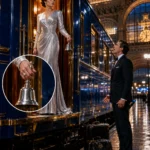
My husband brought his mistress aboard my family’s restored luxury train and told her the owner’s carriage would soon be hers.
She ran one white-gloved hand over the mahogany walls while investors watched me stand near the service door.
The train gleamed beneath the midnight glass of Grand Central Terminal—twelve royal-blue carriages trimmed in brass, crystal lamps glowing behind velvet curtains, silver champagne buckets sweating beneath arrangements of winter roses.
It had taken my family nearly a century to build its legend.
It had taken me nine years to bring it back from ruin.
And it had taken my husband less than nine minutes to announce that he intended to give it to another woman.
Julian Harrington lifted his champagne glass and smiled at the crowd.
“Some journeys end long before people are brave enough to admit it,” he said, looking directly at me. “Old wives should know when their time on the train is over.”
A few guests laughed.
Most looked away.
His mistress, Celeste Arden, rested her hand on the brass handle of the owner’s carriage as if she were already practicing possession.
I said nothing.
I simply waited until the conductor stepped onto the platform and asked the legal owner of the Sovereign Limited to ring the departure bell.
# **CHAPTER ONE — THE WIFE THEY PLACED BESIDE THE SERVICE DOOR**
Six weeks earlier, my husband ended our marriage between the fish course and dessert.
He did it beneath a ceiling painted with angels.
The Halcyon Club occupied the top three floors of a limestone building on Fifth Avenue, the kind of place that rejected celebrities for being too visible and admitted criminals for having old enough money. Its dining room smelled of beeswax, burgundy, and secrets inherited through generations.
Julian had reserved the center table.
He liked center tables.
He liked having witnesses.
He sat across from me in a charcoal Brioni suit, his silver cuff links stamped with the Vale family crest. They had belonged to my father. Julian had begun wearing them after the funeral and had never asked whether he should.
On his right sat Celeste Arden.
Officially, she was the creative director hired to modernize the Sovereign Limited before its relaunch.
Unofficially, she had been sleeping with my husband for eleven months.
I knew because Julian’s driver had sent me a photograph by accident three weeks earlier.
The picture showed Julian leaving the Mercer Hotel at six seventeen in the morning. Celeste was behind him, barefoot beneath a camel coat, carrying her silver heels in one hand.
The driver deleted the message twelve seconds later.
Twelve seconds was long enough.
May you like
I had not confronted Julian.
A confrontation would have given him the chance to lie before I understood why the truth mattered.
Instead, I had smiled through breakfast. I had listened while he complained about interest rates, restoration delays, and my supposed inability to “think commercially.” I had watched him use the monogrammed linen napkin I had ordered for our anniversary to wipe Celeste’s lipstick from the corner of his mouth.
Men like Julian mistook silence for surrender.
They had no idea silence could be an archive.
That evening at the Halcyon, twenty-two investors sat around our table. Two representatives from Vesper Capital had flown in from San Francisco. Three members of the Vale Rail board occupied the seats nearest Julian. A columnist from the Financial Herald had somehow obtained an invitation.
That was how I knew the humiliation was not spontaneous.
Julian had staged it.
The first course was Maine lobster beneath a glass cloche. The second was black cod glazed with miso and honey. When the servers cleared the plates, Julian rose.
He touched the back of Celeste’s chair.
“Before dessert,” he said, “there are two developments I’d like to share.”
Every face turned toward him.
I folded my hands in my lap.
His eyes met mine.
There was no apology in them.
Only anticipation.
“The first concerns the Sovereign Limited. Vesper Capital has agreed in principle to acquire a controlling interest in Vale Heritage Rail after the inaugural journey next month.”
A murmur passed around the table.
The Sovereign Limited was not merely a train.
It was the last surviving masterpiece of the Vale rail empire.
My great-grandfather, August Vale, had commissioned it in 1928 as America’s answer to the Orient Express. Presidents had dined in its walnut-paneled salon. Movie stars had hidden from scandal behind its silk curtains. During the war, its sleeping compartments had carried diplomats across the country beneath armed guard.
Then came bankruptcy, neglect, and forty-three years beneath a leaking roof in Pennsylvania.
I had found the train when I was twenty-six.
Its brass had gone green. Its velvet had rotted. Birds had nested inside the chandeliers.
Everyone told me to sell it for scrap.
Instead, I spent nine years rebuilding it.
I sold two houses, most of my jewelry, and every safe investment my father had left me. I persuaded retired craftsmen to return to work. I tracked down original blueprints in private collections. I slept in freezing restoration yards and learned to distinguish mahogany from stained oak by touch.
Julian joined the project in its fourth year.
He joined me in its fifth.
By our sixth, he had started describing the restoration as his vision.
Now he was selling it.
“Controlling interest?” I asked.
It was the first thing I had said in twenty minutes.
Julian’s smile widened.
“Yes, Eleanor.”
He always used my full name when he wanted to make me sound difficult.
“Vesper’s capital will allow the Sovereign brand to become what it was always meant to be—global, relevant, and profitable.”
“The Vale Preservation Trust prohibits a controlling sale.”
“Only until certification.”
The answer came too quickly.
My pulse slowed.
So he knew about the certification clause.
Interesting.
Julian continued.
“Once the train completes its federal operating inspection, the restrictions can be restructured. The board has been advised accordingly.”
One of the board members looked down at his wine.
Another adjusted his cuff.
Neither met my eyes.
They had already voted.
Or believed they had.
I looked toward the Vesper representatives. Both were men in their fifties, composed and unreadable. The taller one gave me the smallest nod.
Not sympathy.
Acknowledgment.
Julian lifted his glass again.
“The second development is personal.”
Celeste lowered her lashes modestly.
She wore white satin, diamond drop earrings, and the expression of a woman waiting for applause.
“Eleanor and I have decided to end our marriage.”
A server entering with dessert stopped so abruptly that a silver spoon slid from his tray.
It struck the marble floor.
The sound traveled through the room like a crack in ice.
Julian did not look at me.
He looked at the columnist.
“As painful as these decisions are,” he continued, “clarity is kinder than performance. Eleanor’s devotion to the past has become incompatible with the future I am building.”
The future I am building.
Using my name.
My money.
My train.
My father’s cuff links.
Celeste placed one hand over Julian’s.
It was a beautiful gesture.
Almost tender.
Almost believable.
Julian turned to her.
“Celeste will remain with Vale Heritage Rail as chief creative officer after the acquisition.”
A woman near the far end of the table inhaled sharply.
The affair was no longer implied.
It had been presented as a corporate promotion.
Julian had not merely left me.
He had transformed betrayal into a press release.
Everyone waited for me to break.
Perhaps they expected shouting.
Perhaps they hoped I would throw wine into Celeste’s face, giving them a story in which my humiliation became my lack of dignity.
I looked at my husband.
“How long have you been planning this?”
He loosened his shoulders, relieved that I had chosen a question instead of a weapon.
“The separation?”
“The table.”
His smile faltered.
I glanced at the place cards, the columnist, the board members, and Celeste’s flawless dress.
“How long have you been planning the table, Julian?”
Silence settled over the crystal.
Celeste removed her hand from his.
Julian recovered quickly.
“This isn’t the time for one of your dramatic interrogations.”
“I agree.”
I stood.
The room seemed to lean toward me.
I placed my napkin beside the untouched dessert plate.
“Enjoy the angels,” I said. “They’ve seen worse men than you.”
Then I walked away.
I did not hurry.
That mattered.
Outside the dining room, an attendant held my coat open. My hands remained steady until I reached the elevator.
The doors closed.
My reflection stared back from three walls of smoked bronze.
Thirty-eight years old.
Black silk gown.
My mother’s pearl earrings.
A face the newspapers would describe the following morning as pale, stricken, and devastated.
They would be wrong about two of those words.
My phone vibrated before I reached the lobby.
A headline had already appeared.
RAIL HEIRESS ABANDONED AS HUSBAND STEERS FAMILY LEGACY TOWARD BILLION-DOLLAR FUTURE.
Below it was a photograph of Celeste and Julian arriving together through the club’s private entrance.
The article described me as “emotionally attached to the heritage elements of the business” and “resistant to necessary modernization.”
Julian had handed the story to the press before telling me.
The divorce papers arrived at 11:40 that night.
A process server waited in the lobby of our building on Central Park South while photographers gathered outside.
I signed for the envelope beneath the golden light of the chandelier.
“Mrs. Harrington?” the man asked quietly.
“For the moment.”
He looked embarrassed.
I almost felt sorry for him.
Upstairs, the penthouse was empty.
Julian’s clothes were gone from the primary bedroom. So were six paintings, the silver from the dining room, and the blue leather box containing my grandmother’s emerald necklace.
That necklace had been given to Lillian Vale on the night the Sovereign Limited completed its first journey.
I opened the safe.
Julian had taken everything except a sealed ivory envelope.
My name was written across the front in handwriting I had not seen in twelve years.
Eleanor.
My grandmother’s hand.
I carried the envelope to the library and opened it with my father’s letter knife.
Inside was a single card.
No greeting.
No explanation.
Only nine words.
**When a man believes he owns your name, let him sign.**
Beneath the sentence was an address in lower Manhattan.
A time.
Eight o’clock the following morning.
And two initials.
A.C.
I did not sleep.
At seven thirty, I changed into a navy suit and left through the service entrance while reporters waited at the front.
The address belonged to an old banking building on Nassau Street. Its stone façade was blackened by a century of weather. There was no company name above the revolving doors.
A security guard checked my identification and directed me to the twenty-third floor.
The elevator opened into a quiet reception room paneled in dark oak.
A man stood beside the windows.
He was taller than I remembered, though perhaps memory had simply preserved him at twenty-eight.
Adrian Cross wore a black suit without a tie. His hair had begun to silver at the temples. Ten years earlier, he had been the youngest attorney ever appointed counsel to the Vale Preservation Trust.
Nine years earlier, he had kissed me in the rain outside a restoration yard in Altoona.
Eight years earlier, I had married Julian.
Adrian had attended the ceremony, left before dinner, and moved to London three weeks later.
Now he turned toward me with the same stillness I remembered.
His eyes moved over my face, searching for damage.
He found it.
He did not insult me by pretending otherwise.
“I’m sorry,” he said.
“About the marriage?”
“About the manner of its death.”
I looked around the empty office.
“What is this place?”
“The administrative office of the Vale Preservation Trust.”
“The trust is managed in Boston.”
“The public trust is.”
He crossed to a long conference table where three black folders waited.
I did not sit.
“What did my grandmother hide?”
“Almost everything that mattered.”
He opened the first folder.
Inside was an original trust agreement dated October 18, 1998.
My grandmother’s signature appeared on the final page.
So did Adrian’s father’s.
“The entity Julian knows as the Vale Preservation Trust owns the physical train,” Adrian said. “It has no commercial control once certification is completed.”
“I know.”
“No. You know the version your husband was allowed to find.”
He opened the second folder.
A corporate chart unfolded across the table.
At the top was a company I had never seen.
Sovereign Meridian Holdings.
Beneath it were rail rights, hotel properties, licensing agreements, vintage trademarks, and parcels of land in seven states.
At the bottom was the Sovereign Limited.
My mouth went dry.
“What is Sovereign Meridian?”
“Your grandmother’s private holding company.”
“I searched every Vale entity after my father died.”
“It wasn’t a Vale entity. Not by name.”
“Who owns it?”
Adrian looked at me.
“You do.”
The city moved far below us, yellow taxis slipping between shadows.
I stared at the chart.
“That’s impossible.”
“It was designed to seem impossible.”
He handed me the third folder.
Inside was a legal opinion bearing the seals of three states and a federal trust certification.
“Your grandmother anticipated that the family name would attract men more interested in possession than preservation. She separated the visible legacy from the valuable one.”
“How valuable?”
“Before the restoration?”
He paused.
“Approximately four hundred and eighty million dollars.”
I gripped the edge of the table.
“And now?”
“If the Sovereign receives operating certification, dormant corridor rights, trademark options, and development clauses reactivate.”
“How valuable, Adrian?”
“Conservatively?”
“Yes.”
“Two point three billion.”
The room became very quiet.
I read the number again.
“Julian doesn’t know.”
“He knows enough to be dangerous. He discovered references to a secondary trust eighteen months ago. He does not know its name, its assets, or its beneficiary.”
“Then why the sale?”
“Because he believes acquiring the physical train will lead him to everything behind it.”
I thought of the Halcyon table.
The investors.
Celeste.
The rehearsed cruelty.
“He thinks the divorce removes me.”
“He thinks the operating agreement gives him control of your marital shares.”
“Does it?”
“For thirty-one more days.”
“Until certification.”
Adrian nodded.
“When the Sovereign passes its final inspection and completes the ceremonial departure procedure, voting control transfers automatically to the beneficiary named by Lillian Vale.”
“Me.”
“You.”
“And Julian?”
“Becomes a minority stakeholder with no management authority.”
A cold clarity entered me.
It felt nothing like anger.
Anger is fire. It consumes oxygen. It makes noise.
This was winter.
Winter preserved everything.
“What has he signed?” I asked.
Adrian’s expression changed.
There it was.
The reason my grandmother’s note had told me to let Julian sign.
“He has executed a preliminary acquisition agreement with Vesper Capital,” Adrian said. “He warranted that he possesses full authority to sell a controlling interest.”
“He doesn’t.”
“No.”
“What happens when he cannot deliver?”
“The company owes a breakup fee.”
“How much?”
“One hundred and twenty million dollars.”
I almost laughed.
“Vale Heritage Rail doesn’t have one hundred and twenty million.”
“The agreement includes a personal indemnification clause in the event of fraud, concealment, or misrepresentation of ownership.”
“Julian signed personally?”
“Three days ago.”
The first crack appeared in my grief.
Not joy.
Not yet.
But possibility.
“Does Vesper know?”
Adrian closed the folder.
“They know exactly who owns Sovereign Meridian.”
I studied him.
“Who are they working for?”
He held my gaze.
“That depends on what you decide to do next.”
I walked toward the window.
From the twenty-third floor, Manhattan looked clean.
Distance had removed the garbage, the sirens, the stains on the sidewalks. Steel and glass reflected the morning as though the city had never betrayed anyone.
“What would my grandmother have done?” I asked.
“Your grandmother once bought a bank because its manager refused her a loan.”
“That doesn’t answer me.”
“It does if you remember her.”
I did.
Lillian Vale had worn pearls to breakfast and carried grudges with perfect posture. She never raised her voice. She never threatened. She simply rearranged the world until the person who had underestimated her found every door locked.