My husband introduced his mistress as our son’s inspiration at the National Robotics Championship.
Then he told security I was not part of the family photograph.
The championship floor inside the Walter E. Washington Convention Center gleamed beneath a thousand white lights. Camera shutters flashed across rows of polished machines. Corporate banners hung from the rafters like flags over a modern battlefield, and in the center of it all stood my fourteen-year-old son, Owen, beside the robot we had built together at our kitchen table.
Its name was Blackbird.
For eleven months, Owen and I had designed its navigation system, rebuilt its pressure sensors, and rewritten the decision architecture every time the machine confused a staircase with a shadow. We had worked after midnight while the rest of the Sterling estate slept. We had eaten cold pizza over circuit boards and argued about whether a robot could be taught courage.
Owen said courage was just a decision made before fear could interfere.
I told him that sounded like something worth coding.
Now Blackbird had won the National Youth Robotics Championship.
And Graham, my husband of sixteen years, had chosen the moment of our son’s greatest achievement to erase me.
He stood beneath the Sterling Dynamics banner in a midnight-blue Brioni suit, one hand on Owen’s shoulder and the other resting at the waist of Celeste Monroe.
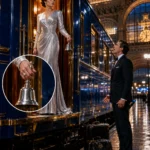
Celeste wore ivory silk.
Of course she did.
Ivory photographed better than white under television lights, and Celeste never entered a room without understanding how she would appear when she left it. She was thirty-two, glossy, ambitious, and professionally warm in the way expensive hotel lobbies were warm. She had been hired eighteen months earlier as Sterling Dynamics’ vice president of brand strategy.
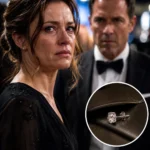
Six months after that, I found one of her diamond earrings beneath the passenger seat of Graham’s Aston Martin.
I had not confronted him.
Confrontation was useful only when the other person still believed the truth could hurt them.
Graham had stopped believing that long ago.
“And this,” he said to the cameras, drawing Celeste closer, “is the woman who inspired Owen to believe innovation could be beautiful.”
The reporters smiled.
Celeste lowered her lashes with rehearsed modesty.
Owen looked at me.
I was standing six feet away, holding the black velvet presentation case containing his first soldering iron. I had brought it as a surprise. The case suddenly felt absurdly heavy.
A photographer lifted his hand.
“Immediate family only for the official team shot.”
Graham did not look at me when he said, “Evelyn, perhaps you could wait near the exit.”
The words were quiet.
That made them crueler.
Public humiliation rarely arrived screaming. Sometimes it arrived in a measured voice, wearing Italian wool, confident that everyone in the room already understood your reduced value.
A few people glanced toward me.
Most looked away.
They knew who I was. Evelyn Hart Sterling. Graham Sterling’s wife. A former systems architect who had “stepped back” to raise their son. The silent woman beside the loud man. The gracious hostess at the Sterling Foundation winter gala. The figure in black standing half a pace behind the billionaire.
May you like
They did not know I had written the original architecture on which Sterling Dynamics had built its first autonomous systems.
They did not know Graham’s empire had begun in my graduate apartment with a borrowed server, two folding chairs, and a code base called Asterion.
They did not know because Graham had spent fifteen years teaching the world that my silence meant I had contributed nothing.
Celeste turned toward me with a small, sympathetic smile.
It was the smile of a woman already imagining herself in my house.
“I hope you understand,” she murmured. “This is really about Owen.”
“No,” I said softly. “It isn’t.”
For the first time, uncertainty flickered across her face.
Graham’s jaw tightened.
“Don’t make a scene, Evelyn.”
I almost smiled.
Men like Graham were terrified of scenes because scenes created witnesses.
I looked at Owen.
His face had gone pale beneath the championship lights. At fourteen, he had Graham’s dark hair and my gray eyes. He also had the unfortunate burden of understanding more than adults wanted him to.
I placed the velvet case on an empty table.
Then I stepped outside the frame.
The photographer arranged them carefully: Graham on the left, Celeste on the right, Owen between them, Blackbird at their feet.
A manufactured family.
A stolen achievement.
A lie polished until it reflected light.
The master of ceremonies approached with a microphone.
“Owen Sterling, youngest winner in championship history,” she announced. “Who would you say made the greatest difference in helping you build Blackbird?”
Graham smiled before Owen answered.
Celeste touched Owen’s shoulder as though preparing to receive his gratitude.
I stood beyond the velvet rope, surrounded by strangers.
Owen took the microphone.
For one long second, he stared at his father.
Then he removed Celeste’s hand from his shoulder.
“My mother designed the code with me,” he said, turning his back on them.
The convention hall went silent.
Owen crossed the floor, ducked beneath the velvet rope, and came to stand beside me.
Camera shutters exploded.
Graham’s expression did not change.
But I saw the pulse in his throat.
He understood something the reporters did not.
Owen had not merely corrected a lie.
By publicly identifying me as Blackbird’s co-designer, he had activated a clause buried inside a trust agreement Graham believed had died with his father.
And in that instant, before the applause began, my husband lost control of everything he had stolen from me.
He simply did not know it yet.
CHAPTER ONE
THE WOMAN OUTSIDE THE PHOTOGRAPH
The Sterling townhouse on East Seventy-Ninth Street had twenty-three rooms, six fireplaces, three generations of portraits, and no place where the truth felt welcome.
We returned from Washington shortly after midnight.
Rain polished Manhattan into black glass. The limestone facade of our home rose above the sidewalk with old-money restraint, though Graham’s family had possessed neither old money nor restraint when I first met them.
Sterling wealth was recent wealth, which meant it was always performing.
The front doors opened before the car stopped. Staff moved silently beneath the chandelier. Someone took my coat. Someone else asked whether Mr. Sterling would require dinner.
Graham walked past them without answering.
Celeste had returned separately.
That was a calculated decision. She wanted the world to believe she belonged in the photograph, but not yet in the house. Women like Celeste understood the importance of appearing reluctant while accepting everything.
Owen followed me upstairs.
His championship medal hung from one hand. Blackbird’s control tablet was tucked beneath his arm.
“You’re not angry with me?” he asked.
I stopped outside his bedroom.
“For telling the truth?”
“For embarrassing Dad.”
“Your father embarrassed himself.”
Owen studied my face. “He’s going to blame you.”
“Yes.”
“He always does.”
There was no accusation in his voice.
That hurt more than anger would have.
Children should not become experts in the emotional patterns of adults. They should not know which parent will punish honesty or which doors close harder after midnight. They should not learn to identify the moment affection becomes leverage.
I touched his cheek.
“Whatever happens next, none of it is your fault.”
“What happens next?”
Before I could answer, Graham’s voice traveled up the staircase.
“Evelyn. Library. Now.”
Owen stiffened.
I kept my hand against his face for one more second.
“Go to bed.”
“I can stay.”
“I know.”
That was the problem. He had been staying too long.
I waited until his door closed before descending.
The library smelled of leather, smoke, and the cedar Graham used in the fireplace because he said oak was too ordinary. He stood at the bar pouring eighteen-year-old Macallan into a crystal tumbler.
His jacket was draped across a chair. His tie had been loosened precisely enough to suggest exhaustion without disorder.
Even furious, Graham remained curated.
He held out a second glass.
I did not take it.
“You coached him,” he said.
“No.”
“You told him to say that.”
“Owen does not require coaching to recognize his mother.”
Graham drank.
For years, I had mistaken his self-control for strength. Now I understood it as vanity. He never shouted when a quieter cruelty would preserve his image.
“Do you understand what you did today?” he asked.
“I stood where you told me to stand.”
His eyes sharpened.
“That little performance cost the company.”
“Did it?”
“Celeste’s campaign was designed around a coherent family narrative.”
I looked at him.
He had just described replacing me as a marketing strategy.
The obscenity of it was almost elegant.
“You brought your mistress onto a national stage and called her our son’s inspiration.”
“Celeste understands the future of the company.”
“Celeste understands camera angles.”
“She understands relevance.”
There it was.
Not love. Not desire. Not even betrayal.
Relevance.
Graham had always been most dangerous when he believed he was discussing business. It allowed him to rename his appetites as strategy.
He set down his glass.
“You have spent years refusing to participate in public life. You cannot withdraw from everything and then resent the people who step forward.”
“I did not withdraw.”
“You abandoned your career.”
“I built yours.”
The silence afterward felt alive.
Graham’s face went still.
I had not said those words in fifteen years.
Not when he removed my name from investor presentations because he said male venture capitalists would trust one technical founder more than a married pair. Not when he persuaded me to license Asterion’s architecture through Sterling Dynamics because ownership would “complicate fundraising.” Not when he introduced me at company galas as the woman who had kept him grounded while he changed the world.
I had swallowed every correction.
Not because I was weak.
Because Owen had been three months old when I discovered Graham’s first serious act of fraud, and I needed time to understand how deep it went.
Then Graham’s father became ill.
Then the company went public.
Then my mother died and left me a trust Graham believed was nearly worthless.
Then the years accumulated the way snow gathered on a roof—quietly, beautifully, until the structure beneath could no longer move.
Graham approached me.
“You helped at the beginning,” he said. “Do not confuse that with building what exists now.”
“I wrote the foundational code.”
“You wrote an early framework.”
“I designed the autonomous decision kernel your company still licenses.”
“My company owns that kernel.”
“No,” I said. “It doesn’t.”
A faint smile touched his mouth.
He believed I was bluffing.
That belief had protected me for years.
“When did you become interested in legal details?” he asked.
“When you started sleeping with the woman who handles your public reputation.”
His expression chilled.
“My relationship with Celeste is not the subject of this conversation.”
“It will be the subject of several conversations. Some of them under oath.”
The room changed.
Only slightly.
Only enough.
Graham studied me as though seeing an unfamiliar object in a familiar place.
“You’ve spoken to an attorney.”
“I have several.”
“Who?”
I said nothing.
He walked to his desk and opened a drawer.
“I had hoped to manage this privately.”
He removed a cream-colored envelope.
My name was written across the front.
Inside were divorce papers.
Of course they were.
Graham had timed them for the championship. He had intended to establish Celeste publicly, humiliate me into emotional instability, then serve me after the event while photographs of his new family circulated online.
The story would have been easy to sell.
Reclusive wife. Lonely husband. Brilliant executive. Supportive new partner. Troubled marriage ending with dignity.
He would have offered me one of our lesser homes, a carefully restricted settlement, and limited influence over Owen’s public role.
The papers were dated three weeks earlier.
I turned to the asset disclosure.
It listed the Manhattan townhouse, the Hamptons property, a house in Aspen, two investment accounts, and a collection of modern art Graham had once mocked before a consultant told him wealthy men were expected to appreciate it.
It did not list Rook Capital.
It did not list the Hart Meridian Trust.
It did not list the licensing rights to Asterion.
It did not list the land beneath the Sterling Dynamics campus in Westchester.
It did not list the secured debt note that would mature the moment the company breached the attribution provisions in my original license.
It did not list those things because Graham did not know I controlled them.
He believed my mother’s trust contained a collection of municipal bonds, an old house in Connecticut, and shares in a defunct manufacturing business.
He had never read beyond the first page.
Graham considered inheritance sentimental money. He cared only for assets loud enough to announce themselves.
“Sign,” he said, “and this can remain civilized.”
I turned to the proposed custody arrangement.
He wanted primary decision-making authority over Owen’s education, travel, and media appearances.
There was a separate clause granting Sterling Dynamics the exclusive right to develop, patent, and commercialize any technology Owen created before his eighteenth birthday.
My fingers went cold.
Not because I was surprised.
Because I had underestimated him.
“You planned to own our son’s work.”
“I planned to protect it.”
“From whom?”
“From people who might manipulate him.”
I lifted my eyes.
“And you believed the solution was to manipulate him first?”
His patience cracked.
“You have no understanding of what is at stake.”
“I understand exactly what is at stake.”
I placed the papers on his desk.
“You built a custody agreement around intellectual property.”
“I built a future.”
“For yourself.”
“For Owen.”
“No. Owen is the door. You only care what is behind it.”
Graham stepped closer.
“Be careful.”
The warning was quiet enough to sound intimate.
Once, that voice had made me feel protected.
Now it sounded like the final click of a lock.
I leaned toward him.
“You should be much more careful than I am.”
Then I left the library.
I did not go upstairs.
I walked through the dark dining room, past the twelve-foot table where I had hosted senators, investors, founders, and women who complimented my marriage while watching my husband.
At the rear of the house, I entered the conservatory.
Moonlight silvered the glass ceiling. White orchids rose from stone planters. In the center of the room stood a black lacquer desk that had belonged to my mother.
I opened the lowest drawer.
Beneath a false panel was a second phone.
It contained only four numbers.
I called the first.
Julian Cross answered before the second ring.
“Is it time?” he asked.
His voice was low, precise, and unchanged by the eleven months since I had last heard it.
I looked through the glass at the rain falling over Manhattan.
“He served the papers.”