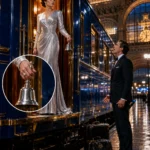
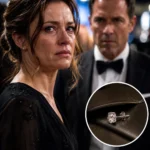
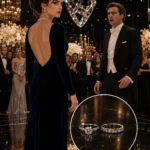
He mocked my age beneath a chandelier worth more than the house where I grew up.
One hundred and twelve of the most influential dermatologists, biotech investors, cosmetic surgeons, and medical journalists in America stood inside the glass-walled ballroom of the Halcyon Tower in Manhattan. Champagne moved through the room on silver trays. A string quartet played something soft and expensive. Beyond the windows, New York glittered beneath us like a kingdom waiting to be purchased.
My husband, Adrian Mercer, stood onstage with one hand in his pocket and the other resting lightly against the waist of the woman he had been sleeping with for eleven months.
Sloane Hart was twenty-nine.
She wore liquid silver silk, diamond earrings I recognized from a charge on our private account, and the small, victorious smile of a woman who believed youth was the same thing as power.
I was forty-eight.
I wore black velvet, no necklace, and the wedding ring Adrian had forgotten to notice I had stopped wearing three weeks earlier.
“Medicine has always belonged to those brave enough to stop worshiping the past,” Adrian told the physicians gathered before him.
His voice had the polished confidence of a man who had spent two decades allowing other people to mistake charm for brilliance.
A few guests glanced at me.
Most pretended not to.
Adrian smiled down at Sloane.
“Sloane represents where our industry is going. Bold. Fearless. Unburdened by outdated thinking.”
Then he turned toward me.
He did not say my name immediately. He let the silence make sure everyone understood that the next humiliation was intentional.
“My wife,” he said at last, “has given many valuable years to Mercer Aesthetics. But every era reaches its natural conclusion.”
A physician near the front lowered his champagne glass.
Someone behind me inhaled sharply.
Adrian continued.
“There is elegance in knowing when to step aside. There is dignity in accepting that the future belongs to younger minds, younger faces, and younger energy.”
Sloane’s smile deepened.
He believed he was introducing her as the new face of his company.
He believed the summit would end with applause, a private celebration in the presidential suite, and my silent retreat into the decorative exile he had prepared for me.
He believed I had come because I was too weak to stay away.
I looked at the enormous screen behind him, then at the lead scientist waiting near the curtain.
Dr. Naomi Reyes gave me the smallest nod.
Not yet.
May you like
Adrian lifted his glass.
“To renewal,” he said. “And to the courage to leave decline behind.”
A few people raised their glasses because wealthy men often confuse discomfort with obedience.
I did not move.
Adrian’s eyes found mine across the ballroom.
For one second, the expression beneath his smile changed.
He had expected tears.
Perhaps rage.
Perhaps the kind of public collapse that could later be described by his attorneys as instability.
Instead, I smiled.
It was not a warm smile.
It was the smile of a woman watching a man sign his own confession without realizing there was a pen in his hand.
Dr. Reyes stepped onto the stage.
“Thank you, Mr. Mercer,” she said.
He beamed, assuming the evening still belonged to him.
She touched the remote in her hand.
The screen behind them went dark.
The Mercer Aesthetics logo disappeared.
In its place appeared a single line of white text.
AEVUM REGENERATIVE PLATFORM
CONTROLLING INVESTOR DISCLOSURE
The room became very still.
Adrian turned toward the screen.
Dr. Reyes continued.
“Before we unveil the clinical data, our regulatory counsel requires that we identify the beneficial owner of the patents, the laboratory infrastructure, and the controlling investment entity behind the Aevum platform.”
Adrian looked confused.
Sloane’s hand slipped away from his arm.
The next slide appeared.
VALE ORISON BIOTECH
FOUNDER AND MAJORITY OWNER: EVELYN VALE
My name filled the wall behind him.
For the first time that evening, Adrian looked his age.
He stared at the screen, then at me.
“This is a mistake,” he said.
His microphone was still live.
Every person in the ballroom heard him.
Dr. Reyes did not blink.
“No, Mr. Mercer. The disclosure has been verified by independent counsel, the Food and Drug Administration filing team, and the board of Vale Orison Biotech.”
Adrian stepped toward her.
“Mercer funded this research.”
“No,” I said.
I had not raised my voice, but the room was silent enough to carry it.
I walked toward the stage.
The crowd parted.
My heels crossed the marble floor with slow, measured precision.
Sloane watched me approach. Her face had lost its color. Adrian looked between us as if he had only just discovered that the pieces on the board could move without his permission.
I stopped at the foot of the stage.
“You funded a branding campaign,” I told him. “With money you removed from our marital holding company without board authorization.”
His jaw tightened.
“You don’t know what you’re talking about.”
“I know the wire dates. I know the shell companies. I know which hotel suites you billed as research retreats. I know which jewelry purchases were categorized as physician outreach.”
A murmur moved through the room.
Sloane touched the diamonds at her ears.
I looked at her.
“They’re beautiful,” I said. “The forensic accountant thought so too.”
Adrian’s face hardened.
“This is neither the time nor the place.”
“You chose the time. You rented the place.”
He stepped down from the stage, lowering his voice.
“Evelyn, whatever you think you’re doing—”
“I’m correcting the record.”
“You’re embarrassing yourself.”
“No, Adrian.”
I looked at the room full of witnesses he had assembled for my humiliation.
“I’m letting you finish.”
Dr. Reyes changed the slide.
A diagram appeared showing the ownership structure of the research platform. At the top was Vale Orison Biotech. Beneath it were the patent portfolio, the laboratory outside Boston, the clinical licensing agreements, and the medical foundation that would control patient-access pricing.
Mercer Aesthetics appeared only once.
TEMPORARY BRANDING LICENSE: TERMINATED.
Adrian stared at the word.
“Terminated?”
“Effective at nine o’clock this morning,” I said.
“You can’t terminate it.”
“I can. You triggered the founder-protection clause when you represented proprietary medical research as a Mercer-owned cosmetic product during an investor solicitation.”
His eyes flashed.
“That clause is unenforceable.”
A man rose from a table near the windows.
Tall. Silver at his temples. Midnight tuxedo. A face made severe by restraint rather than cruelty.
Sebastian Cross.
My attorney.
The man Adrian had spent years believing I no longer spoke to.
Sebastian buttoned his jacket.
“The clause was upheld in Delaware Chancery Court at four seventeen this afternoon,” he said. “The order is in your counsel’s inbox.”
Something dangerous passed through Adrian’s expression.
Not fear.
Men like Adrian did not feel fear when the floor began to crack.
They felt insulted.
“You planned this,” he said.
“Yes.”
“How long?”
“Long enough.”
He looked at Sloane, perhaps hoping to recover some portion of his dignity in her admiration.
She took one step away from him.
That was when he understood the night was not merely going badly.
It had been designed.
The physicians were no longer looking at Sloane’s face or my age. They were looking at ownership disclosures, patent numbers, clinical trial dates, and the man who had publicly declared himself the future of a company he did not control.
I climbed the steps to the stage.
Adrian moved close enough that only I could hear him.
“You’ll regret this.”
I met his eyes.
“For eleven months, you used my silence as evidence that I was powerless. That was your first mistake.”
His mouth tightened.
“What was my second?”
I looked at the screen behind him.
“Believing the future needed your permission.”
Seven weeks earlier, I had found Sloane’s lipstick on a crystal glass in my husband’s private library.
By the time the summit began, I had found everything else.
CHAPTER ONE
THE WOMAN IN THE MIRROR DID NOT BREAK
The lipstick was called American Beauty.
I knew because the gold tube was still lying beside the glass.
Adrian’s library occupied the west wing of our limestone townhouse on East Seventy-Third Street. The room smelled of old leather, cedar smoke, and the twenty-three-year-old single malt he poured whenever he wanted to feel like the kind of man whose decisions became history.
He had told me he was in Chicago.
The flight confirmation had arrived in my email that morning because his assistant had forgotten to remove me from the shared itinerary.
At eight that evening, I returned home early from a dinner with the board of the Vale Medical Foundation. I heard a woman laughing behind the library doors.
Not a surprised laugh.
Not a nervous one.
A comfortable laugh.
The kind that had been practiced in rooms where she believed the wife would never appear.
I stood in the hallway with one hand on the clasp of my coat.
Then Adrian said, “She won’t fight it. Evelyn hates spectacle.”
The woman laughed again.
Sloane.
I had met her four months earlier when Adrian hired her as Mercer Aesthetics’ executive director of brand innovation.
Her résumé was thin, but her photographs were excellent.
She had founded two wellness companies that lasted less than a year, hosted a podcast about “radical self-renewal,” and accumulated several million followers by telling women that aging was a failure of intention.
At our first dinner, she had called me “timeless.”
Women my age know exactly what young women mean when they use that word too carefully.
I should have entered the library.
I should have thrown open the doors and watched them scramble.
That was what the younger version of me might have done—the woman Adrian had married, the woman who still believed honesty could embarrass a liar into becoming truthful.
Instead, I listened.
“The summit changes everything,” Sloane said.
“After the summit,” Adrian replied, “the board will see you as indispensable.”
“And Evelyn?”
A pause.
Then the sound of ice touching crystal.
“She’ll keep the foundation. A few ceremonial shares. The house in Connecticut. She’ll convince herself she chose dignity.”
“You make her sound predictable.”
“She is predictable.”
The quiet certainty in his voice hurt more than the affair.
Not because he knew me.
Because he believed he did.
“Does she know about us?” Sloane asked.
“If she suspects, she’ll pretend she doesn’t.”
“Why?”
“Because women like Evelyn would rather preserve the appearance of a life than admit the life is over.”
Women like Evelyn.
I looked across the hallway at a Venetian mirror Adrian had purchased at auction and forgotten the next day.
The woman reflected there was composed. Dark hair swept into a low knot. Pearl-gray coat. No visible wound.
But something inside her had gone silent.
Not shattered.
Silence is different.
Shattering is noisy. It draws attention. It leaves evidence on the floor.
Silence is when the last fragile thing inside you finally becomes hard.
I walked upstairs without entering the room.
In our bedroom, I removed my coat, washed my face, and opened the safe hidden behind a painting Adrian disliked.
Inside were my passport, my mother’s wedding ring, the original share certificates from my first laboratory, and a sealed envelope I had not touched in twelve years.
SEBASTIAN CROSS
CROSS, BELLAMY & WREN
PRIVATE
I carried the envelope to the window.
Below me, Manhattan moved through the rain in streams of white and red light.
There are moments when a life does not end but divides.
Before.
After.
The choice is rarely as dramatic as people imagine. No thunder. No witness. No orchestra rising in the background.
Only a woman in a quiet room deciding she will never again beg for a place at a table she built.
I opened the envelope.
Inside was a business card and one handwritten sentence.
If the day ever comes when you need the truth more than you fear it, call me.
I dialed the number from memory.
Sebastian answered on the second ring.
“Evelyn.”
He had not heard my voice in nearly five years, but he said my name without hesitation.
“I need an attorney.”
“You have twelve.”
“I need one Adrian can’t buy.”
Another pause, longer this time.
Then his voice changed.
It became colder.
More precise.
“Where are you?”
“At the house.”
“Is he there?”
“Does he know you’re calling?”
“No.”
“Keep it that way. Don’t confront him. Don’t move money. Don’t delete anything. Tomorrow morning, tell him you’re going to Connecticut.”
“I don’t want to go to Connecticut.”
“You’re not going to Connecticut.”
For the first time that night, I almost smiled.
“Where am I going?”
“To meet me.”
We met the next morning in a private dining room at the Lowell Hotel.
Sebastian was already seated when I arrived.
Time had altered him in ways that made him more dangerous.
At thirty-five, he had been beautiful in the careless way of men who have not yet lost enough to understand restraint. At fifty, he had become all precision: charcoal suit, white shirt, silver cuff links, dark eyes that revealed nothing until they settled on me.
He stood.
For one breath, neither of us spoke.
Sebastian and I had known each other before Adrian.
That was the simplest version.
The truer version was that Sebastian had once asked me to marry him on a cold morning in Boston, and I had said yes.
Three weeks later, he left for Washington to lead a federal corruption case. A letter arrived at my apartment, written in his hand, telling me he had reconsidered. That ambition had no room for marriage. That I deserved someone willing to stay.
I met Adrian six months later.
By the time Sebastian returned to New York and claimed he had never written the letter, I was engaged to someone else and too proud to believe that the man I loved had not abandoned me.
Years passed.
We became polite strangers at charity galas.
Then not even that.
Now he pulled out my chair.
“You look tired,” he said.
“You look expensive.”
“I bill accordingly.”
I sat.
He did not ask whether I was sure Adrian was unfaithful. He did not offer sympathy I had not requested.
He opened a leather folder.
“Tell me everything you know.”
I told him about the library.
The summit.
The corporate restructuring Adrian had been pushing for months.
The pressure to merge the Vale Medical Foundation’s intellectual property with Mercer Aesthetics’ consumer division.
Sebastian listened without interrupting.
When I finished, he asked, “What does Adrian believe you own?”
“Twenty-two percent of Mercer Aesthetics, half the marital assets, the Connecticut estate, and several foundation interests he considers sentimental.”
“What do you actually own?”
I looked at him.
“That depends.”
“On what?”
“Whether the Orison structure survived the merger.”
His expression sharpened.
“What Orison structure?”
In 2003, two years before I married Adrian, my mother and I founded a small research company outside Cambridge.
My mother, Dr. Lillian Vale, was a reconstructive dermatologist. She treated burn survivors, children with genetic skin disorders, and women whose bodies carried the evidence of cancer.
She had no patience for the beauty industry.
“Vanity pays for medicine,” she used to say. “The danger begins when vanity starts deciding who deserves it.”
We developed a delivery system for regenerative peptides—a way to teach damaged tissue to repair itself with less inflammation and scarring.
The early work was brilliant.
The business was not.
Then my mother became ill.
I licensed a cosmetic adaptation of one formula to Adrian’s company in exchange for equity. His marketing turned the product into a sensation. Our professional partnership became a marriage. Over time, Mercer Aesthetics grew into a global luxury brand, while the original medical research disappeared beneath layers of acquisitions and corporate paperwork.
Or so Adrian believed.
“My mother insisted on a separate patent trust,” I said. “She didn’t want the medical applications controlled by a cosmetics board.”
“Who drafted it?”
“A small Boston firm. They dissolved years ago.”
“Who is the trustee?”
“I was told the trust became dormant after my mother died.”
“Told by whom?”
I held his gaze.
“Adrian.”
Sebastian leaned back.
“There it is.”
“What?”
“The first question worth several hundred million dollars.”
He closed the folder.
“Did the trust become dormant, or did your husband need you to believe it did?”
By noon, Sebastian’s team had located the original filings.
The Orison Patent Trust had not dissolved.
It had evolved.
My mother had designed it with a contingency structure. Upon her death, control transferred not to me personally, but to a private entity whose voting authority could be activated only if Mercer Aesthetics attempted to claim ownership of the underlying medical research.
For eighteen years, the entity had remained quiet.
It held patents Adrian’s executives had classified as obsolete.
Land outside Boston purchased before values tripled.
Licensing rights in Europe and South Korea.
Royalty streams diverted into accounts no one at Mercer reviewed because they were associated with products the company no longer sold.
And one laboratory in Waltham where a team of scientists had continued my mother’s research under a series of grants.
The hidden entity had a name.
Vale Orison Biotech.
Its beneficial owner was me.
By sunset, Sebastian estimated its conservative value at $640 million.
If the newest trials succeeded, it would be worth several billion.
I stared at the documents spread across the table in his conference room.
“Adrian doesn’t know.”
“No,” Sebastian said. “But I think he knows enough to be dangerous.”
He placed another document in front of me.
It was a draft merger proposal.
Mercer Aesthetics would acquire all “legacy Vale research assets,” including unknown or dormant intellectual property, in exchange for a nominal payment of one dollar.
My signature line waited at the bottom.
“His assistant sent me this last week,” I whispered. “Adrian said it was administrative housekeeping.”
“He intends to have you sign before the summit.”
“Why the summit?”
Sebastian turned to a page describing a new regenerative platform.
Code name: Aevum.
My breath stopped.
I had seen the word before.
It was written in my mother’s notebook beside a sketch of a damaged skin cell restoring itself.
Aevum.
An age without ending.
“He found the laboratory,” I said.
“He found something,” Sebastian replied. “But he may not know who controls it. The summit is likely designed to announce the technology, inflate Mercer’s valuation, and lock the research inside the company before you realize what you’ve signed away.”
I thought of Sloane in the library.