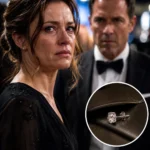
My husband told the yacht insurer his mistress was the vessel’s new first lady.
He did it at sunset, in front of eleven witnesses, two cameras, and a champagne tower shaped like a crown.
Grant Whitmore stood beneath the polished brass compass on the upper deck of the *Aurelia*, wearing a midnight-blue suit that had been tailored in Milan and paid for through a hospitality company he believed belonged to him.
His hand rested possessively on the waist of Sloane Mercer.
She sat beside him in white linen, already selecting upgrades for the master cabin.
Ivory cashmere carpeting.
A Calacatta marble vanity.
A champagne chiller recessed beside the bed.
She spoke about my yacht as if she had inherited it from a woman who was already dead.
“The current suite feels a little severe,” Sloane told the interior designer, touching one perfectly manicured finger to the digital rendering. “Grant wants something warmer. More feminine.”
Grant smiled at her.
“I want it to feel like us.”
The sentence traveled across the deck like a knife wrapped in velvet.
Everyone heard it.
The insurance underwriter heard it.
The captain heard it.
The representatives from the marina heard it.
The three Whitmore House board members Grant had invited to witness my replacement heard it.
And I heard it from ten feet away, standing beneath the shade of the aft canopy in a black silk dress, holding a glass of champagne I had no intention of drinking.
For twelve years, Grant had called the *Aurelia* our sanctuary.
On our fifth anniversary, he had kissed my shoulder beneath the stars off Nantucket and promised that no matter what happened on land, the sea would always belong to us.
On our tenth, he had arranged white roses along the rail and told me I was the only woman who had ever understood him.
Two months later, he began sleeping with Sloane.
Six months after that, he introduced her to an insurance company as if she had already taken my place.
Grant lifted his glass.
“To new chapters.”
Sloane leaned into him.
The diamonds at her throat flashed in the evening light.
They had belonged to my mother.
Grant had taken them from the safe three weeks earlier and told the household manager they were being professionally cleaned.
That was the moment I understood he no longer believed I was a person capable of fighting back.
He thought I was a room he could redecorate.
Henry Cole, the senior marine underwriter, cleared his throat.
He was a cautious man in his late fifties, with silver hair, rimless glasses, and the strained expression of someone who had realized too late that a routine policy review had become a marital execution.
May you like
“Mr. Whitmore,” Henry said, “before we discuss interior modifications, we need to address your request concerning authorized operators and beneficiary changes.”
Grant loosened one cuff with a casual flick of his wrist.
“Of course.”
Henry glanced at me.
“Mrs. Whitmore, perhaps this portion of the conversation should be handled privately.”
Grant laughed.
It was a soft, dismissive sound.
“No. Evelyn understands where things stand.”
I met Henry’s eyes.
“Please continue.”
Grant pulled Sloane closer.
“My attorneys will be filing shortly. Evelyn and I have been functionally separated for months.”
That was a lie.
We had slept in the same Manhattan townhouse until seventeen days ago, when he told me he needed space to prepare for a major acquisition.
He had kissed my forehead before leaving.
He had called me darling.
Then he had driven directly to Sloane’s apartment.
Grant turned toward the underwriter.
“Evelyn no longer has an insurable interest in my life.”
For the first time that evening, absolute silence settled over the yacht.
Even Sloane stopped smiling.
Henry blinked.
“I’m sorry?”
“My life coverage,” Grant said. “The executive policy connected to the marine umbrella. I want Evelyn removed from everything. Sloane will be listed as my domestic partner and primary emergency contact.”
Sloane lowered her gaze with an expression carefully designed to resemble embarrassment.
Grant mistook it for grace.
“Grant,” I said softly.
He barely looked at me.
“Not now, Evelyn.”
“You might want to let Mr. Cole finish.”
His mouth tightened.
“I know how insurance works.”
“No,” Henry said, with the grim patience of a man stepping onto a minefield. “I’m afraid you don’t.”
One of the board members coughed into his fist.
Grant’s expression sharpened.
Henry placed his tablet on the teak table and turned the screen toward us.
“The executive policy is not personally owned by Mr. Whitmore. It is a company-owned policy established under the Ashford Meridian executive-risk structure.”
Grant stared at him.
Henry continued.
“Only the policyholder can request a change of beneficiary, collateral assignment, or ownership.”
“Whitmore House is the policyholder,” Grant said.
“No.”
Henry tapped the screen.
A corporate record appeared.
At the top, in clean black letters, was a name Grant had not bothered to read in twelve years.
MORROW HOUSE HOLDINGS, LLC.
Below it was the name of the managing member.
EVELYN ASHFORD WHITMORE.
Grant’s face did not change immediately.
That was the beautiful part.
Understanding arrived in stages.
First, disbelief.
Then calculation.
Then the first thin fracture of fear.
Henry opened a second record.
“This is also the registered owner of the vessel.”
The *Aurelia*.
Official number.
Registration history.
Title documentation.
All of it displayed beneath the same name.
Sloane slowly removed her hand from Grant’s arm.
He looked at me at last.
Not through me.
Not past me.
At me.
“What is this?” he asked.
“The title record,” I said.
“You put the yacht in a shell company?”
“My holding company purchased the yacht nine years ago.”
“I paid for it.”
“You authorized a transfer from an account funded by the licensing fees on my family’s hotel trademarks.”
His face hardened.
“We’re married.”
“We are.”
“Then it’s marital property.”
“My attorneys will be happy to explain the trust structure.”
The cameras were still recording.
Grant noticed.
His humiliation became anger.
“Turn those off.”
No one moved.
He looked toward Captain Ellis.
“Tell them to turn the cameras off.”
The captain’s gaze shifted to me.
“Mrs. Whitmore?”
“I hired you.”
“No,” I said. “Morrow House Holdings hired him.”
Sloane rose slowly from her chair.
The white linen suit had looked regal when she arrived.
Now it looked like a costume from a coronation no one had authorized.
Grant stepped toward me.
His voice dropped.
“Whatever game you think you’re playing, end it.”
I set my untouched champagne on the table.
“This stopped being a game when you pledged company assets using a forged authorization.”
For one terrible second, his face became empty.
That emptiness told me more than a confession would have.
He knew exactly which document I meant.
The board members began looking at one another.
Sloane looked at Grant.
“What is she talking about?”
“Nothing.”
“It didn’t sound like nothing.”
Grant ignored her.
He kept his eyes on me.
“You have no idea what you’re doing.”
I almost smiled.
That had always been his favorite sentence.
He had used it when I questioned the first overleveraged acquisition.
When I objected to his private jet contract.
When I refused to approve a licensing agreement that would have diluted the Ashford name.
When I told him Sloane’s consulting invoices were fraudulent.
Men like Grant depended on repetition.
If they told a woman she was powerless often enough, eventually everyone in the room forgot to check whose name was on the deed.
Henry closed the policy file.
“Mrs. Whitmore, as the managing member, do you wish to approve Mr. Whitmore’s requested changes?”
Grant’s jaw flexed.
“Evelyn.”
“I also withdraw his authority to make operational requests concerning this vessel.”
“You can’t do that.”
“I just did.”
He moved closer, lowering his voice so only I could hear.
“You’re going to regret humiliating me.”
I looked at the man I had once loved enough to build an empire beside.
The man who had mistaken patience for weakness and devotion for permanent surrender.
Then I looked at my mother’s diamonds resting against his mistress’s throat.
“I’m not humiliating you, Grant.”
My voice was quiet.
Almost kind.
“I’m allowing the paperwork to introduce us properly.”
# CHAPTER ONE
## The Woman He Mistook for Decoration
The video reached three million views before midnight.
Not the entire video.
Sloane made sure of that.
Her publicist uploaded a carefully edited forty-two-second clip showing Grant’s toast, my expressionless face, and the moment I denied his request.
The title read:
**BITTER HOTEL HEIRESS MELTS DOWN AS ESTRANGED HUSBAND MOVES ON.**
By morning, entertainment accounts had turned me into a caricature.
I was controlling.
Jealous.
Frigid.
An heiress incapable of accepting that her marriage had ended.
Grant issued a statement through Whitmore House Hotels expressing “deep concern for Evelyn’s emotional well-being during a difficult private transition.”
He included a request for compassion.
People often use the language of concern when they need to discredit a woman without appearing cruel.
I read the statement from the library of Morrow House, my grandmother’s limestone mansion overlooking the Hudson River.
Rain pressed against the tall windows.
A fire burned beneath the carved marble mantel.
On the table beside me sat three folders.
One was labeled ASSETS.
One was labeled FRAUD.
One was labeled GRANT.
The last folder was the thickest.
My attorney, Mara Bennett, stood at the window in a charcoal suit, speaking quietly into her phone.
Naomi Park, the forensic accountant who had audited Whitmore House for seven years, sat opposite me with two laptops open and a pencil tucked through her dark hair.
Neither woman asked if I was all right.
That was one of the reasons I trusted them.
Powerful women learn early that concern can become another form of interruption.
Mara ended her call.
“Grant filed for divorce at eight twelve this morning.”
Naomi glanced at the clock.
“He waited until after the morning shows ran Sloane’s footage.”
“He wanted the narrative established first,” I said.
Mara placed a copy of the filing beside my coffee.
“He’s seeking temporary control of the Manhattan residence, access to the corporate aircraft, continued use of the yacht, and an injunction preventing you from interfering with Whitmore House operations.”
I turned the first page.
“He wants the court to remove me from the company I built?”
“He claims your conduct has become erratic.”
“Of course he does.”
Naomi rotated one laptop toward me.
“His filing says you’ve had almost no active role in corporate management for five years.”
The lie was almost elegant in its audacity.
Every Whitmore House hotel carried my design language.
The deep green libraries.
The brass room keys instead of plastic cards.
The signature bergamot-and-cedar scent in every lobby.
The midnight room-service menus printed on navy linen.
I had selected the architects, negotiated the art acquisitions, approved the uniforms, developed the membership program, and designed the licensing model that transformed three struggling properties into an international luxury brand.
Grant appeared on magazine covers.
I wrote the standards that made the company valuable.
In photographs, he stood at the center.
I stood half a step behind him.
That was the arrangement he eventually mistook for reality.
“Let him file,” I said.
Mara studied me.
“He’s asking the court for emergency relief.”
“He won’t get it.”
“You sound certain.”
“I am.”
Naomi leaned back.
“What aren’t you telling us?”
Before I could answer, the library doors opened.
Sebastian Kane walked in carrying a black leather document case.
He did not look like a rescuer.
Rescuers usually arrived in stories with urgency and warmth.
Sebastian arrived like winter entering a room.
He was tall, broad-shouldered, and dressed in a black overcoat beaded with rain. His hair was nearly black, threaded with silver at the temples. His face possessed the severe, controlled beauty of a man who had never needed to raise his voice to be obeyed.
Sebastian was the founder of Kane Maritime Capital, a private lending firm that financed ports, shipyards, and luxury vessels around the world.
He had also been my closest friend before I married Grant.
For eleven years, we had spoken only through attorneys and holiday cards.
Three months earlier, I had called him from a hotel balcony in Chicago and asked him to purchase a debt facility without allowing Grant to know the identity of the buyer.
Sebastian had asked only one question.
“Is this business or war?”
“Both,” I had said.
He had purchased the debt the following morning.
Now he removed his coat and handed Mara a sealed envelope.
“The Wilmington facility transferred at nine fifteen,” he said. “Grant signed the emergency amendment personally.”
Naomi’s eyes narrowed.
“He signed it today?”
“Forty-three minutes after filing for divorce.”
I looked at Sebastian.
“What did he pledge?”
“His voting shares in Whitmore House Operations. His interest in the Palm Beach property. The Aspen residence. Two aircraft leases. His contemporary art collection.”
“And the personal guarantee?”
“Absolute and unconditional.”
Mara opened the envelope.
“Did he read it?”
Sebastian’s mouth curved without becoming a smile.
“Grant rarely reads documents when a beautiful woman tells him they are urgent.”
Sloane.
My husband had signed away his future before breakfast because his mistress had told him a rescue loan was waiting.
I looked down at the divorce petition.
Grant believed he had secured seventy-five million dollars from Meridian North Capital, an opaque investment vehicle represented by Sebastian’s firm.
He did not know Meridian North was wholly owned by Morrow House Holdings.
By me.
He had borrowed money from his wife to finance the destruction of his wife.
And he had pledged everything he possessed as security.
“When does the first covenant test occur?” I asked.
“After the Palm Beach gala,” Sebastian said. “Unless there is a material misrepresentation before then.”
“There already is.”
Mara scanned the amendment.
“Several.”
Sebastian’s eyes remained on mine.
“You expected him to sign.”
“I expected him to be arrogant.”
“That’s not the same thing.”
“With Grant, it is.”
For the first time, something warm moved behind Sebastian’s expression.
Not approval.
Recognition.
Twelve years earlier, before my wedding, he had stood with me on the terrace of this same house and asked if I was certain about Grant.
I had been twenty-six and in love with the idea of building something modern from my grandmother’s legacy.
Grant was ambitious, dazzling, and hungry.
I believed hunger could be noble when directed toward a shared future.
Sebastian had known better.
“You always see the architecture of a room before anyone else,” he had told me that night. “But you refuse to see the exits.”
I had kissed his cheek and married Grant three weeks later.
Now Sebastian crossed the library and stopped beside my chair.
His presence carried the scent of rain, cedar, and expensive wool.
“You look tired,” he said.
“Grant’s publicist says I look unstable.”
“Grant’s publicist also described a woman in borrowed diamonds as American royalty.”
My gaze sharpened.
“You noticed the necklace.”
“Everyone who knew your mother noticed.”
For a moment, the room became smaller.
My mother had worn those diamonds at my college graduation.
She had died the following spring.
The necklace was not the most valuable item in the Ashford collection, but it was the only one I had ever cared about.
Grant knew that.
Giving it to Sloane had not been thoughtlessness.
It had been a message.
He wanted me to understand that everything I loved could be reassigned.
“Can we prove he removed it from the safe?” Sebastian asked.
Naomi answered.
“The security log shows Grant entered the vault at 11:08 p.m. on June fourth. He stayed for nine minutes.”
“Camera?”
“Disabled for maintenance.”
Sebastian’s expression cooled.
“Convenient.”
“I have something better,” I said.
All three looked at me.
I opened the folder labeled GRANT and removed a photograph.
Sloane was standing inside a private fitting room at Bellamy Jewelers on Madison Avenue, wearing my mother’s necklace while a jeweler adjusted the clasp.
The date appeared in the lower corner.
Three days before the yacht meeting.
Mara took the photograph.
“Where did you get this?”
“The necklace contains a security tag.”
Naomi blinked.
“A tracking device?”
“A museum-grade identification chip. My grandmother installed them after an attempted theft in 2003. When Bellamy scanned the necklace for appraisal, the registration system sent an automatic notification to the collection owner.”
Sebastian looked at me for a long moment.
“You received the alert and said nothing.”
“I needed to know what Grant intended to do with it.”
Naomi opened another screen.
“Do we?”
“He tried to use it as collateral,” I said.