“From management?”
“From the company.”
Then I heard papers moving.
“Do not confront him again. Do not sign anything. Do not access documents you are not legally entitled to access.”
“He is sleeping with Sloane.”
“That may matter to your heart. It does not yet matter to your case.”
“He also signed a debt facility without disclosing the safety defect.”
“That matters.”
“Is the Northlight license valid?”
“And the patents?”
“Still owned by the trust unless you assigned them.”
“I didn’t.”
“Are you certain?”
“I would remember giving away my life’s work.”
Mara’s voice sharpened.
“Julian may not need you to remember. He may only need a document that says you did.”
I watched commuters rush beneath the station’s painted constellations.
People leaving.
People returning.
Everyone convinced the ceiling was the sky.
“What do I do?”
“You become boring.”
“No scenes. No threats. No dramatic resignation. You attend meetings. You answer emails. You let them underestimate what you understand.”
“And then?”
“Then we learn what they have done.”
I closed my eyes.
“And if they’ve forged something?”
Mara’s reply was almost tender.
“Then your husband has not stolen your company, Evelyn.”
“What has he done?”
“He has gift-wrapped it.”
# CHAPTER TWO
## Silk Gloves, Sharpened Knives
I went home that evening and prepared dinner.
It was the coldest act of my life.
Our penthouse occupied the top two floors of a limestone building overlooking Central Park. Julian had called it an architectural investment. I had called it absurd.
The dining table was twelve feet long and cut from a single slab of black walnut.
For ten years, we had eaten at one corner.
I roasted salmon.
I opened a bottle of white Burgundy.
I lit the candles Julian’s house manager usually lit.
When he arrived at eight thirty, he paused in the doorway.
“You cooked.”
“I needed something ordinary.”
His eyes searched my face.
He had expected broken glass.
People like Julian were comfortable around anger because anger was easy to document. Calm made them nervous.
He removed his jacket.
“How are you feeling?”
“Embarrassed.”
He softened.
“I shouldn’t have accused you without proof.”
Every word tasted metallic.
He walked toward me slowly.
“You were under pressure.”
“I was.”
“I know how much this company means to you.”
“It means everything.”
A careful answer.
He kissed my forehead.
I held still.
“Let’s reset,” he said. “We postpone any personal decisions. We complete the safety review. Then we take a week somewhere quiet.”
“Where?”
“Amalfi. Or St. Barts.”
The places wealthy men take wives when they hope sunlight will make betrayal look less ugly.
“That sounds nice.”
Relief crossed his face.
We ate.
He spoke about Blackridge, the launch, and a dinner with the governor of Ohio. He did not mention Sloane.
I asked small questions and listened.
At ten, he went to shower.
At ten eleven, his personal phone illuminated on the kitchen counter.
The message preview contained no name.
Only a black heart.
**She believed you?**
I did not touch the phone.
I photographed the screen using an old digital camera Mara had delivered through a courier.
Julian returned wearing a robe.
He picked up the phone.
“You’re not coming to bed?”
“I have reports to read.”
“Don’t work all night.”
“I won’t.”
He climbed the stairs.
At midnight, I heard the private elevator.
At twelve five, the building’s service log recorded his departure.
At twelve twenty-two, the car assigned to our household crossed Fifty-Ninth Street.
At twelve thirty-eight, it stopped outside a townhouse on Gramercy Park.
I knew because the vehicle was registered to a family account I had administered before Julian transferred our finances to his private office.
The townhouse belonged to Avenue Twelve Holdings LLC.
I had never heard of Avenue Twelve Holdings.
By breakfast, Mara had.
The shell company had purchased the property nine months earlier for $14.8 million in cash.
Its manager was a law firm used by Asterion.
The funding had passed through three entities before originating from a “strategic development account” controlled by Julian.
“He bought her a house with company money,” I said.
“We do not know that yet.”
“The money began at Asterion.”
“The money began in an Asterion account. We need to establish whether it was compensation, a loan, a reimbursement, or theft.”
“He stole fourteen million dollars.”
“Emotionally, yes. Legally, let me finish the sentence.”
We met inside a private dining room at the Union League Club, where Mara had persuaded a retired judge to leave her the key.
She placed two folders on the table.
One was blue.
One was gray.
“Blue is the marriage,” she said. “Gray is the company. Do not confuse them.”
“What is the difference?”
“The blue folder contains infidelity, humiliation, hidden gifts, and your husband’s predictable belief that a younger woman will make aging feel negotiable.”
“And the gray?”
“The gray folder contains securities fraud, breach of fiduciary duty, theft of intellectual property, falsified board records, misuse of corporate funds, and potential criminal exposure.”
I touched the gray folder.
“Which one destroys him?”
“The gray one.”
“And Sloane?”
“That depends on whether she is a participant or merely expensive evidence.”
I opened the folder.
Inside was a copy of Asterion’s original licensing agreement with Northlight Research Trust.
Before Asterion existed, I had filed three provisional patents using money from my father. The inventions were held by Northlight, a trust named after the fishing boat he claimed he would buy when my battery made us rich.
He never bought the boat.
He died six months before our first major investment round.
The Northlight agreement granted Asterion an exclusive license to commercialize the technology.
But ownership remained with the trust.
Julian knew that in the beginning.
He had called it temporary.
Once we married, he stopped mentioning it.
I turned to the section Mara had marked.
**License termination may occur upon fraudulent misrepresentation of inventorship, unauthorized assignment, concealment of material safety data, or use of licensed technology in violation of the Trust’s public-benefit covenant.**
“Why would he risk this?” I asked.
“He may believe the license was replaced.”
“Was it?”
Mara opened the second folder.
An amendment dated three years earlier appeared to assign all Northlight intellectual property to Asterion Energy.
At the bottom was my signature.
It looked perfect.
“I did not sign this.”
“I know.”
“How?”
“Because the document was notarized in Manhattan on November fourth.”
“So?”
“On November fourth, you were giving sworn testimony before the Wisconsin Public Utilities Commission.”
I stared at her.
“That was public.”
“Livestreamed for six hours.”
“So the notary date proves—”
“That you could not have appeared in Manhattan.”
A pulse began behind my eyes.
“Who filed this?”
“Asterion’s outside counsel.”
“Julian’s lawyer.”
“Why didn’t anyone verify it?”
“Because no one expected the founder’s husband to forge the founder’s signature.”
I looked again at the document.
My name curved across the page with the familiar downward slant.
The signature had been copied from our mortgage closing.
I knew because the final stroke ended with a small ink hesitation that had happened when the broker distracted me with a question.
“He used my house to steal my company.”
“Technically, he used your mortgage signature.”
“Mara.”
“Precision will save you.”
I pushed back from the table.
“We expose him now.”
“No.”
“He forged an intellectual-property transfer.”
“And if we accuse him today, he will say it was an administrative mistake. The board will correct the record. The license survives. He remains CEO. You become the angry wife.”
“He committed fraud.”
“We need to prove knowledge and intent.”
“The signature is proof.”
“The signature proves forgery. It does not prove who ordered it.”
“Julian benefits.”
“So does Asterion. So do you, on paper.”
I hated that she was right.
“What do we need?”
“His internal communications. Board minutes. Drafts. Billing records. Metadata. Evidence he knew Northlight still owned the technology.”
“I can access company records.”
“Only records within your authorized duties. Do not become the person he accuses you of being.”
I thought of the safety archive.
Every test conducted at Asterion was automatically copied to an independent compliance server. As chief scientist, I had lawful access.
The server also stored document histories attached to safety reviews.
If Julian had used the forged assignment to override my authority, the revision trail might be there.
“I know where to look.”
“Good.”
Mara closed the folder.
“One more thing.”
She slid a photograph across the table.
It showed Sloane leaving the Gramercy townhouse carrying a garment bag.
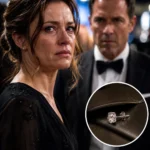
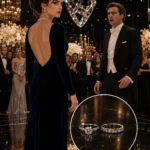
On her finger was a square-cut yellow diamond.
My stomach tightened.
“That stone belonged to Julian’s grandmother.”
“No,” Mara said. “It belonged to you.”
I looked closer.
She was right.
Julian had given me the ring after our engagement, saying it was a Vale family heirloom. I stopped wearing it because the setting caught on laboratory gloves. It had been stored in our home safe.
“How did she get it?”
“That is a blue-folder question.”
I pushed the photograph aside.
“Put it in the gray folder.”
“Why?”
“Because Julian insured that ring through the company’s executive-property policy.”
Mara’s eyes narrowed with approval.
“Now you’re learning.”
Over the next three weeks, I became the wife Julian wanted.
Quiet.
Reasonable.
Grateful.
I returned to the laboratory. I attended executive meetings. I stopped challenging him in public.
When the independent safety review concluded that the C-19 incident was “unlikely to reproduce under standard operating conditions,” I signed an acknowledgment stating that I had received the report.
I did not sign approval.
Julian noticed.
He said nothing.
Sloane began attending technical meetings.
She sat beside him, took notes, and repeated my explanations several minutes later using more expensive vocabulary.
If I said, “The separator needs to interrupt heat propagation,” she would say, “Our design philosophy should emphasize autonomous thermal isolation.”
Julian would nod as though she had translated science into wisdom.
One afternoon, she followed me into the elevator.
Her perfume was soft and smoky.
“I hope this isn’t awkward,” she said.
“My increased involvement.”
I pressed the button for the lobby.
“Why would it be awkward?”
“You’ve built so much here.”
The elevator began descending.
“And now you’re building it?”
She glanced at me.
“Julian thinks the company needs a more expansive voice.”
“Julian thinks many things.”
“He respects you.”
“Does he?”
“Deeply.”
The word nearly made me laugh.
Sloane turned toward the mirrored wall.
“You know, not every transition has to become a war.”
“I’m not trying to take anything from you.”
The yellow diamond flashed on her right hand.
She wanted me to see it.
I wondered whether Julian had told her its history.
I wondered whether she believed wearing my ring made her chosen, or merely promoted.
“You should have the setting checked,” I said.
Her fingers stiffened.
“The lower prong is loose.”
She looked down.
I had invented the defect.
She covered the ring with her other hand.
“Thank you.”
The elevator opened.
As I stepped out, I said, “Some things look secure until pressure is applied.”
The next morning, Julian requested a private conversation.
He shut my office door.
“You upset Sloane.”
“I advised her about jewelry.”
“You made a threat.”
“Did she tell you that?”
“She said your behavior felt hostile.”
I leaned back.
“Do you want me to apologize to your employee for noticing she is wearing my engagement ring?”
For the first time, his composure cracked.
Only slightly.
“You haven’t worn that ring in years.”
“It was inside our safe.”
“My mother gave it to me.”
“You gave it to your wife.”
“It is a family asset.”
“And Sloane is family?”
His jaw tightened.
“There is no affair.”
“Then your chief brand officer is wearing my engagement ring for professional reasons.”
He walked toward the window.
“I didn’t come here to discuss jewelry.”
“Why did you come?”
“The board is restructuring leadership before the launch.”
He placed a document on my desk.
I read the first page.
The board proposed moving me from chief scientific officer to founder emerita, a nonexecutive advisory position.
My laboratory authority would be transferred to Darius Cole, our safety director.
My board seat would remain temporarily, pending a shareholder vote.
“You want me to become a decoration.”
“You would remain the scientific face of Asterion.”
“Without scientific authority.”
“You have said yourself that the launch process exhausted you.”
“I said the battery could fail.”
“The review disagreed.”
“The review was based on incomplete data.”
His eyes narrowed.
“What data?”
I held his gaze.
“Why? Did someone remove something?”
It was a risk.
A small one.
His reaction answered me.
He looked away too quickly.
Not proof.
But direction.
“I am offering you dignity,” he said.
“No. You are offering me silence with a title.”
“Your compensation remains unchanged.”
“Money is not the issue.”
“It always becomes the issue.”
He pushed the document closer.
“If you sign today, we announce the transition as your decision. You retain your equity, benefits, and public role.”
“And if I refuse?”
“The board may remove you without the courtesy.”
I looked at the signature line.
He had placed a silver pen beside it.
The same kind of pen he used to sign our marriage license.
“May I have forty-eight hours?”
His shoulders relaxed.
“Of course.”
I closed the document.
“Thank you for giving me a choice.”
He almost looked ashamed.
That night, I copied the safety-server metadata to an encrypted legal archive.
The missing C-19 data had not been deleted.
It had been moved.
The transfer was authorized through Julian’s executive account.
Attached to the action was a legal memorandum citing the forged Northlight amendment as proof that Asterion controlled all testing records and could restrict my access.
Julian knew.
He knew the amendment existed.
He knew he had used it.
And someone had left a comment inside the draft memorandum.
**J—Once E is transitioned, we can revise the founder narrative before launch. S.**
Participant.
Not evidence.
I sent the files to Mara.
Her response arrived twenty minutes later.
**Do not refuse the transition. Negotiate. Ask for continued access, confidentiality, and public attribution. Make them state their intentions in writing.**
The next day, I returned to Julian’s office.
Sloane was there.
She sat on the edge of his conference table, reviewing launch photographs.
Julian stood when I entered.
“Do you need privacy?” Sloane asked.
“No,” I said. “This concerns you.”
She remained seated.
I placed the transition agreement before Julian.
“I will accept founder emerita status under three conditions.”
He glanced at Sloane.
“Go on.”
“First, I retain access to historical research records.”
“Second, Asterion publicly acknowledges me as inventor of the LumenCell platform.”
Sloane crossed one leg over the other.
“The company prefers collaborative language.”
“The patents list one inventor.”
Julian’s face remained blank.
“The patents are owned by Asterion.”
“That is not what I said.”
A pause.
He picked up the pen.
“What is your third condition?”
“I want written confirmation that the company will not launch any unit that fails the original thermal-isolation threshold.”
“That may be operationally restrictive.”
“It is my condition.”
Sloane looked at him.
A conversation passed silently between them.
Then Julian said, “We can agree to language requiring compliance with applicable safety standards.”
“That is standard wording.”
“I am not standard wording.”
His expression hardened.
“You are not in a position to dictate.”
“Then remove me publicly.”
Sloane stood.
“Julian, perhaps we should—”
“No,” he said.
The sharpness in his voice surprised her.
He turned back to me.
“You want attribution?”
“You will have it.”
“Written.”
“Access?”
“Limited access.”
“And the thermal threshold?”
He paused.
Then smiled.
“We will honor the original threshold.”
I extended my hand.
He looked at it as though uncertain whether I was mocking him.
Then he shook it.
Sloane watched.
The agreement was revised by evening.
They included every condition.
They believed the language protected them.
It did the opposite.
By guaranteeing my access, they preserved the evidence trail.
By guaranteeing attribution, they created a written record contradicting their planned founder narrative.
By guaranteeing the thermal threshold, they made any launch using the altered safety standard a knowing breach.
I signed the transition at nine o’clock.
At nine fourteen, Asterion disabled half my credentials.
At nine twenty, Sloane’s communications team distributed a draft announcement describing me as “the early scientific contributor whose foundational curiosity helped inspire Asterion’s collaborative platform.”
At nine thirty-one, Julian sent her a private message through the company server.
**Once she’s off the board, the rest is cosmetic.**
I read the message because it was attached accidentally to a document placed inside my authorized transition folder.
Perhaps an assistant made a mistake.
Perhaps someone inside Asterion had begun to understand which side of history would require fewer lawyers.
I saved the file.
Then I signed the final page.
Julian kissed my cheek at the announcement dinner.
Sloane raised a glass to my legacy.
The board applauded my grace.
Everyone mistook my silence for defeat.
No one noticed that the founder emerita agreement gave Northlight forty-five days to review any public claim about the origin, ownership, or safety of licensed technology.
The launch was scheduled for day forty-four.
# CHAPTER THREE
## The Price of an Elegant Lie
The public announcement made me famous for disappearing.
Business magazines praised my “selfless transition.”
Commentators called me a brilliant scientist who understood her limitations.
One television host described Julian as “the rare husband courageous enough to protect both a company and a fragile spouse.”
That sentence received eighty thousand likes.
I watched the clip once.
Then I added the host’s network to the litigation-preservation list.
Julian moved out of our bedroom the following week.
He said we needed emotional distance.
He relocated to the guest suite on the lower floor, but rarely slept there.
His clothes remained in our closet. His cuff links remained in the velvet drawer. His face remained in our wedding photographs.
His body belonged to Gramercy Park.
He wanted the marriage to look intact until after the launch.
Divorce would create questions.
Questions would create due diligence.
Due diligence would lead people toward Northlight.